Dorset Ancestors Rotating Header Image

2011:

The Hamlet of Steeple and Creech Grange

Steeple is a small hamlet surrounded by heathland in the sparsely populated parish of the same name. Comprising a church, fine manor house and a few cottages, it is about four miles south west of Wareham between Lulworth and Corfe Castle at the foot of the Purbeck Hills. This rolling Dorset Down separates the hamlet from Creech Grange, the mansion and estate of special interest to American visitors because of the association with Sir Oliver Lawrence, an ancestor of George Washington. The Lawrence coat-of-arms featuring the stars and stripes is in the porch of the church and is repeated in the barrel roof and is the same as the coat-of-arms on a signet ring belonging to George Washington. Could this little place and nearby Affpuddle, which has similar features, be the birthplace of the stars and stripes?

The Lawrence and Washington families were from Lancaster and united through the marriage in 1390 of Edmund Lawrence to Agnes Wessington. Sir Oliver Lawrence came to Steeple and John Washington a descendent of Agnes, travelled to Virginia; his great grandson was George Washington, who became the first President of the United States of America.

In Domesday this place is referred to as Stiple a reference to the steepness of the hills. It was a part of the manor of Glole, Stiple and Criz or, as we would say today, Church Knowle, Steeple and Creech. We can see from the terrain surrounding the church that in medieval times Steeple was a large village. Now the church is quite isolated from the few cottages of limestone construction that make up Steeple today.

Before the Reformation the land hereabouts was owned by Bindon Abbey, but all that changed when Henry VIII ordered the dissolution of the monasteries in 1539. Sir Oliver Lawrence, the brother-in-law of King Henry’s Lord Chancellor, acquired the land and built Creech Grange here, completing it before his death in 1559. The house was bought by Nathaniel Bond in 1691, when the Lawrence line died out. Thomas Bond was made a baronet by Charles II and later turned an area of London known as Conduit Mead – at the time nothing more than a rubbish tip – into a habitable place. Today we know it as Bond Street the famous London Street synonymous with fashion and luxury shopping; many ladies will know that for many years Conduit Street was home in the UK to the Christian Dior label.

In 1682 the then Rector Samuel Bolde, dared to declare in a sermon that “everybody had a right to their own beliefs.”  When word of this reached King James II he was not well pleased and Rector Bolde found himself in prison.

The parish church is dedicated to St. Michael. Built from rubble and ashlar and roofed with stone slates it comprises nave, chancel, south chapel, north pew, south porch and west tower. Much of the nave survives from the 12th century; it has a 17th century plaster barrel vault, which was renewed in 1954. Edward Lawrence sponsored several alterations and additions during the 17th century including the building of the west tower. The chancel and south porch were rebuilt between 1852 and 1861.

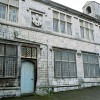
The Manor House was built at the start of the 17th century and later enlarged probably in 1698. On the front of the building there is the Clavell family crest probably commemorating the additions to the building by Roger and Ruth Clavell and they made further additions at the beginning of the 18th century. The extensive additions made to the north east of the house are modern.

To see the other important buildings in the parish we have to climb some 700 feet to the top of the downs and Grange Arch. Built in the 18th century by Denis Bond “to form an architectural focus to the view southward from the Grange” says the RCHM. From this vantage point we can look down on the mansion known as Creech Grange.

The impressive house we see today owes little to the original building, which was badly damaged by the Parliamentarians during the Civil War. The front of the building was completely rebuilt in 1846 by the Bond family.

Near to the grand house is the Chapel of St. John the Evangelist built in 1746 by Denis Bond, who died before it was completed; for a century the unfinished building was used as a workshop. Originally it consisted of a west tower and nave with a small sanctuary entered through a 12th century archway, brought from the priory church at East Holme and according to the RCHM is a “notable Romanesque feature.”  It was 1840 when work was recommenced by John Bond who died in 1844. His brother the Revd Nathaniel Bond rebuilt the nave and tower and added the north transept in 1849. 1868 saw the addition of the chancel, the vestry and organ chamber.

Every parish, village and hamlet has a history deserving to be told and Steeple, with its associations with America’s founding fathers, its outspoken clergy, and the transfer of its grand mansion from a distinguished Royalist family to another prominent family is no exception.

The Late Parish of Stoke Wake

The parish of Stoke Wake is no more. Its church is redundant, pensioned off to a life as a farm store, its cottages and farms thinly spread over little more than a thousand acres incorporated, not so many years ago, into the neighbouring parish of Hazelbury Bryan.
 
On the brighter side the effort of a climb up Bulbarrow Hill to Rawlsbury Camp will be rewarded with magnificent views. “Surpassing imagination” is how John Hutchins described the vista from the summit of this Celtic encampment, one of the highest points in the County. From here on a day when the skies are clear you will see Shaftesbury some 15 miles to the north; peer south and you will pick out the monument to Thomas Masterman Hardy at Portesham and, beyond that, the English Channel shimmering in the sunlight.

We must go back beyond 1086 and the Conqueror’s ledgers to find the origin of the name of this ancient place. In The Domesday Book it appears as Stocke, possibly a derivation of the Old English word stoc, which is a reference to an outlying settlement or farm.  Looking around this wooded landscape we might agree with John Hutchins’ suggestion that ‘Stoke’ is a derivation of the Saxon word stocce, which means wood or stock.
 
The first reference to ‘Stocke’ is relayed to us in Thomas Gerard’s work written early in the 17th century and known as Coker’s Survey of Dorsetshire (See our article about Thomas Gerard.) “In A.D. 941 King Edmund, King of Wessex, gave to Eddric, his vassal and friend, two manors in Stoke to him and his heirs forever.” At some later time these manors seem to have been given or sold to the Abbess of Shaftesbury as, according to the Domesday Book, “The Church of St. Mary of Sceptesberie held Stocke.”

The Abbess of Shaftesbury’s first tenant lords were the Cusins or Cosyns and the manor was known as Stoke Cosyn until the 13th century. We know that in 1227 John Wake held the manor. In his book, written around 1625, Thomas Gerard records: “The river passing Hollwell, leaveth on the hill over it Wakes Court, now a ruinate place, but antientlie the seat of the noble family of Wakes branched from Lord Wake of Lydell and from who a fair inheritance descended to John Caybes, Hugh Titell and John Mitchell, who married the daughters and heirs of John Wake.” No trace remains of the two dwellings but the Wakes were very rich and we might expect them to have lived in some grandeur, their homes enclosed by some 200 acres of parkland.

Indeed in 1485 Henry VII referred to the Wake manors as Stoke Park but by then they had passed to a Somerset family, the Keynes of Compton Pauncefort, although the place continued to be known as Stoke Wake.  The Keynes arrived in 1416 and departed two centuries later in 1614, when the Seymour and Pitt families bought them. The Seymour family bought out the Pitt family and continued to hold the manor into the 19th century.

John Hutchins tells of an ancient church here and there is a record from 1305 that shows a John Wake as patron of that church. Hutchins in 1770 describes a church here built in 1540: “Small late Perpendicular fabric, dedicated to All Saints. It consists of a nave and chancel, a south porch and embattled tower containing four bells, one dated 1626…Over the west door with two scrolls – nearly illegible – are the initials of Robert Childe, Rector 1545. Against the north pillar was painted a beggar and under him the words “He that loveth pleasure shall be a poor man,” The font and shaft are octagonal, of good Perpendicular type, with carved panels. In the north aisle are some curious fragments of stained glass, design, chalice wafer and cross. In 1542 Richard More by his will ordered his body to be buried in the new aisle here.”
 
Two churches gone and another, All Saints, arose on the same site in 1872. It was designed by G. R. Crickmay with, we are told, a little help from Thomas Hardy. Built at a cost of £900, the four bells from the earlier church were sold to help meet the cost. Being in private hands it is no longer freely accessible so we turn to Pevsner for a brief description: “nave, chancel with apse and a north aisle with a three-bay arcade.” It is built of squared rubble with a red tiled roof with a western bell turret housing just one bell to summon the dwindling congregation, which in the end led to its demise and redundancy.

Near the church, too the north is the Old Rectory described by John Hutchins’ editors as “a commodious and substantial house.” Built by Revd. Thomas Wickham Birch, Rector of Stoke Wake from 1817 to 1872. To the south of the church is The Manor House built in the 18th century.  In 1817 the patron was H Seymour Esq. and the living was a rectory in the archdeaconry of Dorset and diocese of Bristol rated in the king’s books at £8. 8. 9d.

To recap, Stoke Wake is a redundant church and parish, its remaining cottages and farms too scattered to be recognised as a village or even a hamlet. A traveller could pass through it and never know its name.

John Calcraft: Father of a Rempstone Dynasty

The ancestry of John Calcraft of Rempstone Hall, like that of many other Dorset families, did not have its roots in the county with which they are most associated, but in another. Calcraft was born on 14th August 1726 in Grantham, Lincolnshire, son of another John Calcraft who was a lawyer, and a woman called Christian Bursbie. At least, that is the genealogy according to the penned inscriptions in three family Bibles.

But official records tell a rather different story. It is now more likely that John Calcraft was an illegitimate son of the famous Whig parliamentarian Sir Henry Fox by Christian, who also appears to have been the mother of John’s Brother Thomas. For it has been noted that the name Christian occurs more than once in both of these Lincolnshire families; added to that there is a marked resemblance between John and Henry Fox that can be seen in portraits handing at Rempstone Hall in Purbeck.

There are no surviving records about the younger John’s education, but by the age of 18 he had meteorically risen to the position of Deputy Paymaster to the army in Scotland. At 19 he had been entrusted with considerable responsibilities. This entailed commanding and escorting consignments of money from Newcastle to Edinburgh – in winter, often through deep snow. Furthermore, Calcraft was appointed Clerk of the War Office towards the end of 1746, and was to effectively act as Fox’s private secretary. By 1749 the latter was securing army agencies for him and for several years was even recommending him as “a dear relative.”

In March 1753 Fox promoted Calcraft to Deputy Commissary General at 23 shilling a day. One of Calcraft’s friends was General Edward Braddock, who the British had charged with expelling the French from the American colonies in 1754. Braddock however, was killed in action in Quebec soon after, but not before he had made a will in favour of John Calcraft, leaving his table silverware to him. Calcraft was also well acquainted with many of the military leaders of his day, including the Duke of Cumberland and General Wolfe.

Another friend was a cavalry hero, John, Marquis of Granby, who in collaboration with Fox and Calcraft is known to have shared as mistresses two leading stage actresses of the day, Georgina Bellamy and Elizabeth Bride. By 1753 Calcraft had moved in with Georgiana in London, and was amassing a fortune in his work as banker and contractor to the forces. Besides his residence in Parliament Street he acquired a property on Sackville Street and also Ingress Abbey. His relationship with Georgiana seemed to be founded on a lasting basis for several years, but was eventually fated to end when Calcraft was distracted by an attraction to Elizabeth Bride, leaving Georgiana in distress and saddled with many debts. Georgiana had kept house for John from about 1752 to 1761. Calcraft then lived with Elizabeth from 1764 until his death.

Calcraft’s children by Elizabeth were Katherine, born at Parliament Street in 1764; Granby at Ingress Abbey in 1766; Richard at Sackville Street, 1770 and William at Ingress Abbey in 1771. His heir was John, born at Ingress on 16th October 1765, though it is not certain that Elizabeth was his mother. However, since all five children were left to her guardianship after their father’s death, it is thought that John, too, must have been Elizabeth’s son. From his will Elizabeth inherited from Calcraft £3000 and an annuity of £1000 for life.

In 1757 Calcraft acquired the sprawling eleven square mile estate and manor of Rempstone in Purbeck and the manor of Wareham ten years later from Thomas Erle Drax; the same year he bought from John and George Pitt and John Bankes all the remaining Wareham land.

In 1763 Fox, who had gained a reputation for affluence and corruption, was deserted in his cause by Calcraft, in favour of an alliance with William Pitt, 1st Earl of Chatham. Calcraft stood as MP for Calne, Wiltshire from 1766-68, and for Rochester from 1768 to 1772. He also had his younger brother Thomas elected for Poole in 1762 and 1768. Ideologically, he stood for liberty of the people and for Parliamentary reform but only one speech of John has been recorded: during a debate on the Liberty of the Press Bill on December 2nd 1770. In the hope of persuading voters to return the men he favoured to Parliament, Calcraft used his great wealth to buy up boroughs and other property such as Ingress Abbey.

Not long before he died, Calcraft had been the subject of several satirical cartoons and malicious attacks mainly instigated by Fox and Georgiana Bellamy. He was further lampooned by his detractors under the derisory label of “Crafterio.” It is recorded that in appearance Calcraft was a rather tall man with a ruddy complexion, handsome, of easy address and facility of speech that recommended him to others.

John Calcraft died on August 23rd 1772 at the age of only 46. He had not lived long enough to warrant the title of Earl of Osmonde.

St. Martins – Broadmayne

Straddling the main Dorchester to Wareham road, Broadmayne, it has to be said, is not one of the prettiest of Dorset villages. In the 18th century there were kilns here producing bricks made from local clay so it is surprising that only one brick-built cottage of the period, dated 1732, has survived here and you will not find many other examples from this period in the county. Don’t be fooled by the appearance of the 13th century Manor house; what appear to be bricks are simply tiles added in the 19th century for protection. Modern housing detracts from the few surviving older cottages.

Dedicated to St. Martin the parish church is at the north-west end of the village, visible from and alongside the main road.  The walls are faced, roughly squared and coursed rubble with ashlar dressings, all of Portland stone; the roofs are tiled, with stone-slated verges. Depending on your point of view the church benefited or suffered from extensive restoration during the Victorian era. The architect Thomas Hardy, later novelist and poet, while articled to the Dorchester firm of J. Hicks, drew up the plans for the work in 1865-66 and his drawings are on display in the vestry.

St. Martin’s is unusual in that it has a south tower with the lower stage ground floor doubling as a porch where there is a piscina and stoup and on the outside wall, east of the door, is a scratch dial. The positioning of the tower was probably dictated by the land, which slopes away quite sharply to the west of the church. The tower is of the 13th century but the upper stage was rebuilt late in the 15th century or early 16th century.

 The entrance is through the porch into the 14th century nave. The window by the font and the large west window over the west door are 15th century in the Perpendicular style. The font of Portland stone is of the 15th century and has been restored. There are stoups outside both the south and west doorways. The north aisle, north arcade and vestry were added during the 19th century restoration and the entrance to the vestry from the north aisle is through the original 14th century chancel arch.

Hardy’s plans for the restoration work clearly show that there were galleries on the north and west sides of the nave. The windows in the north aisle are all of similar design and of the 19th century with the exception of the most easterly one which, though of the same design, is 14th century.

Dating from the 13th century the chancel is the oldest part of the church with original windows. From the outside it is possible to see the priest’s door in the south wall – now blocked up. The chancel arch is Victorian; the original 14th century arch, as we have seen, is still employed in the church.

In the 12th and 13th centuries this place was known as Maine Martel and the Martel family were the Lords of the Manor. In the north aisle is a 13th century coffin lid that was found in the churchyard during work on a 1980’s road widening scheme. The floral cross carved on the lid can still be made out. Other monuments within the church include ones to Eliza, wife of John Gardiner 1834; Laura Hussey 1845; several to members of the Urquhart family during the 19th century. In the churchyard William Gatch and his wife 1691 and 1698; John Sherren and his son Henry and Thomasine, Henry’s wife, 1714, 1752 and 1761; Jeremiah Pount 1692; John Tibbes 1712;  Phillip Tibbes 1703; Phillip Bard 1700; and Jeffrey Samway 1737.

Iwerne Courtney (Shroton)

Five centuries before the birth of Christianity, the folk living here in the early days of the Iron Age occupied the huge earthen ramparts they had built for themselves on Hambledon Hill, which rises above the village of Iwerne Courtney, also known as Shroton.
 
Following the conquest by Roman Armies under General Vespasian the people left their hill town and made their homes in the valley and lowlands. We know the Romans were here from remains of a Roman residence discovered at nearby Preston in 1880 by General Pitt-Rivers.

The dual place names relate to the ownership of the manor before the Tudor period. Iw(erne) or Yw(erne) is from the Celtic for yew tree and the chalky soil here would certainly favour that tree. But what of (Iw)erne? Possibly it is a reference to a heronry, as one was mentioned in a Charter of King Edwy in 986 as a “cranemere” or heron pool and there is a Heron Grove on Preston Hill. In 1244 the affix Curtney appears and relates to the Earls of Devon who owned the manor from the early 13th century; their family name was Coutney.

Seward, a Saxon thane, owned the manor at the time of the Norman invasion but we learn from the Domesday Book that twenty years on in 1086 the manor was the property of Baldwin of Exeter, the Sheriff of Devon. Locally the parish is often referred to as Shroton, a derivation of scir-refa and tun, which translated from the Old English, means the sheriff’s estate.

The village is found in an expansive valley off the main Blandford to Shaftesbury road. It hasn’t changed very much down the centuries; its thatched cottages and interesting church remain but the fairs and sales allowed under a Charter granted 750 years ago died out in the early years of the 20th century. Shroton Fair was held on the Fair Field every 25th and 26th of September for the sale of horses, cattle and all manner of produce. William Barnes wrote in 1888: “Some high holidays of Dorset people have been those of their great fairs such as…Shroton, to which were formerly brought stores of all kinds of wares for the life-gear and house-gear of Dorset homes and to which the house-wives were wont to lay in the year’s stock. I have heard that a ball-room was put up at Shroton Fair where, I was told, young ladies were brought out in a County Ball.” There were stalls and booths, games and sporting events including boxing with bouts between local champions.

Gallows corner on the road from Iwerne Courtney to Farringdon probably got its name from a gibbet erected to display some sad soul from Monmouth’s rebellion, or to frighten deer poachers; something that was rife here during the 18th and 19th century.

Soon after it was rebuilt in the early years of the 17th century the church was to play a cameo role in the Civil War. Parliamentarian dragoons rounded up some 400 protesting Clubmen off Hambledon Hill and locked them in the church overnight. Such was the reputation of Cromwell that they feared they would never see their families again. The following morning they were doubtless much relieved to be released and sent home. (For the full story see our article: “Poor Silly Creatures.”)

All that remains of an earlier church is the 14th century battlemented tower. In 1610 Sir Thomas Freke, owner of several manors in Dorset, rebuilt the church in the Gothic style. There is a monument in memory of Sir Thomas in the mortuary chapel on the south side, enclosed west and south by a carved wooden screen that has been described as the most beautiful in Dorset. In 1871 the south aisle was extended and the roof replaced. The inside of the chancel was much altered in 1872 when new windows and a terracotta reredos were added; the outside of the chancel is as it was built in 1610.

An Inventory of Church Goods made in 1588 includes some grand priestly vestments: “one greene velvet with birds, one blue sylke with pecocks, one changeable green and yellow.”

A Muster Roll of 1542 lists the names of able bodied men possessed of arms and may be of help to family historians. The following names were included: Goodbynes, Burden, Baker, Copp, Gellet, Tyllet, Hancke, Here, Simons, Trevell, Sanysberry, Candeljou, Mychel, Swetnam, Hogger, Smythe, Mullens, Porter, Pyres, Danys, Best, Somers, Pyllwyn, Lamere, and Talbot.

The summer of 1756 saw a military camp established at Iwerne Courtney and for a short while it was home to six battalions of infantry and two troops of light horse, with twelve pieces of artillery. General Wolfe wrote: “the men were encamped upon a pleasant spot open to the wind which scoured the camp and purified it.”  This was three years before the General fell during the battle of Quebec in 1759.

About a quarter of a mile to the east of the St. Mary’s church and set in 100 acres surrounded by woodlands is Ranston House, seat of the Baker Baronetcy from its creation in 1805. On the death of her father, Sir Randolf Baker, Mrs Selina Gibson Fleming inherited the estate in 1959; she passed away in 2010. With her husband, Major William Gibson Fleming, she made significant changes to the estate and the Grade I listed house, which was built in 1755, is considered one of the finest in Dorset.

William Edward Forster of Bradpole

Within the space of twelve months the nation lost two of its great Victorian social reformers. Following the death of the 7th Earl of Shaftesbury in 1885 another Dorset man who shared a concern about the poor and elementary education passed away in 1886; he was William Edward Forster.

Born in Bradpole, a parish in the west of Dorset on the 11th of July 1818, he was the son of William and Ann Forster, ardent workers for the Quaker cause who travelled widely to promote Quaker principles. Even while pregnant his mother went to Ireland to encourage the meetings of Friends there. They had their son educated at a Quaker school; lacking a formal University education he abandoned his plans for a career in the law instead steering a course into the world of trade and commerce, successfully entering the wool business in Yorkshire.

Jane Martha Arnold, the eldest daughter of Dr Thomas Arnold, became his wife in 1850. In the church at Ambleside there is a memorial window dedicated to him. William and Jane were not blessed with children of their own but on the death of Jane’s brother William in 1859 the Forster’s took in and later adopted his four children. Marrying Jane Arnold, who was not a Quaker, brought Forster into conflict with the movement and he was excommunicated for marrying her. Later he joined the Church of England.

William travelled to Ireland with his father in 1846-47 to distribute aid in the Connemara. His time there left a lasting impression on him and he started to take an interest in the troubles in Ireland and elementary education at home. He also took an interest in anti-slavery: his father died in Tennesee in 1854 while he was on an anti-slavery mission for the Quaker movement.

He grew-up at a time when wages in the south west of the country fell to three shillings a week, resulting in most agricultural workers relying on some support from the parish. This was a time of hayricks being fired, threshing machines destroyed, and there were widespread riots in 1830. Over half of the parishes in rural areas lacked schools. Forster said of his own parents: “they are as poor as rats… keeping neither carriage, nor gig, nor horses, only a small pony…and our house is quite a cottage.” 

It was against this backdrop that William Forster began to take a more active role by speaking and lecturing. He summed up his political aims thus: “If I had to take part in the administration of affairs in this country, I would strive to accomplish two great purposes…to give relief, and lasting relief to poor Ireland; and get the children of the working classes out of the gutter, by educating them”. He was destined to tread the corridors of power and was true to his ambitions.

In 1859 he stood for election to Parliament, but was unsuccessful as the Liberal candidate for Leeds. He tried for Parliament again two years later and he was returned unopposed to represent Bradford and again in 1865, 1868, and 1872.

He contributed to Parliament’s debates on the Civil War in America and in 1868 was made Under-Secretary of State for the Colonies. He brought in Education Bills in 1867 and 1868 and when the Liberal Party formed the government that year he was appointed Vice-president of the Council and tasked with the job of formulating a government measure for national education. Forster was the architect of the Elementary Education Act passed in 1870 and he was responsible for seeing the Ballot Act of 1872 through Parliament.

Strongly tipped to become leader of the Liberal party he would not allow his name to be put forward.  He was elected to the Royal Society and became Lord Rector of Aberdeen University. In 1876 he visited Serbia and Turkey.

When Gladstone was returned to office in 1880, Forster was appointed Chief Secretary for Ireland and held the position until May 1882. This role put his life in harms way and on his frequent visits to Dublin he was escorted by mounted and armed police: several attempts on his life were thwarted. The Nationalist press nicknamed him Buckshot because they believed he had ordered its use by the police when firing on a crowd. Forster resigned on 2nd of May 1882 after Gladstone announced the government’s intention to release nationalist prisoners; a few days later his successor, Lord Cavendish, was murdered in Dublin. His political record in education and anti-slavery are all over shadowed by his time dealing with the troubles in Ireland.

The census records give us an insight to how his influence and power grew. In 1851 he is living with his wife, sister in law, and three servants at Otley in the West Riding of Yorkshire, and he is described as a Worsted Stuff Manufacturer.  A decade later William and Jane Forster are to be found in Guildford Street, St. Pancras, London and the record shows two nieces and one nephew are with them. There is a governess and four servants; he is described as an M.P., Spinner and Manufacturer.

At the height of his influence in 1881 we find him and his family at 80, Eccleston Square, St. George, Hanover Square, London.  The record confirms he and his wife have adopted their nieces and nephew who are now in their twenties. The family enjoys the support of a lady’s maid, cook, upper housemaid, two footmen, under housemaid and a kitchen maid. He is described as M.P. Chief Secretary to the Lord Lieutenant of Ireland.

William Edward Forster passed away on the 6th of April 1886.

Caroline Jane Cousins (1837-1927)

One of the Last Knocker-Uppers!

The idea of an Alarm Clock has been around for a long time but it was not until 1908 that a reasonably reliable device came onto the market at a price a working man could afford. This brought with it the demise of the Knockers-Uppers, a profession that finally died out in Dorset soon after the end of World War I.

This is the story of Caroline Jane Cousins, a lady who, in her twilight years managed to make a living as a Knocker-Upper in Poole; more specifically from the Quay to the Gas Works which took in Lagland Street, Thames Street, Stand Street, Taylor’s Buildings, Emerson Road and the High Street. For three pennies a week she would come around and wake up workers from their slumbers by tapping on the bedroom window. For most of her clients this would mean a really early morning call as work in most of the factories in Poole started at 6am.

In winter she would start her rounds well before daybreak, dressed in a black dress, white apron and shawl, all topped off with a white bonnet. She had a lantern and a long pole which she used to tap the windows with. She also had a whistle with which she could hail the police if anyone attempted to assault her.

She became known as ‘Granny Cousins,’ though by all accounts she was not the family woman this form of address implies, at least in her later years. Indeed, when one of her sons, Solomon, lost both his legs in an accident she took it quite philosophically and apparently showed little sign of grief when he died; neither does she appear to have had much contact with her children and grandchildren in her later years.

Recalling the days when she lived in the country was something she liked to do. Those were times when necessity meant she had to make a meal go a long way and this was her top tip: “You put yer piece o’bacon in pot and then when he’ve a-cooked a bit, put in yer cabbage, then whack up yer dough enough for the family and put he in on top. Tha’s Skiver Cake,  that is, an’ good for’ee, too. But, don’ee drow away the water ‘tis biled in. You drink that there an’ twill keep away all manner o’ diseases.”

She was the daughter of Benjamin and Sarah (Lovell) Bartlett and baptised at St. Mary’s church, Morden, on New Year’s Day 1837.  Her parents were both from close-by Lytchett Matravers and they married there on the 14th of June 1820.  Her mother died aged 49 and was buried on the 12th of August 1847at St.Mary’s, Morden. The census taken in 1851 records Caroline with her father, older unmarried sister Diana, and one-month-old niece Elizabeth, living at Sherford, Morden. In 1861 Caroline is lodging with Isaac and Martha Lovell at White Field, Morden; she is described as a nurse and house servant.

She married Joseph Cousins in the early months of 1863. Joseph was older than her by 34-years and after her marriage she more often than not appears in records as Jane. As far as we can tell Caroline and Joseph had four boys and two girls. In 1871 Joseph then 69 years of age and Caroline just 35 years could be found at 3, Horse Pond Cottages, East Morden, with them their children: Benjamin, Thomas and Louisa. (There are indications of another child born early in 1865. He was named Owen but we haven’t been able to establish were he was in 1871 and 1881.)

Joseph Cousins died in 1880 leaving Caroline in desperate circumstances. She was forced to move into the Union Workhouse at Wareham, taking sons Thomas and Soloman and daughter Dinah Fanny with her.

By 1891 Caroline had removed herself from the workhouse and was living at Scaplins Yard, Salisbury Street, in the St. James parish of Poole. With her is her daughter Dinah and sons Solomon and Owen, who is now married to Rosena Ellen (Gallop); they married towards the end of 1887. Owen was a bricklayer’s labourer.

In the years between 1891 and 1901 Caroline became detached from her children and was living at 1, West Street, St James, Poole, where she was employed as a housekeeper to a widower, James Arnold, a bricklayer.  The 1911 census records her at 24 Skinner Street a boarder with William Efemy, a fisherman.

We think her time as a Knocker-Upper started around 1901and continued until just after the end of World War I when she retired and also gave up working at the local twine factory. She was described as a strange old woman who didn’t wear her heart on her sleeve and had a way of talking at great-length to no one in particular, staring straight ahead as she did so.

After her retirement she joined the Salvation Army, a cause she remained faithful to until her death in 1927. She received no old-age pension and she was looked after by the parish. Having no home of her own she showed no signs of self-pity and lived in the humble lodgings she had acquired with a friend. She had enjoyed good health for most of her life, something she put down to always drinking the water she cooked her vegetables in.

Inevitably her strength started to fail her. She was taken to the local infirmary where she died aged 89. She possessed a battered alarm clock, which had no doubt accompanied her on her morning rounds. But she deserves to be remembered not only for her unusual occupation but because of her determination to get on with life despite all the hardship it threw at her.


Footnote:

Vanessa Marshall writes: Her daughter Fanny Dinah Cousins married Edward Martin Effemy in 1893 at St James’ Church, Poole and Granny Cousins attended the marriage. The had a total of eight children, including: Mary Fanny Caroline and James Effemy in 1904. Mary’s middle names were after her mother and grandmother. Unfortunately Fanny Dinah died in 1905, when Mary was only 14 months old.

Mary and her elder sister were fostered out, but Mary knew her grandmother Granny Cousins well. Furthermore, Granny Cousins was living with a distant relative of Martin Effemy’s – William Effemy (sic) in 1911. The sad thing was that Granny Cousins outlived all her children, but she knew her Effemy grandchildren.

Her granddaughter, Mary, went on to marry Robert William Frederick Bessant (whose own mother was also an Effemy and their first daughter – Mary Ann Diana Jane was born at Poole in 1932 – the Diana Jane part of her name being a tribute to her grandmother and great grandmother. Mary Bessant is my husband’s mother.

(Granny Cousins was not as detached from her family in her later years, as our article suggests. Ed.)

Jordan Hill Roman Temple and the nature of pagan piety

Leaving Weymouth and travelling two miles north east along the A 353 towards Overcombe, one draws close to an area known as Furzey Cliff. This feature lies within the ownership of the National Trust, but something of far greater value for Britain’s ancient heritage is also here – or rather was, but for the disappearance of all but its foundations. It was a 4th century Romano-Celtic temple of four-square plan, characteristic of the period, a convention which can also be seen in the ground plan of a very similar religious structure the Romans built within the enclosure of the Iron Age hillfort at Maiden Castle. But both there and at Jordon Hill, the site of the temple near Furzey Cliff, all that remains are the footing walls.

The story of how those footing walls re-emerged into the light of day began one day in 1812 when some farm labourers, ploughing a field on the brow of the hill, had to call a halt to their work when their ploughshare struck an object buried in the ground.  It was found to be an urn containing a hoard of several hundred Roman silver coins, which the astonished men principally distributed among themselves. Only a remnant of this amazing find found its way to the county museum in Dorchester. And for another thirty years, Jordon Hill would become a focus of growing speculation as to the possibility that a Roman settlement could once have existed there. But who would be responsible for establishing that that was indeed the case?

In 1843 James A S Medhurst was living in the Weymouth district of Melcombe Regis and working as a craftsman specialising in the production of a kind of decorative inlaid woodwork called Tunbridge Ware, after the town of Tonbridge Wells. Tunbridge Ware involved skilled intricate work, commonly taking the form of boxes having small strips of wood glued together. Woodcraftsmanship, then, was Medhurst’s occupation, but the craftsman had a sideline that would eventually lead to the first systemmatic excavation of Jordon Hill; for Medhurst was a keen archaeologist who had already carried out a considerable amount of digging work in Suffolk before coming to live in Weymouth.

The summer of 1842 was a notably dry one. Under such conditions the foundations of buried buildings are apt to be revealed in grassland or cereals as crop marks. At that time Medhurst’s curiosity had been aroused by the failure of the wheat harvest on Jordon Hill, an event which led to his suspicion that an extensive ancient building lay just beneath the surface. Medhurst commenced his preliminary excavation in 1843, and would continue the work over several other seasons throughout the 1840’s.

The archaeologist first unearthed the foundation of a massive stone wall five feet thick enclosing a square of about 35 square feet. Associated with this wall were pottery and coins clearly of Roman origin and consistent in style with a 1st century construction. Early on in the progress of the work Medhurst had sought the opinion and advice of Professor Buckland who, following his inspection of the site, made known his findings to the British Archaeological Association and the Oxford Ashmolean Society in 1844. He gave as his opinion that the stonework Medhurst had unearthed was the foundation of a square-planned Roman temple, an inner square having been the cella or shrine, while the massive outer wall would have been the peristyle or outer collonade of the normal Romano-Celtic type. Interestingly, some later speculated that the structure may have been a signalling station or Pharos for guiding mariners, but most authorities agree that Buckland’s interpretation is correct. The subsequent discovery of a British coin associated with Roman ones has confirmed the fact.

As the excavation work progressed a number of interesting features came to light. The foundations of a short flight of steps marking the entrance were found near the centre of the south wall. Four feet inwards from the topmost step the bases of four slim columns of Purbeck Marble were found, Beyond the north wall were the base and capital of another column, now on display in the County Museum. In addition to Roman coins and fragments of pottery four sackfuls of bull horns and bones were found by Medhurst within the peristyle, evidently the remains of animal sacrifices to the deity worshipped there.
 
But the most exciting discovery was yet to come. This was a shaft four feet two inches by fourteen feet deep in the south-east corner of the temple area, a feature described in great detail by Hutchins. The shaft had been lined with clay and stone tiles. A cist formed from two oblong stones and containing two small urns, a 21-inch-long sword, an iron crook and bucket handle, two long irons, an iron knife and a steelyard, had been inserted into the base of the shaft. Immediately above the cist was a thin layer of stone tiles arranged in pairs; between each pair lay the skeleton of a bird and a small Roman coin; this arrangement was repeated sixteen times between the top and bottom of the shaft, the sequence being broken midway by the insertion of a second cist containing urns, a spearhead, and an iron sword. The birds had been buzzards, ravens, crows and starlings. The shaft partly underlay the south-east corner of the building. Professor Buckland speculated that the temple had been a shrine to Aesculapius, the god of healing and that the birds and coins had been votive offerings made by Roman families.

Whether the shrine on Jordon Hill had been dedicated to Aesculapius or not, the fact remains that the Romano-Celtic shrines were by no means to be exclusively for the veneration of any one deity once the Romans had established themselves in England. The pre-eminent concern of the new colonists was to consolidate their authority and to give the native Britons to understand that, having arrived in the country in full force, they meant to stay to time indefinite. Any dissent, resistance or outright rebellion would be swiftly and brutally suppressed, but at the same time the tenor of the system of government they established would otherwise be, as a matter of policy, one of peaceful cooperation and neighbourliness. As became clear from James Medhurst’s excavation of a nearby cemetery, the natives responded positively to the Romans friendly overtures, for the dig had revealed the interesting fact that Romans and Celts alike had shared the same communal burial ground. Furthermore, they had also worked together in contemporary potteries discovered and excavated at Sutton Poyntz. But most interesting of all was that this cooperation extended to religious belief as well. Polytheism, belief in the existence of more than one god, was of course endemic to the pagan civilisations and pre-Christian societies, and so the coming of the Romans into contact with the Britons created a fusion of two pagan traditions. Each race worshipped their own pantheon of deities under different names, but it was quite possible for men of both traditions to practise the sharing of a shrine, to use it for the worship of their own gods and to retain their distinctive beliefs. Cross-cultural identification of deities ruling the same thing (eg: health, love, war) was also commonplace. It was never the policy of the Romans, at least to the very end of the occupation, to ruthlessly suppress the religions of the lands they conquered or forbid on pain of death the worship of all gods but their own.

Consequently the Jordon Hill temple cannot be considered as dedicated to any one particular pagan deity, but was quite likely shared between conquerors and conquered alike. James Medhurst died in 1879, having left Dorset for another part of the country soon after his excavations were concluded. The archaeologist took most of his collection of finds with him but upon his death Pitt Rivers bought a share of the collection and many more of the objects were purchased by or given to several county museums where they are still held today.

But the Jordon Hill site had not given up all its secrets. In 1928, 116 years after the initial find of the urn hoard, a similar discovery was made in the near vicinity of the temple. This time however there was no trace of an urn, the coins having been buried loose as a hoard within the ground and simply covered over with a stone slab. It was, and remains, the largest hoard of Romano-Celtic bronze coins ever to be found anywhere in the Roman Empire. As this find was obviously one of considerable importance the coins were entrusted to Mr F S Salisbury, a noted expert numismatist. His description of them is given in detail in Vol 51 of the Proceedings of the Dorset Archaeological Society. Following classification of the currency it was intermediately entrusted to Mr Mayne & Co, owners of the then Weymouth Bay Estate, who in turn dispatched the coins to the British Museum for re-distribution to Dorchester, Portland and Yeovil Museums as well as to the offices of Weymouth Corporation.

Most of the coins in the Weymouth Hoard of 1928 as they became known, were of 4th century origin, the great majority of them having been minted during the reign of Theodosius 1. This emperor, a successor to Constantine, had decreed Christianity to be the official religion of the empire by the time
of his death in 395 CE, But despite a distinct loosening of the hold of the old gods on the popular imagination of the pre-Christianised Britons towards the end of the 4th century, the advent of Christianity also (paradoxically) brought with it a distinct hardening in attitude on the part of Rome towards the pagan deities. Their worship was declared to be illegal and the offering of sacrifices even became a capital offence.

But what was really interesting about the coins was their marked worn condition, confirming the widely held suspicion that a continuation of the old religion or paganism persisted in the countryside after the Christianisation of the towns, and furthermore, that the Jordon temple site remained in use almost to the very end of the Roman occupation from 410 – 429 CE. Once the Romans had withdrawn from Britain and the value of currency had depreciated, hoarding and burial became the popular way to dispose of the valueless coins. Interestingly, J Collingwood Bruce, in his Handbook to the Roman Wall notes that: “AD 418 The Anglo-Saxon Chronicle says: This year the Romans collected all the treasures that were in Britain, and some they hid in the earth, so that no-one has since been able to find them; and some they carried with them into Gaul…”
Perhaps a few of the temples and shrines that the colonists had built were re-consecrated as Christian oratories, but the remainder were either demolished or abandoned to fall into ruin. It is likely therefore that the Jordon Hill temple was one of the last to go, given the evidence of the long duration and late abandonment of the site. The Romans may have destroyed the building before (or as) they left, or, as is more probable, it was simply deserted and left to rot.
 
By 1931 the whole of Jordon Hill had passed into the possession of the Weymouth Bay Estate Company, with a view to development for housing. This clearly posed a threat to the archaeology of the site and brought about an urgent need for the conservation of the already existing structures, plus the imperative for seeking out anything hitherto missed by Medhurst’s excavations. Accordingly Charles Prideaux, and eminent archaeologist member of the Dorset Archaeological Society, was appointed to direct a rescue excavation, his first job being to uncover the site, a task in which he was assisted by volunteers from Weymouth College Field Club. Trial trenches were opened in various directions and the ground opened up to a distance of 15 feet from the outer wall of the temple, but no boundary wall or any other structural find of significance was made. However, many objects of interest did emerge, Jewellery, combs, black burnished pottery, as well as coins and iron nails. The following year Col Charles Drew, curator of Dorset County Museum took over from Prideaux as director, but was no more successful in locating structural finds of note, although, again, more artefacts would be revealed. Indeed, by the time these excavations were concluded 88 Roman coins and one Celtic coin had been recovered. This brought the total found in direct association with the temple to 177. The site was then temporarily covered with a layer of earth as a protection from bad weather and then offered to the nation by the WBCE, passing into the custodianship of HM Office of Works. 

Since the Prideaux-Drew excavations were concluded, there has been only one further investigation of the related sites, this being undertaken by Dorset archaeologist Bill Putnam in 1969. Anyone sufficiently interested in researching the subject further can find additional material in Hutchins’ History of Dorset      Volume 2 and the Dorset Field Club Proceedings  Volumes 10, 21, 44, 51, 53, 54 & 57.

Thomas Gerard of Trent

Thomas Gerard was born at Trent in 1593. Educated at Gloucester Hall, Oxford, he was an historian, friend of Leicestershire historian, William Burton and an admirer of William Camden. It is only recently, since 1896, that Trent transferred from Somerset to Dorset. Thomas Gerard developed a liking for Dorset, following his marriage in 1618 to (Mrs) Ann Coker of Mappowder.

Their daughter, Ann, married Francis Wyndham of Trent in 1646 and in 1651 Francis and Ann provided a refuge for King Charles II, hiding him from the pursuing Parliamentarian soldiers as he travelled through Somerset on his way to Bridport and safety in France.

Thomas Gerard wrote the first book in English about Dorset but today it is still known as Coker’s Survey of Dorset, having been wrongly credited to his brother-in-law, John Coker, when the manuscript, missing its title page, was discovered and published a century after Thomas Gerard had written it. ‘Coker’s Survey of Dorestshire – containing the Antiquities and Natural History of that County’ is the book’s full title.
 
It is Gerard’s unfinished work about Somerset: ‘Particular Description of Somerset’ of which there is no doubt he is the author, which provides the proof that he, rather than his brother-in-law, John Coker, was the author of the Survey of Dorset. Both books use the same organised plan of work and start with a map of the county showing the names of the hundreds, followed by a general description of the County using headings such as: rivers, commodities and forests. He follows the rivers each in turn from their source, describing the towns along their route to the sea noting any important families living along the way. If further proof is needed on page 76 of the book the author refers to “…my predecessor John Gerard.

 The History and Antiquities of the County of Dorset, by John Hutchins is the major reference work for anyone studying the history of the county and Hutchins used ‘Coker’s,’ as he referred to it, as a reference source.

Thomas Gerard died aged 40 years.

“Poor Silly Creatures”

Who rules England:  the King or Parliament? That was the question setting the country alight in the middle of the 17th century. Both had their armies ready to slog it out to the death and it seems either side gave scant regard for peoples land, crops or property.
 
Here in Dorset and some other counties the less politicised among the population got thoroughly fed up with Charlie and Ollie’s gangs trampling down their crops, stealing their livestock and causing mayhem in their towns and villages. So they decided to form their own gang, becoming known as the Clubmen because of the crudity of their weapons: clubs, pitchforks and scythes in the main.

The Clubmen owed allegiance to neither side and were made up of a ragbag of yeoman, farmers, and villagers with a few parsons shouting orders from the sidelines. They were intent only to preserve the peace in their communities, save their land, livestock and possessions and to put an end to the pillaging carried out by the troops of the opposing camps.  A simple white cockade was their uniform and they marched with banners proclaiming: ‘If you offer to plunder or take our cattle, be assured we will bid you battle.’
 
Battle they did. For their trouble, they usually came off worse. To Cromwell, who first came upon them at Duncliffe Hill a little to the west of Shaftesbury, they were an annoying distraction who posed no real threat to his plans or his men. In August 1645 the Clubmen gathered on Hambledon Hill – between 2,000 and 4,000 angry citizens. Led by the Revd Bravel of Compton Abbas , they were ready to do battle against whatever Cromwell threw at them.

Earlier, during the siege of Sherborne Castle,  General  Fairfax  ordered the arrest of about 50 of the Clubmen’s leaders while they were holding a meeting at Shaftesbury.  On the 4th of August 1645 Cromwell, having successfully laid siege to Sherborne Castle, had an army of about one thousand men freed-up.

These Parliamentarian soldiers were far fewer in number but better organized, armed and commanded. They attacked the Clubmen, including four members of the clergy ,from the rear most of them fled. Those left on the hill were chased by about 50 of Cromwell’s dragoons.
 
Hambledon Hill was to be the Clubmen’s last stand in Dorset.  The dragoons rounded up about 400 Clubmen off the hill and locked them up in St. Mary’s church at Iwerne Courtney, leaving them to stew overnight. The next day Oliver Cromwell himself having already decided they were “poor silly creatures” came and lectured them and then to everyone’s surprise let them go home including the “malignant priests, who were principle stirrers up of the people to these tumultuous assemblies.”

Joshua Sprigg, who was General Fairfax’s chaplain, is quoted as saying; “If this had not been crushed in the egg, it had on an instant run all over the Kingdom and might have been destructive to the Parliament”.  In some people’s minds then, the Clubmen were a force to be reckoned with after all.