Dorset Ancestors Rotating Header Image

Dame Alice – a child of fate in a merciless age

When James Scott, Duke of Monmouth, made landfall at Lyme Regis in 1685, it was the curtain-raiser for one of the most bloody and shameful episodes in English history. An illegitimate son of Charles II, the Duke believed himself to be the rightful heir to the Crown, and raised an army in rebellion against the incumbent James II. But the insurrection collapsed, with fatal consequences for the Duke and all those who took up arms in his support. For the revolt could scarcely have been more ill-timed, coming as it did when the Lord Chief Justice in the land was the infamous Baron Sir George Jeffreys of Wem.

Probably the most tragic figure to become ensnared in the judicial reprisal for the rebellion was not one of the numerous renegade soldiers so soon to be hung in gibbets at crossroads the length and breadth of the west country. No, this particular victim of Jeffreys’ indiscriminate brutality was a quiet genteel woman of high standing and humanism, whose only crime was to naively commit the one well-meaning act, which would lead to her downfall. The woman was Dame Alicia (or Alice) Lisle, who earned the unenviable distinction of becoming the first of the accused (and the only woman) to be condemned to death for complicity in the Monmouth Rebellion.

Alice was born Alice Breconsawe (or Breckonshaw) about 1614 and brought up at her family home at Moyles Court, an Elizabethan manor in the parish of Ellingham, just north of Ringwood on the Hants side of the Dorset border. Together with her sister Elizabeth (the future Lady Tipping) she was a daughter of Sir White Breconsawe and Elizabeth Bond. Of the Breconsawe’s next to nothing is known, but on her mother’s side Alice was a descendant of the Purbeck scion of the manorial Bond family of Dorset, whose estate was at Blackmanston.

In 1636 when she was grown up, Alice married John Lisle, a leading Parliamentarian who, under Cromwell, would take up arms against the King in the Civil War. He was called to the bar in 1633 and was MP for Winchester from 1639 and for Southampton in 1654. In  1659/60 he was also Commissioner for the Navy. Lisle was a leading promoter of the trial of Charles I in Westminster Hall in January 1649 and actually drafted the death sentence for the doomed monarch. Later Cromwell appointed Lisle Commissioner of his Seal, and to a place in the House of Lords. By him Alice had four daughters and one son.

The road which would ultimately lead Alice Lisle to her cruel fate began on the battlefield of Sedgemoor, Somerset, in 1685. The Duke of Monmouth, who had declared himself king at Taunton shortly before, was routed at the head of his rebel army by the superior forces of the King, then captured, tried and executed.

Among the Duke’s supporters who would remain at liberty until their eventual capture were two fugitives, one of whom, a man called John Hickes, would later become known to Alice as a wanted man, but not for the reason she supposed. Hickes was a dissenting minister who sent Alice a message asking for shelter at Moyles Court. He arrived at 10pm on July 20th, accompanied by one Richard Nelthorp and Alice, though not believed to be a Monmouth sympathiser, secreted the fugitives in a malthouse. It was there, during a county-wide mopping up sweep of rebel runaways by the King’s men under the command of a Colonel Penruddock (who had been tipped off by a spying villager) that the two men were flushed out the next day, sentenced, then hung, drawn and quartered.

Though Alice Lisle knowingly concealed the wanted man, she mistakenly assumed that John Hickes’ offence was one of religious dissent, not treason. But under Jeffreys’ draconian interpretation of the criminal code, the difference would probably have been academic. Although many more arrests, trials, and executions were to follow in the months ahead, all of these were of male combatants fighting in a rebel army. It is thus a measure of the extraordinary harshness of 17th century justice that, at least in the Lisle case, no concessions were made to the accused’s sex, age, infirmities, or social status. She would go down to her grave along with those far more guilty and deserving of punishment than herself.

As Chief Justice it fell to Jeffreys to try and condemn Alice and the captured rebels as the King’s advocate, under duress to apply harsh retribution for Monmouth’s treason. Many hundreds would be hung; some luckier ones transported – but fewer still would ever be acquitted. Indeed it was said that Jeffreys was a magistrate who never found anyone innocent (though 80 rebels were pardoned.) He was equally deaf to any appeals for clemency. On one notorious occasion at Dorchester a girl saw her brother’s lifeless body hanging from a wall opposite her window the morning after she had pleaded with the judge to spare his life.

For the circuit of trials and summary executions that have passed into history as the Bloody Assizes, Jeffreys embarked upon a veritable tour de force, holding court at Dorchester and elsewhere in the west country. In Dorset’s county town the judge presided in a room at the Antelope Inn, ever after known as the Monmouth Room. Alice Lisle however, was not tried and sentenced at the Antelope, but at a court in Winchester.

Here she was charged with the treasonable act of harbouring two of the King’s enemies. But despite the jury finding her innocent three times, Jeffreys refused to accept the verdict – three times. Still, the bullying judge was very persuasive. After much coercion, and probably fear of their own lives, Jeffreys managed to exact from his jury precisely the verdict he wanted: not one determined so much by the facts or mitigating circumstances, as by a malicious prejudice and paranoid loathing for anyone wishing ill of the monarch!

Then Dame Alice’s fate was sealed. As a woman inevitably found guilty she was first sentenced to be burnt at the stake. But this method of dispatch proved too extreme for the Clergy of Winchester to stomach. Following their intercession to James II, the King commuted the sentence to one of beheading!

It is recorded that the condemned woman spent her last night at the Eclipse Inn in Winchester after delivering a remarkable execution speech apparently recorded for posterity by the court clerk. And the following day, 2nd of September 1685 in Winchester’s market square, Dame Alice Lisle’s head was struck from her body by a swordsman. She was then about 75 years of age and was supposedly buried in the precincts of Ellingham’s 13th century church, although there is some archaeological evidence that the tomb supposed to be hers was occupied by someone else.

By this time however, Sir John Lisle was already dead. At the Restoration in 1660 he fled to Switzerland, but was murdered there by a man called Thomas McDowell in 1664. As for Jeffreys, when the Protestant William III came to the throne, the King, possibly fearing a Papist backlash against the judge, threw him into prison for his own safety in 1688, but he died from kidney failure the following year.

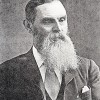
Joseph Clark (1834-1926)

Artist in Oils

In 1857 Joseph Clark submitted his first picture for the Royal AcademyExhibition, entitled The Sick Child; it was accepted. He exhibited regularly atthe Royal Academy and at the Royal Institution until a few years before hisdeath. In 1876 he was awarded a bronze medal at the Centenary Exhibition at Philadelphia. Then, in 1877 his painting Early Promise was purchased for the nation and a further painting Mother’s Darling was purchased for the nation in 1885; both paintings are held by the Tate. His first painting offered at auction realised £4.17s.6d, a high price for the time and his paintings continue to command good prices when they come up at auction today.

He was the son of a draper and calico bleacher, born at Cerne Abbas on the 4th of July 1834. His early education was at a Dame school, these small privateschools usually run by an elderly woman who taught the children to read and write before they were old enough to work. He was then enrolled at the Dorchester school run by William Barnes. A book has survived in which the young Joseph detailed various workings of geometrical problems and précis of lectures given by Barnes on divinity, English and Roman history, geography and geology.  He developed an interest and aptitude for art, which was encouraged by Barnes.
 
Following the death of his father the family fortunes declined and he was removed from Barnes’ school to be apprenticed to a chemist at St. Neot’s in Huntingdonshire. He was not happy in his new position and returned to Cerne Abbas where he joined his mother, Susan, and his two older sisters, Mary and Emma, and their family servant, Jane Seard. Meanwhile, the family business had been taken on by his older brother William who had added a tailoring establishment.

The boy’s burning ambition was to go to London to continue his art studies and in this he received help from an unexpected quarter. His brother had employed a cutter to work in his tailoring shop; the man had come from London and he was a cultured individual who was familiar with the London art galleries and exhibitions. Having seen some of Joseph’s paintings he encouraged Mrs Clark to let Joseph go to London to further an artistic career.

On his arrival in London he wasted no time, immediately enrolling as a pupil at the school ran by James Leigh, located in Newman Street, which is just off Oxford Street. The school later became known as Heatherley’s; it still exists today. From Leigh’s school he progressed to the Royal Academy School then situated in the National Gallery building in Trafalgar Square.

By 1861 Joseph had been joined by his mother and the family servant, Jane. They all lived together at 25 Belle Vue Villas, Sussex Road, Islington, London. Thecensus confirms he had established himself as an ‘Artist in Oils.’

The next decade was a time of sorrow and happiness for Joseph. Early in 1866 his mother passed away having reached 76 years, her death being recorded inChristchurch. Towards the end of 1868 Joseph married Annie Jones, who was almost half his age. Her father was a Woolstapler from Winchester in Hampshire.

 
These two events suggest Joseph may have moved away from London for a while but by 1871 he was back in London, living at Arthur Road, Islington, with his young family and the faithful family servant, Jane. Jane Seard was now 60 and was assisted in her duties in the Clark household by a fourteen year-old girl, Emma Mills. A decade later we find Joseph and Annie Clark and their eleven year-old daughter, Annie, at 396 Holloway Castle, Islington. The couple enjoy the services of an elderly nurse and a young servant girl.

Then in 1891, after a space of fourteen years, the sound of young children can be heard again in the house. There are two more daughters and a son: Elsie was born in 1884; Wilfred in 1886 and Margaret in 1888. A 21 year-old governess, Harriet Eusor, was employed as well as a 23 year-old servant girl. Joseph Clark never seems to have needed an excuse to move house but his move to 23, Grosvenor Gardens, Hampstead, suggests more room was needed for his growing family and confirms he was a successful artist.

In 1901 we find Joseph and Annie with their four children at ‘Wenouree,’ Pinne Rd., Harrow-on-the-Hill. Their eldest daughter is teaching music and their son, Wilfred, is a Clerk to a Grain Broker. Joseph and Annie’s house moving continues but they stay, for now, north west of the metropolis and in 1911 they are in Uxbridge with two of their girls: Annie, who is still teaching music and the piano, and Margaret who is teaching at a private school.

Joseph Clarke died aged 92 years. He died on his birthday at Ramsgate in Kent, his death being registered in the Thanet district. Perhaps he had tired of north London and decided the Kent coast would be a nice place to live out his last years.

Like his parents, Joseph was a life-long member of the New Church, sometimes known as Swedenborgians. He served his church well as a Sunday school teacher and Church deacon as well as being a member of the Committee of Management.
In all his paintings he showed a feeling for family affection. All hispaintings express a love of family domesticity and portrayed moments of ordinary mans difficulties, sorrows and joys in his everyday existence. Many ofhis paintings had Barnes’ style captions, such as: Jeanes Wedden Day in Mornen (1879);  Farmer’s Woldest Dater (1908) and Wedden Morn (1909).
 
He spent most of his life away from Dorset but he had with him those views and memories which had been so familiar to him in his youth and are suggested in many of his paintings.

Sylvia Townsend Warner (1893 – 1978 )

During the early years of the 20th century the village of Chaldon Herring attracted a stream of talented people from the artistic and literary worlds: the magnet was Theodore Powys who had given up farming in Norfolk and returned to Dorset to write.

Theodore Powys was a withdrawn melancholy character who, until this point, had not enjoyed great success as a writer but this did not stop a host of young poets, writers and artists warming to him. One after another they were drawn like pilgrims to this remote Dorset parish, some of them making the village their home.

Sylvia Townsend Warner was enchanted by the village and fell under the Powys spell. Born on the 6th of December 1893 in Devon and baptised Sylvia Nora Townsend Warner she was the daughter of schoolmaster, George Townsend Warner and Nora Huddleston Warren. Sylvia was tall and slim in stature and bespectacled.

At the age of 20 she moved to London to study music and was one of the editors of the study Tudor Church Music. Her interest in writing poetry, short stories and novels trumped her interest and undoubted talent for music. In 1926 her first novel ‘Lolly Willowes’ was published, followed by ‘Mr Fortune’s Maggot’ the following year.

It was 1922 when Sylvia made her first journey to Chaldon Herring. Her friend, a former pupil of her father’s, Stephen Tomlin the sculptor, suggested she meet Theodore Powys. It was in his house during 1927 while enjoying huge celebrity as the best selling author of Lolly Willowes that Sylvia was introduced to the poet Valentine Ackland. Ackland, an assumed name, was twelve years her junior but that did not stop the two women starting a love affair that was to last a life time, ending in 1969 when Valentine died from breast cancer.

In 1930 Sylvia bought the cottage opposite ‘The Sailor’s Return’ public house and this is where the lovers lived until 1937, when they moved to a riverside cottage in another little Dorset village, Frome Vauchurch. The Chaldon Cottage was rented out and was destroyed by a direct hit from a German bomb during the war.

In 1933 Sylvia and Valentine published a joint book of poems ‘Whether a Dove or Seagull,’ a collection of love poems.  They were both members of the Communist Party of Great Britain and Valentine was a contributor to left-wing papers, including The Daily Worker. It was during the 1930’s that Sylvia’s short stories were first accepted by The New Yorker;  all told the magazine published nearly 150 of her stories.

The couple spent most of their time together in Dorset. They attended the American Writer’s Conference in New York in 1939, returning home shortly after Britain declared war on Germany. Sylvia continued to write during the war publishing an anthology of short stories The Cat’s Cradle Book in 1940 and A Garland of Straw’ in 1943. She was a member of the Women’s Volunteer Service and helped set-up centres for people evacuated from the cities.

Sylvia’s relationship with her mother was a difficult one, they were never close. Her father died in 1916 and her mother remarried. Soon after the war ended her mother’s health deteriorated into senility; as the only child she had to take responsibility for her mother until she died in 1950. During this time her lover, Valentine, had rekindled an earlier affair with an American woman Elizabeth Wade White, returning to Sylvia in 1949. Sylvia continued to write during this unhappy period, notably The Corner That Held Them, published in 1948. After all these tribulations the following years were uneventful. During this period Sylvia wrote several books including a biography of the novelist T.H. White.

In the thirties cross-dressing women and lesbian affairs were viewed as a titillating curiosity. In the years of austerity that followed the war they were viewed rather differently and their left-wing tendencies and lesbian lifestyle resulted in publishers becoming less supportive.

In 1967 Valentine was told she had breast cancer and battled with it for two years, she died in 1969. Sylvia was then in her seventies, a time when there was renewed interest in her writing, especially from the growing feminist movement. In 1973 she published a book of poems by her lover under the title: The Nature of the Moment.

Sylvia Townsend Warner lived out her days with her cats in the little cottage on the banks of the River Frome at Frome Vauchurch. She died there on May Day 1978, Sylvia and Valentine’s ashes are buried in Chaldon Herring’s churchyard.

About Durweston

Three miles north west of Blandford on the A350 road to Shaftesbury a left turn onto the A356 takes the traveller onto an old stone bridge across the river Stour. About a quarter of a mile further west is the village of Durweston.

It is thought that the name derives from the tun or farmstead of a man called Durwes; alternatively, it comes from dwrwys meaning “deep water.” The setting for this village is an embayment in the chalk downs and the willow-bordered Stour, which near a mill takes a broad sweep off towards the west end of the parish, where the escarpment of Hod Hill dominates the further bank at some distance.

The bridge was designed and built in greensand ashlars for the Portman family by Joseph Towsey in 1795, who provided it with triangular cutwaters and refuges. At that time the Portman estate included the land between the high ground and the water meadows, but this is recent history. Like most parishes in Dorset the Durweston area was inhabited much earlier: in about 1800 BC when two tribal chiefs or aristocrats of the Bronze Age Wessex Culture were buried beneath round barrows still to be seen in the parish. During the following Iron Age the focus of local settlement would have shifted into the defended enclosure of Hod Hill, later conquered and occupied by the Romans, who used the south east corner of the rampart to form two sides of a marching camp. Evidence of a warmer climate in southern England in the 11th century is suggested by the Domesday survey in 1086, which recorded three acres of vineyards at Durweston and surveyed three parcels of land under the name Durvinestone.

The Lord of Durweston in 1316 was Brian de Gouiz, but later the Manor sequentially came into the possession of the Fitz-Payne, Poyning, Percey and Kitcon families and thence to the Cokes. On the death of Thomas Coke, Earl of Leicester in 1753 it was purchased by Julines Beckford, who’s son Peter sold it to Henry William Portman in 1774.

The present Church of St. Nicholas was originally the parish church of Knighton before that parish and Durweston were integrated in 1381 (Durweston’s own Church once stood by the water mill, where today only some foundation stones remain.) The earliest recorded Rector was Will de Aylesbury, the incumbent in 1309. Although the tower is original the central nave and rear chancel had to be restored in 1846 after a survey found the structure to be so badly decayed as to present a risk to safety. The restoration work, which is in revived Gothic early English and Perpendicular styles, was financed by Lord Portman and re-incorporated fragments of the older fabric in places.

Two sculptures by Don Potter created in 1991 of St. Nicholas and a Madonna and Child can be seen on the south side of the tower, but the parapet and the interior of the church also display some lively gargoyles. Purbeck Marble was used to make the font, which is the oldest feature of the church. During the restoration of 1846 another sculpture was rediscovered under an east window and re-set above the inside of the south door. It commemorates St. Eloi (Latin: Eligious) as a patron saint farriers. The relief shows Eloi as a monkish figure (who’s head has been lost) at a blacksmith’s forge, shoeing the detached leg of a horse, which stands to the right on its other three legs, beside its rider as they await the completion of the work. The Portman family plot, and one of the oldest gravestones in Dorset, that of Mary Cocks (1690-1759) are situated near the south-west corner of the tower, which has six bells.

The nearby water meadows probably date from medieval times and were created to cultivate an early crop of grass for over-wintering the local farm’s livestock. Strip lynchets on the downsides are the remains of medieval cultivation terraces. Sheep and arable farming were also important, wheat and barley being the main cereals (these have now been supplemented or superceded by peas, flax and oilseed rape.) Older industries have been milling (on the Stour,) agricultural machinery and oddly, steel fabrication.

When the railway was laid nearby in the 19th century, the village was served by Stourpaine and Durweston Halt. Between 1848 and 1875 Durweston was the home of Lord Sidney Godolphin Osborne, an outspoken Rector appalled by the rural poverty of the time. Osborne therefore campaigned for the repeal of the Corn Laws, a stance which brought him into conflict with George Banks, then Dorset’s Conservative MP who was upholding the Laws in Parliament. Charles Kingsley, author of The Water Babies, was a friend of Osborne’s and spent some time with him in Durweston, while he held a brief position as a curate at nearby Pimperne.

Up until World War, 2 Durweston was part of the Bryanstone estate, when the entire village and its farmland belonged to the Portmans. In 1951 however the estate passed to the Crown. The present manor in Bryanstone Park is a red brick Regency mansion designed by Norman Shaw for the 2nd Viscount Portman. The building stands on a knoll in the centre of the great park and the main entrance is an imposing 18th century structure.

Until the 1960’s it was noted that Durweston had about three shops, a school, a post office, reading room, carpenter, joiner, and a pottery. The village also possessed a filling station. The dwellings of Durweston typically include some picturesque cottages some with hollyhock and jasmine in their front gardens. Typically the cottages have walls of flint, brick or cob, with brick chimneys and thatched roofs. Dairy House is a more recent building with a 19th century brick cottage nucleus. Most of the approximately 160 homes in the village however are probably 18th century or later.

By the end of the decade however, a much-publicised decline had set in. There is an excellent first-hand account of this contraction by a man from Wimborne who bought up the post office-cum-shop as a lightweight early-retirement-due-to-health occupation in the early 1970’s. He could testify that there were then the two other shops, the steel fabricator works, the school, filling station, two farms employing local men, and nearly twenty well-kept allotments, supplying rich and poor alike with a wealth of fresh fruit and vegetables. There were, he adds, many plumbers, chimney sweeps and general handymen.

Yet by the time this gentleman had sold up the business some years later to return to the vibrancy of town life the shops, filling station and steel fabricators had closed, the farm livestock had gone, and the farm was employing just two men. The school kept going, but only by bussing in children from other places. And those allotments? – they “grew” new homes in their places; as is the way of today, beyond the affordability of new generation villagers.

Little wonder then that Durweston folk spoke of the days when allotments flourished and everyone supported or took part in the village show. They spoke of when football and cricket teams played regularly, when there was a youth club, and when a barn and reading room were available for village activities such as dances, skittles, competitions and meetings. Previously, with no village hall or pub, group meetings had to be held in member’s homes.

Sometime when it was at its lowest ebb it was said of Durweston that it was “not a village, which impresses with any beauty of architecture.” But now the tide has turned and Durweston is growing again. A purpose-built village hall was opened in 2003 and the playing field was recently extended to include a tennis court. Yet at the 2001 census a population of only 489 was recorded – thirty fewer than in 1851, since when, and until at least the end of the 19th century, the population is likely to have risen still higher.

Today the parish is a Conservation Area of archaeological importance and with Areas of Outstanding Natural Beauty. But a large proportion of the revival, as in so many other rural communities, is made up of new, if restricted, commuter or holiday homes at the expense of former social amenities and community spirit.

Frome St. Quintin

The parish of Frome St. Quintin is about seven miles north of Dorchester in the Frome valley and comprises a little over one thousand acres. In the Doomsday survey this place is recorded as Litelfrome, meaning little estate by the Frome. Then, it was owned by Queen Matilda, the wife of William the Conqueror, but by the end of the 12th century the Earls of Gloucester were lords paramount and granted or leased it to one of King Richard the Lionheart’s most trusted and powerful barons, Herbert de St. Quintin. Other families who were later lords of the manor here are the Marmions, Fitzhughs, Dacres, Hardy and by the 19th century it was a part of the Ilchester estate.  During the reign of Henry III a fair was granted to the parish to be held on the 1st of May and the 16th July, a tradition that died out in 1800.

Frome House, 150 yards west of the church, has  on the porch the name and date: George Baker 1782; he added the three sided porch with its Roman Doric columns.

The church is dedicated to St. Mary and stands in the corner of a field a little apart from the village which, it is said, was originally built around the church but the Black Death took so many lives, only the church remained.
 
The main entrance to the church is through a porch on the south side of the building; this was added during the 15th century. The oldest part of the church is from the 12th century and is found in the doorway leading into the vestry under the unusually short embattled tower, which dates from the 14th century and is home to two bells. The bells are said to be by Thomas Bilbie of Cullompton, dated 1782 and another by the Salisbury foundry. The nave and chancel under a barrel roof are 13th century and the chancel arch was rebuilt at the beginning of the fifteenth century.

The font dates from the early 13th century. It is octagonal with a cylindrical stem and chamfered base. The medieval altar is of polished marble and bears five recent crosses. The window above it, depicting the Nativity and the carving of The Last Supper, are Victorian. The oil lamps are worthy of mention. The church was restored in 1881 and 1889 at a cost of £500, paid for by the rector and parishioners. A new pulpit, lectern, and reredos of alabaster and Caen stone have been added. St Mary’s can seat 100: the average population in the parish in Victorian times was 150 and the 2001 census records 157 people living in the parish.

There is a brass in the chancel ‘To Jude Collant 1684.’ In the nave is a monument ‘To George Baker 1803 and Hannah Baker 1806’; ‘To Sarah Knight and Jeremiah Hayne, the mother and brother of Hannah Baker’; and another ‘To Thomas Bridge 1793 and Mary Devenish 1833.’ In the tower there is the inscription: ‘To Henry…. 1620.’

In the churchyard are table tombs ‘to Mary, wife of William Ria.le, dated 1694’; ‘To John Hopkins 1734’ and another ‘To John Shepherd 1793’. There is a 17th century headstone to Robert Pilliard and another dated 1687 remembering Elizabeth, daughter of Matthew. Other weather beaten memorials decline to share with us the names of those departed whose remains they stand sentry over.

Thomas Morton Colson 1833-1908

The Revd. John Morton Colson and his wife Julia had a daughter and a son; a small family for the early 19th century. We might have expected their daughter, Julia, to marry and have a family and their son to follow his father, grandfather and great grandfather into the church. It was their daughter who championed the Christian cause and spent her life doing good works and helping others, but what did their son, Thomas, make of his life? (See our story Miss Julia Colson of Swanage in the Swanage Category.)

It was clear from an early age that Thomas was not going to take up an ecclesiastical vocation. Early in 1851 when the census was taken we know this small family was all together at the family home in Swanage. Thomas is described as a midshipman. Thomas’ father died in 1863 and his mother passed away two years later.
 
We have not found Thomas in the 1861 census but we do know he married Sarah Wardley early in 1861 at Islington in London. Sarah was from Suffolk but in 1851 at the age of 15 she was working as a servant in a coffee house at 15 South Street, St. Marylebone, London; it seems Thomas did not hold with convention and married below his station.
 
Thomas and Sarah named their first child Louisa Story, Story being a reference to the maiden name of Thomas’ mother. The child was born at Poplar in London in the first-half of 1864. The couple named their second child, Julia, again after Thomas’ mother; the birth was registered at Mile End Old Town, London in 1867. We believe the couple had at least one other child that did not survive infancy.

A year later their third child, another daughter, Florence Maude was born at Netherbury in Dorset. Then in Somerset in 1869 Sarah delivered a son who was named after his father, Thomas Morton Colson. A year later another daughter, Mary, was born at Creech. These events suggest something of a turning point in the fortunes of Thomas and Sarah. The 1871 census shows the couple living at Creech St. Michael, Somerset. Thomas is described as a landowner – no occupation. Here in Somerset Thomas and Sarah benefited from the help of two servant girls but it seems they did not stay long in Somerset. By the first quarter of 1872 Thomas had moved his family back to Dorset and they were living in Radipole near Weymouth. It is here that their next child Robert Worgan Morton Colson was born.

We do not know how long they stayed in Dorset but by 1881 the family had moved to Linkenholt in Hampshire. The census for that year reveals that Thomas is a Farmer Landowner occupying 1030 acres and employing thirteen men, eleven lads and two women. All of the children are with their parents and in education except their eldest, Louisa, who is a pupil at a boarding school at Littlehampton.

A decade later we find the family back in London at 3, Adam Street, St. Martin-in-the-Fields where they own a small hotel run by Sarah who is described as a Hotel Keeper; she is assisted by daughters Louisa and Florence. Thomas Junior is an Electric Engineering Student; Mary is a clerk in an envelope addressing office and Robert is a clerk in a stained glass works and their father is working as a clerk in a newspaper office. Ten years on and we find Thomas and Sarah still running their hotel; with them is their daughter Mary who works as a clerk. Judging by the guests registered at the hotel in the 1891 and 1901 census returns the hotel was not a tremendous success.

Thomas Morton Colson was baptised at St. Mary’s, Piddlehinton, on the 10th of April 1833. His death was registered in the first quarter of 1908 at Wandsworth, London; he was 75. Three years later we find his widow on her own, a lodger at 24, Sydney Road, Richmond, Surrey: she is said to have “small private means.”  Sarah’s death was registered early in 1913 at Chelsea, London, she was 73 years old.

Thomas Morton Colson appears to be a man who did not play by the rules and conventions of the day. We wonder what his father, who for forty years was the Rector of St. Peter’s, Dorchester, would have made of his son’s journey through life. Marrying for love his entrepreneurial spirit was, perhaps, kick started by an inheritance that does not seem to have grown under his guardianship.

Lane, Moore & Bravel Pt.2

Thomas Bravel (1616-1655) had also studied at Oxford. He too had become rector of Compton Abbas, but later became more famously known as the leader of the “Clubmen,” the men who fought Oliver Cromwell’s forces on Hambledon Hill. The Clubmen were countrymen from various parts of the country; men who resented the “un-natural” English Civil War and who were becoming increasingly exasperated as they witnessed the opposing armies trample their crops and loot both their livestock and their stores. It is said they wore a white cockade by way of uniform and their banners proclaimed: “If you offer to plunder or take our cattle be assured we will bid you battle.”

This motley force, armed in the main with clubs (hence the name “Clubmen”) and with other agricultural implements such as scythes, were particularly well represented in Dorset, and having been earlier harried by Cromwell’s roundheads, some two or four thousand of them became entrenched on Hambledon Hill on the 2nd of August 1645. It was here they made their last stand, led by the rector of Compton Abbas, the Reverend Thomas Bravel.

Against them was Cromwell’s army of some 1000 men, fresh from the siege of Sherborne Castle. On Hambledon Hill, Cromwell attacked from the rear and the Clubmen were routed, despite reports that Thomas Bravel threatened to “pistol whoever gave back.” Of course, they were no match for Cromwell’s more professional and disciplined soldiers, and the Clubmen were trounced, many taken prisoner, including four rectors and curates. The leaders, including, presumably, Thomas Bravel, were locked-up overnight in the church of St. Mary’s at nearby Shroton (Iwerne Courtney.) Cromwell, described them as “poor silly creatures,” and after allowing them to be first lectured he ordered their release next morning with no further punishment.

Although there appears to be little surviving written record of the “battle” itself, Thomas Bravel gives an impression of a somewhat fiery character, and the transcribed Minutes of the Dorset Standing Committee 1646-1650 are possibly testament to this. In 1646, the Committee at first effectively sacked Thomas Bravel as rector of Compton Abbas for his association with the Clubmen, and or “words by him spoken in abuse of the favour of this Committee towards him.” He was told he could not “officiate in any Cure within the Countie until further order.” But then he appears to have been demoted rather than sacked and although ordered to leave Compton Abbas with his wife and family, was given the living of Poorstock instead. A Mr Ed. Wootton, a “godly and orthodox divyne clerk,” was awarded the parish of Compton Abbas in his place, but it appears the parishioners refused to pay their tithes and taxes to this particular gentleman, and Thomas was reinstated at Compton Abbas after only six months absence.

When I first read the story of Thomas Bravel I at first imagined him as an older man, perhaps white haired, in black cassock, swarthy and forthright in both body and deed – very much like the Father Collins character played by Trevor Howard in the film “Ryan’s Daughter.” But of course, Thomas was only in his very late twenties at the time of Hambledon Hill, and he died a relatively young man in 1655, aged only 39. In his will he appoints his wife (given name unknown) and his brother-in-law (presumably his wife’s brother, rather than a sister’s husband) as executors. The brother-in-law is named as William PYM, tailor of St. Martin in the Fields, London. We believe this to be the same William Pym, tailor in the Strand to Samuel Pepys and mentioned in his famous diaries.

The Oxford alumni records Thomas Bravel originating in Chipping Campden, Gloucestershire. At that time Chipping Campden and the surrounding area was an extremely wealthy and influential part of England, the prosperous wool trade producing many wealthy merchants, many of whom later found political influence in London.

Thomas’ father was also Thomas Bravel (1568-1639.) This Thomas had been born in nearby Saintbury, a pretty little village overlooking the Vale of Evesham. Two more Bravel generations are to be found there, Thomas snr’s father John (1550-1601) and his grandfather Thomas, who died in 1582. Both the later gentlemen are described as “Husbandmen of Saintbury” in their respective wills. Thomas the elder was my 11xG grandfather.

The search for the Bravel surname and its origins then leads to Charlton Kings, near Cheltenham. Here, the name and its variants certainly existed, and although the link to Saintbury is really conjecture rather than fact, tantalisingly, several other Bravel – connected names such as BALLARD and HORSEMAN appear in Charlton Kings and both Saintbury and Chipping Camden. For example, the elder Thomas Bravel of Saintbury had married a girl of surname Ballard. In any event, within the records for Charlton Kings there are numerous mentions of the name Bravel/Brevell/Bravell as far back as the fourteenth century. Contained in a document of unknown origin, a Walter Brevell was assessed at 2s 8d in 1327. A second Walter held a messuage and half-virgate called ‘Brevells’ c1380, and after him a third Walter c1410, and fourth c1450. Another document describes how the Brevells have left their name in the surviving timber-framed and plastered house called ‘Brevell’s Haye.’

Returning back to what I feel is the “safer ground” of Chipping Camden, I discovered from wills and other documents that Thomas Bravel (the rector) had at least four siblings. These include an older brother Richard (1608-1655;) he, unlike his more adventurous brother, appeared content to stay at home in the Market Square of Chipping Camden, taking over from his father – his house and his money. Among three sisters, Anne (1612-1656) married a Thomas BONNER in about 1605, and this branch of the family appeared to do very well for itself indeed.

Older brother Richard had six known children, and the eldest, another Anne, died unmarried. Consequently her 1657 PCC will is extremely informative, as it mentions a great many people both by name and relationship. It is, I think, one of the saddest wills I have come across while researching my family history, because at the age of only 23 Anne knew she was about to die.

From the various and numerous wills generated by this Chipping Camden family, and from other sources such as parish records and the IGI, I have been able to draw-up a pretty convincing Bravel family tree. Names connected to the family include Horseman, READ, LILY and HARRISON, and these names (including Bravel) crop up in a story of mystery and intrigue that surrounds the village of Chipping Camden to this very day. “The Camden Wonder” is an enigma that has remained unexplained for nearly 350 years. Set in one of the most turbulent periods of English history, in the mid-seventeenth century, the story revolves around a prominent local man, William Harrison, who had been out collecting rent money for his employer, but had inexplicably failed to return home.

A John PERRY is sent out to search for Harrison, but Perry does not find him. John Perry then gives a strange account of his actions, and largely on the strength of this – and the fact that Harrison does not return – John is accused of his murder. He implicated his own mother, Joan, and both were hanged on Broadwey Hill near Chipping Camden. Less than two years later, Harrison returned to Chipping Camden, with a seemingly unlikely story, claiming to have been abducted by pirates and sold into slavery in Turkey. Although there has been no shortage of theories about this strange tale, the case has never been satisfactorily resolved, and the more one reads about it the greater becomes the enigma! Conspiracy theories involving those in the highest office of the land have even been proposed. The time of Harrison’s disappearance in 1660 is set against the backdrop of the English Civil War and the Restoration, and so it is indeed fertile ground for speculation. The tale of the Campden Wonder is a mystery, and with the unlikely prospect of additional evidence emerging at this late stage, it is almost certain to remain just that.

Throughout my personal journey I have learned a great deal of history, some social history and some geography as well. I have visited places in England where I had no reason to go before, and I have met interesting and almost-always friendly people along the way. Most remarkably of all, my unknown ancestors have “come to life” in a way I find hard to believe, as I discover more and more about them.

Nowadays we are told we are but merely part of each of our forebears, passed down to us through their DNA. I am not religious, but I find it incredible, if not a little humbling, to recognise that I exist – as must we all – not merely by a fluke of luck, but by a million and one little turns of fate.

Whatever! It has been an astonishing journey, as I hope you will agree.

Lane, Moore and Bravel

A closer look at some family connections

It is I believe a common conception that those who research their family history are hopeful they might stumble upon at least one famous, and preferably wealthy, ancestor. This never once crossed my mind; I just needed to know who my ancestors were and where they came from. In the event it was enormously gratifying to discover that those of my direct male line were almost certainly farmers as far back as the early sixteenth-century, and that much later on there was a smattering of both wood-working and sea-faring blood in there too. All this makes perfect sense to me. And I now know exactly who I am, and to some extent, why I am the person I am. It is a great feeling, and I am sure many others researching their family history will concur.

During the process I have made some surprising discoveries, a few involving blood ancestors, and also some other more tenuous ancestral connections to well-known historical figures, places and events – even to writers of literature and to poets, no less. History, particularly as taught in my school-days, had singularly failed to inspire me; but now, with the search for my previously unknown family history, it has suddenly come alive.

I learned that my paternal 3xG. grandfather was another John Lane (1769-1840) a yeoman farmer of Lower Bridmore Farm, Berwick St. John in Wiltshire. Berwick St. John is a quiet, sleepy little village close to the Dorset border, a west-country picture-postcard village as one might easily imagine it – of quaint thatched cottages set against tall and colourful summer hollyhocks, or in winter, of wispy blue smoke curling up from stone chimneys into the cold still air of a frosty day. And whereas many a researcher might need to be content with a few documents such as parish records, BMD certificates and the odd will if they are lucky – I managed to hit an absolute goldmine.

John’s landlord was Thomas GROVE of Ferne. His daughter, Charlotte (1783-1860,) through her mother’s PILFORD family, was first cousin to none other than the poet Percy Bysshe Shelly. Rather late in life Charlotte married the village rector Richard DOWNES and between the years 1811-1860 she kept a diary, of which most years survive. Searching through the original diaries, now held at the Wiltshire Record Office, I found members of my Lane family mentioned in perhaps four hundred separate daily entries. As the squire’s unmarried daughter and later the rector’s wife, Charlotte had a tendency to treat parishioners as her very own, taking a great deal of interest in their everyday lives, whatever their social standing, and writing about them in her journal. So now, almost two hundred years later, I am able to draw a sketch, if not paint a picture, of John and Mansel Lane and their eight children – how they lived and farmed, who they loved and how they died; their frequent illnesses, their primitive education and the books they read. Recorded too were the tenant’s dinners – with the predictable effects of too much punch – dancing on the village green at Whitsuntide, parties, visits to Salisbury, or even to London, and trips to Shaston Fair.

I am greatly indebted to the present occupier at Bridmore for showing me around the farmhouse, which has remained tenanted and therefore virtually unchanged since those early times. There still are the eighteenth century white-painted panelled doors with original handles, the stairs leading up to the servants’ quarters in the attic and perhaps most poignantly for me, the window seats set into the thick stone walls. Here, if only in my imagination, once sat the three little Lane girls, Mansel, Betsey and Mary Ann, laughing and giggling as they sewed or read, or taking it in turns to play their piano; or where perhaps later, as young ladies, they huddled together and whispered in hushed tones the latest secrets of their respective “lovers.”

Mansel Moore Lane (1806-1861,) the first-born of these three girls, married James BRINE of Tolpuddle in 1838. A farmer of several hundred acres, James was thought unlikely to be of the same family as his more famous namesake, James Brine, the Tolpuddle Martyr. But further research revealed they were in fact first cousins. James Lane, my twice great grandfather and younger brother to Mansel, was working as a miller at Tolpuddle in 1851.

James Brine and Mansel had one child, Betsey Lane Brine, and sadly she died in 1854 aged just 14. All three are buried together at Tolpuddle with others of the Brine family on the south side of the churchyard. The badly-eroded limestone gravestones are covered with lichen, and already the inscriptions are mostly unreadable, as the stone begins to crumble and itself disappears into the past.

John Lane had married Mansel MOORE (1781-1857) at Fontmell Magna in 1805, Mansel being the only child of farmer Stafford MOORE (1781-1817) and Leah WAREHAM (1751-1795.) The Moores were part of an old-established family that had lived in and around Dorset’s Blackmoor Vale for many generations. Several Moore family wills testify to the established pattern – they were millers and yeoman farmers, and from settings similar to those as described in Thomas Hardy’s books – places and villages that include Kings Mill, Marnhull, Stalbridge, Todber, Stour Provost or Sturminster Newton. It is strange to think my ancestors might once have lived and worked in the very same dwellings, farms and mills, or perhaps frequented the inns and taverns that inspired Hardy enough to describe them in his now classic and timeless stories.

In 1640, Robert Moore (1605-1697,) my 8 x G.grandfather, was churchwarden at Marnhull, as presumably befitted his status in the community, as was later William, his eldest son. My 6xG.granfather Robert Moore (1680-1745) of the following generation, married Margaret BRAVEL at Stourpaine in 1711. At first the name Bravel meant very little to me, except that it cropped-up with increasing regularity in my research, both as a surname and as a given name, also that it was annoyingly ambiguous in its varied spelling – or more probably, mis-spelling. Nevertheless, Bravel, Bravell, Bravil, Braville or another variation, appears a most unusual name, and therefore worthy of further investigation.

Robert and Margaret had eleven known children, including an obligatory Stafford, a Mansell, a Palmer, a Bravel and a Richard Bravel. The first four of the eleven were baptised at Compton Abbas, at the church now left ruined in East Compton – to be found today down a little narrow winding lane, where there is also a farm and very little else. The remaining seven were baptised at Stour Provost, indicating perhaps a move by the family in about 1720, or possibly that the earlier children were baptised in the mother’s old parish, as was sometimes the customs in those days. Margaret, herself, was the eldest of two known surviving daughters of Richard Bravel (1650-1694,) a rector of Compton Abbas. Richard had studied at Oxford, the alumni records him as once Chaplain to the garrison of Tangiers, and later as a vicar of Welton, in Yorkshire. An interesting fellow perhaps, but as it transpired, nowhere near as interesting as his father Thomas.

To be contined…

Evershot

More than Just a Village

Evershot is a large village nestling in a valley of chalk and Greensand in the north-west portion of Dorset, well-sheltered by blocks of beech woodland. It is situated between Beaminster and Cerne Abbas, being about 7.5 miles north-east of the former, and anciently came under the Saxon Hundred of Tollerford, now part of the diocese of Salisbury.

This village has other claims to fame. At 90 metres (625 feet) Evershot is the second highest in the county (Ashmore is the first), and is also the parish in which the River Frome has its source. The source of a tributary stream of that river, known locally as St John’s Spring, also rises within the parish, and there are the Evershot Stones (or The Three Dumb Sisters) – a group of close-standing megaliths now doubling as a public bench. A legend states that they were once three girls turned to stone for dancing on the Sabbath.

Though Evershot can accurately be described as a large village it has also been referred to by one authority as a large town. It has also been said of Evershot that  “..it is a neat, clean little place with nothing worthy of notice”. Certainly in bygone days the population was considerably larger, as this included the resident yeomen farmers and tradesmen of the village and their families. Yet today the in-living population barely reaches 200, a figure that includes children, though not the hotel workers who commute in to keep the village’s vibrant tourist trade ticking over.

Tracing Evershot back to its earliest antiquity and writing a comprehensive organised history of this village has been described by one authority as an undertaking which could take years of full time research. The Dumb Sisters, a Bronze Age monument, indicate some prehistoric habitation in the parish, but otherwise Evershot can hardly be traced back further than the 12th century, when traces of Norman stonework preserved in the church were first laid.

The parish church, dedicated to St Osmund, was originally a “chapel of ease” for Frome St Quintin, though the living is now independent of the parish. In 1853 a restoration of all but the tower and chancel was carried out in Forest Marble with Ham Stone for the dressings. The style replicates early 15th century Gothic with a nave of three bays, aisles, and a south porch. The south-east corner of the tower is produced into a short spire in which a small clock face has been set. There is a peal of six bells. St Osmund’s living is a chapelry annexed, with Melbury Bubb’s rectory, to that of Frome St Quintin. The church also holds 1.25 acres of Glebe land; the parish registers start from 1694.

Some of these original St Osmund parish records of births, marriages and burials still reside in the church safe. The earliest record is of the marriage of William Groves and Sarah Gale in 1707. A descendant of William, Richard Groves, lies with his wife Elizabeth in the churchyard, their grave marked by a prominent headstone.

The local manorial estate is Melbury House & Park, home of the Strangeways family, Earls of Ilchester. The main thoroughfare, Fore Street, transects the village from east to west in a single broad arc, with side roads and lanes, most notably Summers Lane (to Cattistock) and Tanyard, off from the south. Along these streets stand a mixture of buildings ranging from 16th century through Edwardian to modern; built of stone, plaster or unadorned brick; roofed with thatch or slate. Today a doctors surgery, post office/shop, primary school, bakery, inn, hotel, and some light industry comprise the socio-economic mix of life in the village. Near to and opposite the church there are some Edwardian-style houses with bay windows and laid to lawns in the front. Beyond the church is Tess Cottage. The post office-cum-stores occupy a building with a quaint double-bay frontage.

Evershot’s principal pub-restaurant on the high street is The Acorn Inn, once also known as The Kings Arms, a traditional 16th century coaching inn which appears as “The Sow & Acorn” in Thomas Hardy’s Tess of the D’Urbervilles. This inn once brewed its own ales using water drawn from the Frome. Today the accommodation features nine on-suite bedrooms (each named after a Tess character), two oak-panelled bars, and a skittle alley-cum-function room for 60 people.

After the Church and Inn, the next institution to be established at Evershot came in 1628 when Christopher Stickland founded a Free School for “reading, writing, grammar, and the instruction and breeding of men and children”. A market was once held in the village on Saturday, but has been discontinued for many years; a fair for cattle, pigs and cloth was formerly held on May 12th. The Mummery play was also once regularly performed here at Christmas.

Evershot is one village which appears to be well-documented regarding its former male residents. The  Dorset History Centre retains a hand-written notebook containing a record known as a Militia List, which notes the names and occupations of 74 of the village’s men between the ages of 18 to 50, eligible to serve in the county Yeomanry near the time of the Napoleonic Wars. The 1831 census revealed that there were living in the village: 12 cordwainers (leather boot makers); 23 labourers, 4 yeomen; 3 tanners; 3 woolcombers; 3 barbers; 2 wool staplers; 2 butchers; 2 clerks, 2 tilers; 2 plumbers, 2 thatchers, 2 hoopers (barrel makers) and one of each other occupation. Ploughmen, innkeepers, servants and shepherds, however, do not appear in Evershot’s list. For the 1841 census a population of 566 was recorded.

On the 26th of September 1865 a serious fire destroyed about 18 homes, mainly in Summers Lane, which was discovered at the home of the village’s carpenter at 1pm. Only one or two cottages survived the fire, though no lives were lost (for a full account of this tragedy see Fire at Evershot – 18 Houses Destroyed, 100 Homeless in the Evershot category). At the time of the 1871 census it emerged that there were three women blacksmiths working in Evershot!

There are some good hotels in the parish, of which the Summer Lodge Hotel must rank first, having a chequered history including a bevy of fascinating facts. Now a grade-listed building, the hotel began life as a dower house built by the 2nd Earl of Ilchester in 1798. Another two floors were added in 1893, to plans drawn up by Thomas Hardy (when still working as an architect) and a further modernisation was carried out by Lord Stavordale – the last earl to live in Dorset – in 1932. It was then vacated and lay derelict for three years from 1976 to 1979, when Nigel and Margaret Corbett bought the hotel, converting the stables and coach house into more bedrooms in 1988. Summer Lodge then came under new ownership and management in 2003, but before 2000 the property had been in the possession of only two families throughout two centuries.

In 1918 Evershot Womens Institute was founded. The Parish Council began building the village hall in 1919, though the WI could not hold its first venued meeting there until the hall was completed in 1921. When war was declared in 1939 the women were forced to meet in member’s homes after the hall was commandeered by the army. In 1996 an over 60’s Club was formed, meeting in the village bar on the third Thursday of each month (interestingly, a scene or scenes for Jane Austen’s Emma was filmed in Evershot in the same year).

As Evershot is quite small with a small population sports events are infrequent, though well-supported. The football and cricket teams meet at the Acorn Inn and play two matches a year on bank holiday weekends. The football team plays against Cattistock Fox & Hounds; the cricket team plays against the team from the Fox Inn at Corscombe. Although 16 organisations were recorded in the village in 1975, by 2002 only the Parish Council, Parochial Church Council, Playgroup and Stickland’s School were still functioning. For local transport the Weymouth branch of the Great Western Railway was routed near the border of the parish, with a station being built at Holywell, about 1.5 miles east of the church; there are bus services to Weymouth, Dorchester and Yeovil.

In 2000 the Parish Council balloted villagers for suggestions on how to best mark the Millennium. After the votes were cast about twelve project ideas were short listed, but the outright winner was an ambitious scheme to make the source of the Frome attractive to Evershot’s visitors. The work towards the project included clearing the river bank of scrub after coming to an agreement with Ilchester Estates, who own the land at the Frome’s source. The Parish Council agreed to pay an annual sum towards the maintenance of the amenity.

Rebecca Payne (nee Sparks): 1829 – 1885

She was the first child of James and Maria Sparks and the eldest sibling of Tryphena Sparks, who, it is generally agreed, had a romantic connection to Thomas Hardy, although there is little agreement about how serious the affair with Hardy was or how long it lasted.  Hardy was a cousin of the Sparks children; his mother was Maria Sparks’ sister, Jemima.

In 1962 Lois Deacon contributed Tryphena’s Portrait Album to the Monographs on the Life, Times and Works of Thomas Hardy series and in it asserts “Rebecca Payne (nee Sparks,) the supposed eldest sister of Tryphena, but almost certainly her mother.” Ms Deacon also claims that Rebecca was herself the illegitimate daughter of Jemima Hand, the mother of Thomas Hardy. Then there is her sensational claim repeated in her book written with Terry Coleman: Providence and Mr Hardy, that Tryphena and Thomas Hardy had a child. We have not been able to find any documentary evidence to support this and Hardy biographers give it no credence.

Lois Deacon is right to point out that Tryphena Sparks was baptised when she was about six years of age and uses this to hint there may be reason to wonder about who her mother was.  Maria Sparks registered Tryphena’s arrival in this world just a week after her birth in 1851.  As for Rebecca being anyone other than the child of James and Maria Sparks it is worth noting that her parents married on Christmas Day 1828 and Rebecca was baptised on the 25th of October 1829.

By all accounts Rebecca Sparks was a very good seamstress and dressmaker. In 1871 she was living in Puddletown with her widowed father, James Sparks. Tryphena was at a teachers’ training college in London. The following year Tryphena left the college and moved to Plymouth where she had accepted a position as headmistress of a school and, at the age of 43, Rebecca married Frederick Payne of Puddletown , a man several years younger than herself and, puzzlingly,  she immediately left him.

Rebecca probably returned home to live with her father who died in 1874. It is thought that at some time she was with her sister at the school in Plymouth teaching needlework. On the 15th of December 1877 Tryphena married Charles Gale and gave up teaching ; we know from the 1881 census that Rebecca was living with her sister and her family in Devon.

In the Gale household Rebecca was known as aunt Bessie because there was a Gale relative named Rebecca. Her niece, Tryphena’s daughter, Eleanor, described her aunt as “a very quiet, prim and proper ladybody”.  Eleanor was only six years-old when her aunt Rebecca died in Devon in 1885.

There is a photo of Rebecca Payne in the photo section.