Dorset Ancestors Rotating Header Image

The Bennetts of Lyme Regis

Sometime in the year 1774 or possibly 1775 a young man still in his teens bade farewell to his parents at the family home in Chard, Somerset, and walked the twelve miles towards Lyme Regis on the south coast, to begin a new life of independence. Since it is thought that the boy already had an aunt living in Uplyme, just over the Devon border to the north of Lyme, he first lived with them, though he would later move down to become a man of property and renown in the town itself.

The youth was John Bennett, and his move to Lyme sometime after 1776 proved to be the starting pistol for a productive life spanning almost eight decades in the service of the town. However, John was just the outstanding ancestor; for he went on to sire a kind of dynasty of civic notables who in no small way through their own family lines temporarily replenished Lyme’s dwindling population during the years of its early 19th century revival as a health resort. Lyme built ships, caught fish, mended nets, wove silk, and traded cloth; here also William Pitt lodged, Jane Austen danced, Princess Victoria stayed and Mary Anning hammered fossils out of rock. Bennett’s arrival clearly coincided with an auspicious time for civic betterment and reconstruction.

From his relation’s home in Uplyme John would descend the steep hill to the town to work as an apprentice to a cordwainer (shoe-maker). This was an honourable trade of seven years indenture or training, and Bennett was no exception to the tradition of literacy and erudition among its practitioners; indeed he was noted for his steady handwriting and signature. John was also a competent violinist, who was soon playing at dances held at Lyme.

In September 1788 John Bennett married Maria Denning, a local women the about 25 years old in St. Michael the Archangel Church. Their first child was Henry, born in 1790, who was followed by Maria (1791); Elizabeth (1793); William (1794); Eleanor (1796); Mary (1797); Sarah (1798; Ann (1799); John (1801); Thomas (1803) and William (1804). Five of these children would survive childhood, but the first William died as a baby, as did Mary and Sarah in infancy soon after.

By 1800 Mr Bennett’s shoe-making business was prospering and in 1802 he rented a house on Bridge Street, off Cockmoile Square, next door to the home of the Anning family. Fossil-collector Mary was then just three; the two families never inter-married however, Mary dying a spinster. However, it has been suggested she may have fostered an interest in fossils in some of the Bennett grandchildren.

For another local family it was a different matter. Mr & Mrs Govis, regular customers of Mr Bennett, had a daughter, Mary, to whom Henry was strongly attracted – so much so that their first child, Henry Jr. was actually conceived before his parents wedded in November 1812. By this time Mr Bennett had deeply committed to administering St Michaels as a churchwarden and as a member of the town council. As Lyme became something of a mecca for health-bathing, he took possession of one of the town’s three public baths. When he wasn’t pre-occupied with his business, the Corporation, and the Church, Mr Bennett had to fight a lifelong battle defending his other properties from storm damage and coastal erosion.

Henry and Mary’s second son Edwin was born in December 1814, being followed by John (1817); Emily (1820); William (1821); Frederick (1824); Caroline (1825); Elisha (1829) and Augustus (1832). Of all John and Maria’s 11 children, Henry was the only one of two to establish solid, contiguous lines of descent. The other was John, who after his marriage to Eleanor Woodman in July 1825 had six children by her: Ellen-Kate (1826); John (Woodman) (1827); Charles (1830); Maria (1831); Joseph (1834), and Rose (1836). Born in Cerne Abbas in 1799, Eleanor came to know John as a friend of his younger sister Ann, with whom she entered into partnership running a millinery shop in Lyme. Between them these Bennett brothers would disperse the Bennett genes to other parts of the country and abroad.

Contrary to his father’s hopes. Henry Sr evidently had no leanings towards a cobbler’s life, finding his true vocation as a schoolmaster; being also a talented musician, he filled the position of organist at St Michaels and taught children music. His younger brother was not so fortunate. Mr Bennett taught his son the cordwaining business, but in 1837 John drowned when a boat returning him from Charmouth capsized in a squall.

Soon after their marriage John and Eleanor bought Malabar House, a fashionable property where in later years Eleanor was to become a warm-hearted mother-figure to her own children and some nieces and nephews. Now a widow she kept up her shop, though in 1832 Ann had married widower, Richard Cox, a saddler by trade in Bridport, and moved with him to that town, leaving Eleanor to run the millinery shop on her own. By Richard her sister-in-law had three children: John (1834); Emily (1836) and Richard (1838).

Of John and Eleanor’s own children Ellen-Kate married john Sharpe, a solicitor’s clerk from Norfolk in August 1853. She bore him seven children: John Woodman; William, Eleanor; Alice; Charles; Clara and Rosalie, between 1854 and 1858. Eleanor Bennett’s Charles married Elizabeth Smith in 1852 and emigrated to Australia, but died only eight years later from wounds sustained in a bizarre shooting accident in 1860. Buried in Geelong Cemetery, Melbourne, he left Elizabeth with two sons and a daughter to bring up. Maria, Eleanor’s second daughter, married Richard Loveridge, a London cheese-monger in May 1856. The couple had grandparents in common, for Richard’s grandfather, also called Richard, married old Mr Bennett’s sister Eleanor; he was therefore, Mr Bennett’s great-nephew. Richard and Maria had four children born between 1857 and 1862: Eleanor, Anne, John and James, but by the latter date these children were orphaned. They were adopted by grandmother Eleanor, and so went to live with her at Malabar House.

That left John, Joseph and Rose. John married Sarah Longhurst in Hackney in October 1870; at the time he was living and working with Joseph in Devizes, who like him had not remained in Lyme beyond childhood, but unlike him, had no recorded issue. Joseph married Jane Wing, a London girl, in the capital in January 1857. They had seven daughters and four sons. Rose married Thomas Brown, Lyme ironmonger, in January 1862. Their son and daughter were born in a house on the Cobb before the couple eventually went to live in London.

Of Henry and Mary’s branch of the family, Henry Jr married twice: first, Priscilla Loveridge in April 1835, and after her death, Martha Murley in October 1846. By Priscilla (apparently un-related to Mr Bennett’s sister’s family) Henry had three children: Henry Alfred; Esther, and Myra, between 1838 and 1841. He too became a schoolmaster and succeeded his father as organist at St. Michaels.

Henry’s brother Edwin married Emma Dunster, daughter of a local builder, in October 1834. The Dunsters, however, were better known as a Lyme family in the printing trade, and for a time Edwin went into partnership with them as Bennett & Dunster. By 1839 they had left Lyme, leaving the business to Daniel Dunster. Edwin and Emma had five sons and five daughters.

William, fourth son of Henry Sr married Elizabeth Spear, a London-born Bridport woman 20 years his junior, on Boxing Day 1864. The couple had four children: William Henry; Mary; Esther; and Minna, between 1865 and 1883. William became a prominent figure in Lyme and by 1880 he would be almost the last of the Bennetts still living in the town. One of his later duties was to collect harbour dues, but he was a gifted painter, mainly of the local land and seascapes, though he also painted portraits of his grandparents, old John and Maria.

Elisha married Sarah, though it is not certain who she was, whether Sarah Longhurst or someone else. After his brother’s re-marriage Elisha became a master mariner in South Shields. According to the recorded selective genealogy of the family neither he nor his siblings John, Emily, Frederick and Caroline, are shown as having any descendants, and of these, only Elisha married.

With the death of William in 1881 and Elizabeth’s move to Bridport with the children, the perpetuation of the Bennett line effectively ceases. Henry Jr’s last son Augustus is a progeny of particular significance, for he was the last Bennett to be living in the town at the time of his death in 1911. Eleanor Woodman Bennett, the home matriarch of Malabar House, died April 28th, 1873 in her 74th year.

As for John and Maria, the patriarch and matriarch of the extensive Bennett clan, they died in 1852 and 1831 respectively – but not before seeing about 20 of their 72 descendants born. Demographically, the family is interesting in that it appears to buck the trend for the period in two respects. Not because of the size of the generations, for ten to twelve children was the norm in the late 18th and 19th centuries. It is that at least one Bennett bride –Henry senior’s Mary – did not go to the altar as a virgin, and also the atypical longevity of John Bennett himself, in that he lived long enough to become a great-grandfather.

However, any diligent search for Bennett graves in the churchyard is likely to be futile. Although family members were buried in Lyme cemetery and at St Michaels, the area of consecrated ground at the latter that formerly included the Bennett plot has been reclaimed by the sea through landslipping.
Iwerne Minster

Peel back the patina of a century of modernity and you will find in Iwerne Minster – the village and the parish – much to interest those of us curious about bygone times and Dorset ways. Here is one of only three churches in the county that can boast a medieval spire, here is a large country house and curiosities, and here lived some people deserving of our remembrance.

Equal distance of about six miles between Shaftesbury and Blandford the road we tread today through the village was originally made up in the 19th century by a Turnpike Trust, rendering it suitable for stage coaches.These colourful vehicles brought to the village some gaiety and bustle for the few years before their demise. A parish of 2,865 acres, the eastern half being downland over 600 feet in height, falling to the fairly level valley at about 200 feet above sea level in which the village stands. The small river Iwerne flows through the west of the village.

 About a mile south west of the church an Iron Age settlement and a Roman Villa were excavated in 1897 by General Pitt-Rivers. Ethelgwa, daughter of King Alfred, was installed as Abbess of Shaftesbury in AD 888 and she was given some of his lands to administer including Euwenmynstre.  A charter from AD 956 by King Eadwig (or Edwy) confirmed the authority of the Abbess of Shaftesbury over Iwerne Minster and its five churches; in earlier times the parish included the modern parishes of Sixpenny Handley, Hinton St.Mary, Margaret Marsh and East Orchard; all were parochial chapelries of Iwerne Minster.

Domesday Book records this place as belonging to Shaftesbury Nunnery, from whom it was held in small manors: Brookman’s by Ralf de Brockman, Pegg’s by Geoffrey de Puego and Goodman’s (being three or four meadow grounds adjoining Pegg’s farm) was the manor of Roger Godman. 

On the 4th of August 1645 Cromwell ordered a troop of cavalry from Shaftesbury to suppress the Clubmen assembled at the earthworks on Hambledon Hill and they would have passed through Iwerne to avoid the sharp ascent and descent over the Downs.

Towards the end of the 18th century button making came to Dorset providing much needed employment for women and girls who produced linen buttons; metal rings covered with linen. Iwerne Minster became a business hub for this new cottage industry, which was brought to a close with the arrival of the button making machine in 1851.

As the 20th century opened, modernisation at Iwerne Minster was being ushered in by the folk residing at Iwerne Minster House. The house and estate had been in the Bower family for two and a half centuries when in 1876 Capt. Thomas Bowyer Bower sold it to George Glyn, the 2nd Baron Wolveton; he was a banker and a politician. Glyn demolished the house and in its place had Alfred Waterhouse build him a palatial country residence in the Victorian Perpendicular Gothic style. The 4th Baron Wolveton, Frederick Glyn, who was the 2nd son of George Glyn’s brother, married Lady Edith Amelia Ward in 1895. The couple sold the house in 1908.

The new owner of Iwerne Minster House was James Hainsworth Ismay and his wife Murial Harriet Charles Mcdonald Moreton. Muriel Moreton was James’ second wife. He was previously married to Margaret Seymour who died in 1901 aged 32. The census records for 1891 and 1901 describe James Ismay as a ship owner which is rather an under-statement. He owned the White Star Fleet and made his fortune when he sold it to an American in 1903.

James’ older brother was Joseph Bruce Ismay and he used to regularly shoot on the estate. It was Bruse Ismay who was named in the Wreck Commissioner’s report as being primarily responsible for the sinking of the Titantic.

A look at the 1911 census return gives a clue to the wealth of James Ismay. It tells us he is living off private means with his wife and two daughters. ‘Below stairs’ there were twenty servants living-in.

We should not conclude from all this grandeur that he was a selfish man. By all accounts he took a great interest in the lives of the villagers most of whom would have been his tenants. All the houses had red-roller blinds, which were supplied by the estate office that also made sure all the hedges were regularly cut. The tenants weren’t allowed to strip Ivy from their houses. He insisted all the village boys wore blue jumpers with a red band and all the girls had Little Red Riding Hood cloaks. Interestingly, the flag of White Star Line was a white star on a red background. James Ismay provided a library and a village hall for the community.

On Ismay’s death Iwerne Minster House was bought at auction and Alex Divine started a school for poor children there – nowadays it is known as Claymore School and is for fee paying pupils.

The parish didn’t have to wait until the 20th century for wealth to arrive. Back in the 18th century a local man, John Willis, had for over 30-years ran a school for teaching hand- writing. Such was his fame scholars arrived in Iwerne Minster from all parts of this country as well as from Switzerland, Holland, the West Indies, and the American colonies. He was buried at Iwerne Minster on 28th of April 1760, it is said he made a considerable fortune.

Many of the cottages and buildings in the village are Grade II listed buildings. A most ordinary little shelter with its parish notice boards has made the Grade; more, perhaps, for its history than its architecture. During World War I, James Ismay wrote and despatched newsletters to local men serving at sea, on the Western Front and in the Middle East, with a copy being posted in the shelter along with all replies from servicemen, together with newspaper cuttings and telegraph bulletins. The Shelter became known locally as The War Office and that tradition continues today.

During the Great War some German prisoners of war were put to work at a nearby farm sorting potatoes, which were despatched to London by way of Shillingstone station.

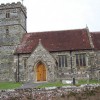
The parish church dedicated to St. Mary is a Grade I listed building. Pevsner says it is “The most important and interesting church in its neighbourhood…” and as such we will devote a separate article about in the future.

As the Edwardian period began Frederick Treves, the surgeon, was preparing his book Highways and Byways of Dorset. In it he uses Iwerne Minster to debate the advantages and disadvantages of picturesque old thatched cottages and red brick modern housing, in Iwerne Minster he could witness the transition being made. As he peered into the future to see what it held for rural village housing he failed to see what today’s home improvement experts can do with an old cottage or derelict barn. Looked at today we can see Iwerne Minster hasn’t faired too badly, there being a pleasant mix of the old and the new.

Arne

Arne stands on a peninsula between the Isle of Purbeck and Poole harbour. The parish is entirely rolling heath land with a farm and a small number of houses. It furthermore includes parts of the earlier Wareham Holy Trinity parish. Not spoilt for amenities, Arne has no shops, no public houses, nor restaurants in the village and motorists are encouraged to leave their vehicles in the car park and walk to the village – a distance of about half-a-mile. The car park serves the Royal Society for the Protection of Birds nature site, which surrounds Arne and attracts visitors interested in the rare birds who make this their home.

From about 948 AD Arne belonged to Shaftesbury Abbey and the church, built in the early 13th century, is dedicated to St. Nicholas and is attractively sited at the foot of a wooded hill. The architecture is Early English: a single cell structure comprising nave and chancel with a south porch where above the door are the remains of an early fresco. The upper part of the west end of the nave was partitioned off in the 17th century to make room for a bell gallery; Hutchins mentions a bell in this gallery having the initials: ID-RRT and the date 1625. There being no tower, the solitary bell cast in 1782 and replacing the original bell of 1625 hangs in the roof space. The heads of some of the windows were hewn out of a single stone. The East Window, being a triplet, dates the building at around 1220 AD.

The altar is made from a pre-Reformation stone, which was found buried outside, has five small crosses carved on it and sits on a timber frame. Near the altar is a piscine; probably original 13th century it has a acutely pointed head and round drain. There are several monuments and floor slaps inside the chancel area the oldest being a floor slab “to Mary, wife of Thomas Baker Jun., 1673/4.”

In the 3rd (edited) edition of Hutchins there is mention of a linen cloth embroidered with the emblems of the Trinity presented as a gift to the church in 1861 by William Wake, Rector of Holy Trinity. Arne had been a chapel of ease of Holy Trinity since the 15th century and earlier it had been a chantry.

Outside there are five buttresses all apparently added during a restoration in the 19th century.

Looking from the altar window of this ancient place, built all those years ago by the order of the Abbess of Shaftesbury, you can see across the heath land to the shipping roads and watch the modern day ferries majestically sailing to and from Poole harbour. The view is delightful.

The name Arne is derived from the Saxon ‘Aerne’ meaning a house or secret place.

Purbeck – Into the Quarries

“Carved by time out of a single stone” was how Thomas Hardy described Portland. Yet all of Purbeck can be regarded as a geologist’s bonanza, a chronicle of millions of years of the earth’s history set in stone. Small wonder then, that this “county within a county” should have become one of the country’s major centres for the quarrying and mining of aggregate and building stone.

The stone industry of Purbeck has been the economic mainstay of the ‘Isle’ for over 500 years. For Britain, and for the Empire through export, it has been a font of supply for several kinds of rock belonging to the Portland and Purbeck Beds. All these are part of the two uppermost-and youngest-formations of the Jurassic period, deposited between about 150 and 135 million years ago, when Dorset was sub-equatorial. The Portlandian was laid down in shallow, warm sea, which then regressed to leave a lagoon environment in which the Purbeck beds were then formed.

Although prehistoric man probably carried out very local quarrying for the stone, it was the Romans, particularly favouring the use of the decorative Purbeck Marble for their villas and tomb slabs, who first began quarrying on any significant scale. In ‘modern’ times the industry really took off during the Middle Ages; in the 17th century, too, stone was shipped from Swanage to London, where Wren employed it in re-building the capital after the Great Fire in 1666.

During the 18th and 19th centuries the Purbeck quarries reached their peak in manpower and production. It was at this time when a variety of stone used to build many of Dorset’s older cottages and homes was extracted from small local quarries now long since abandoned and overgrown. Sine transporting the stone overland was difficult and costly, the major quarries and mines were concentrated upon the coastal outcrops, where the stone could be transported away by sea.

As a focus for quarrying, nowhere else in Purbeck was more central or important than Swanage. This town became a centre for the mediaeval trade in limestone, where serious quarrying began in about 1700 and continued until the mid 19th century. This was the heyday of great stone barons, the businessmen who made their fortunes from the industry, George Burt, and John Mowlem being probably the prime movers. Swanage was built from stone in more ways than one; exports from the quarries secured its location and the prosperity of the Burt and Mowlem families. It was during this period too, that the quarry platforms in the cliff outcrops at Tilly Whim, Dancing Ledge, Winspit and Seacombe were cut.

Tilly Whim, Dancing Ledge and Winspit are all coastal quarry sites for Purbeck stone which has been used in a number of Buildings including Durlston Castle, Lulworth Castle and Swanage Town Hall.  The Tilly Whim Caves at Anvil Point are the most easterly of the coastal quarries and are thought to have originally been open-cast working which later shifted towards adit or drift-mining from galleries cut into the cliffside. A capping rock was blasted away so that the high-grade building stone, the Under Freestone, could be quarried out using wedges called “gads.” Galleries of about 3 metres by 8 metres were cut into the hillside, sometimes as far as 60 metres. To support the roof, quarrymen left pillars in the in-situ limestone or else built pillars from stone wasters. Blocks were lowered from the caves using timber derricks (whims) that loaded the stone onto lighters or barges which then trans-shipped the stone to an offshore cargo vessel in calm weather.

Similarly at Dancing Ledge Quarry, the stone was lowered to a large sloping ledge, and carried to a shipment point at the very edge. Here the trammels or ruts made by the carts or wagons, which moved the stone, can still be seen. Quarrying at Dancing Ledge ceased in 1914. Winspit is an area just below Worth Matravers on the south coast where large cliffside quarries have been opened on both sides of the valley. Stone working at Winspit began in 1719. The west quarry has a very large underground gallery, which was worked until 1953; the east quarry has square cut holes for crane positions still to be seen on the cliff top.

Seacombe is a large quarry excavated where Seacombe Bottom meets the coast. This was worked from the 18th century until 1923-31, when much investment in mechanisation took place. Stone was shipped from below the west end, and the foundations of the steam-derrick remain. Other quarries were opened between Durlstone Head and St. Aldhelm’s Head, from where the stone for the harbour walling at Ramsgate was shipped. At Durlstone, deeper beds were worked from underground “quarrs,” the stone being brought to the surface by a horse drawn capstan. There are also shallow quarrs in the country-park. In 1897 197 men were working in 58 quarrs. The last timber derrick to survive anywhere in Dorset can be seen at St. Aldhelm’s Quarry.

Away from the coast there have been extensive quarries in other Purbeck Beds outcropping over the high ground between Swanage and Worth Matravers, though Lychett Matravers to Acton. Purbeck Limestone is worked for aggregate in Swanworth Quarry (due for imminent closure) and Purbeck stone is still quarried in the Acton area west of Swanage, where the rock was formerly mined from underground shafts. Today good decorative stone is being extracted at Acton from open cast pits down to 10 metres. Corfe was formerly the centre for the quarrying of Purbeck Marble (which is not true marble but shelly limestone able to take a hard polish), but the trade no longer exists today.

While the stone native to the mainland has been of considerable commercial value, Portland’s limestone has probably been even more so, and not wholly for its infra-structural applications. This oolithic limestone has encased the gargantuan shells of Titanities, the largest ammonite to have inhabited British Jurassic waters, and which today is to be seen displayed in many of Portland’s garden walls. For centuries, man and nature have contributed to the island’s landscape, and there are features marking where the original landscape once stood.

Wren used Portland stone in the re-building of London, notably the new St. Paul’s, but it has also been applied in the re-construction of the capital after the destruction left by the last war. The old quarry gangs and their methods have almost entirely disappeared. The piers and jetties of the old quarries, from where stone has been shipped around the world, also have largely vanished, and some of the excavations have been infield; no derrick or crane now remains in the Portland Quarry. In Jordan Quarry the succession in the Portland Beds can be traced up to the overlying Purbeck in a sequence which the geologist can read like a book, and which reveals the climatic changes in the region 150 million years ago.

But today some of the Portland quarries have been given a new lease of life. Through a 1983 initiative begun by the specially formed Portland Sculpture Quarry Trust (PSQT) artists and sculptors have been coming to Portland to work creatively in response to the quarry environment. The Trust aims to forge links between the artists and the lives of the masons working in stone, enabling them to share and exchange knowledge and skills, rather than undertaking public commissions for works. This project has fostered much working collaboration over the years, including the creation of Britain’s first Sculpture Quarry in the now regenerated Tout Quarry. Works produced here include Anthony Gormley’s ‘Still Falling.’ and ‘Falling Fossil’ by Stephen Marsden. PSQT is further extending access through workshops. Since 1983 the experience of the Trust has been as appreciation of the importance of the personal aspects of people’s lives and their relationship to the landscape.

Happily, after decades of decline in Portland and Purbeck, something of the old landscape is making a comeback. Abandoned quarries and older sites are being restored to their pre-extractive agricultural state, often with no trace of the former activity in evidence. While the industrial landscape on Portland is being revitalised, in Purbeck nature is re-claiming the traces of an industry, which ranged from prehistoric bell-pits, through opencast excavations and thence gallery mining, to mechanisation and decline.

Monolith on Batcombe Hill

Above the village on Batcombe Hill, an area of outstanding natural beauty offering views over Somerset clear to the Bristol Channel, there stands an upright stone pillar a little under four feet in height.

This pillar, which is a monolith of hard oolithic stone, with fragments of fossils appearing on its surface, stems from a rectangular base, chamfered at the four angles, measuring about 7 inches by 8 inches, the longest sides facing to the east and west. It is difficult to make out but above this base runs a semi-circular moulding. Rising from this moulding is the major part of the pillar; its statistics measured by circumference being 34 inches at the lower part, 33 inches in the middle and 28 inches at the top of the shaft. The overall height is just 46 inches. These measurements were taken on the 16th of July 1889. Round the top of the shaft runs another semi-circular moulding similar to that at the base and it is topped off by a spherical capital.

This stone known as the Cross-in-Hand has been described as mystic, it has been suggested it could be the site of a harrowing murder or perhaps a miracle; on the other hand it may just be a mislaid boundary marker. It has been stated that a devotional cross once stood here and the pillar or stump is all that remains. No recognised authority has said what its purpose is or what it represents.

Nevertheless over the years it has attracted much interest. In his novel ‘Tess’ Thomas Hardy’s character Alex D’Uberville claims that the pillar is a “Holy Cross” but turn a few pages and a passing shepherd suggests to Tess “…’Tis a thing of ill-omen miss…”

In 1889 the Revd. C.R. Baskett related a legend, which he credited to a Mrs Cockeram “whose whole life was spent near Batcombe Hill, and whose memory was stored with Dorset legends.”

The legend has it that back in the middle ages, one dark and stormy winter’s night the Batcombe priest was called out to administer holy communion to a man close to death. Taking pyx and his service book the priest set off travelling through the storm across Batcombe Down to the sick man’s house. On arriving he found that he had dropped the pyx on the way and so he ventured forth back into the storm faced with the hopeless task of finding it.

Back on Batcombe Down he saw a pillar of fire reaching from heaven to earth and shining in the night. He could make out cattle kneeling in a circle around the pyx and the steady beam of light. According to Mrs Cockeram the stone is all that remains of a cross that was set up here. Hardy’s poem ‘The Lost Pyx’ is based on this legend.

Batcombe – The Church of St. Mary Magdalene

For the visitor a stop at the picnic area on Batcombe Hill will be a rewarding experience. This is an area of outstanding natural beauty with views over to Somerset; on a clear day you can see as far as the Bristol Channel including Glastonbury Tor. This wide-open space provides habitats for orchids and butterflies and there is woodland, hay meadow and heathland in abundance. At the foot of the hill tucked away under the northern slopes of the Dorset Downs, is the small agricultural village of Batcombe.

The Church at Batcombe is dedicated to St. Mary Magdalene and is to be found at the far (south) end of the village. As you descend into the village you will see the tall tower and if you are familiar with the local folk tale about ‘Conjuring Minterne’ you will not be able to resist looking at the pinnacles.

 In its heyday during the 19th century the parish population reached 200. Numbers declined to between 40 and 50 although we have been told by a long time resident of the village that recently there has been a “crop of children, mostly boys,” bringing the current population back to between 50 and 60.

There are indications that a church has stood on this site since the 11th century but the first recorded mention of the place tells us only that there was a rectory here in 1291 and that John Carls resigned as Rector in 1309.

Architecturally the church comprises chancel, nave and tower. The west tower was built in the first half of the 15th century and the nave and chancel built shortly after. In 1864 John Hicks restored the church and it was then that the chancel was rebuilt and the north porch added. Sacrificed during this restoration was the Minterne Chapel. The walls are of local rubble and flint with freestone dressings; the roof is tiled.

The chancel is modern except for the 15th century chancel-arch and a stone screen of similar antiquity. The pillar-piscina is 12th century and there is a fragment of stone in the middle south buttress of the chancel with pre- Norman Conquest interlacement, suggesting an earlier church at Batcombe. The modern roof incorporates some 15th century timbers.

The nave, approximately 35 feet, has in the north wall a 15th century window and doorway; there is a similar doorway opposite in the south wall which also has two similar windows. The partly restored 15th century roof of the nave is of collar-beam type with curved braces forming four-centred arches; the moulded principals and purlins have carved foliage bosses at their intersection. Beside one of the pews on the north wall is an ancient stoup.

The west tower is early 15th century and in three stages with an embattled parapet with pinnacles and gargoyles at the angles. There is a west window and on the second stage a north window of one pointed light. There is a two-light window in each of the walls of the bell chamber.

In 1827 there were four bells. One of the original bells was cracked and sold in 1864 the proceeds going someway to pay for the restoration work. A second cracked bell thought to have been cast in 1592 at Leigh by William Warre has been retained and presently rests in the intermediate chamber. The other two bells were melted down and used to cast a new bell in 1958. The new bell and the 1592 Warre bell were for some years on display in the Nave and in 1974 were stolen but fortunately recovered a couple of days later in Hampshire. The new bell now hangs in the ringing chamber and was first rung on 17th November 1974 and is still in use.

The altar cross was made by one of the parishioners in 2004 and the church has a new organ built by Brian Daniels of Crewkerne.

Within the church are memorials dating back to 1595 and include monuments to George Harris (1804), Ann his mother (1810), and John her husband (1826); John Minterne (1592); John Palmer, rector (1702-3); Thomas Beazer, rector (1734); Frances (Minterne), wife of Andrew Buckler (1648); John Minterne (1705) and Eleanor his wife (1716-7) and Ruth their daughter (1685). In the churchyard are memorials to Francis Stount (1685) and Sarah his daughter (1685-6). The oldest gravestone dates from 1680.

There are some legends about Batcombe the most intriguing being the legend of Conjuring Minterne, which tells us that one day as he was riding away from the village to Batcombe Hill he remembered he had left his book of spells open on his desk. Realising the dangers of someone dabbling with his magic book he turned back towards the village and with help from the Devil his horse leapt over the village in one gigantic stride. The horse’s hooves clipped one of the church pinnacles and it fell to the ground, Conjuror Minterne landed safely in a field near the church. It is said the pinnacle lay by the church tower for many years and it was believed it would bring bad luck to the village if it were replaced. But in 1906 it was restored and to this day it can be seen to be crooked. When he died Minterne left instructions that his body should be buried ‘neither in the church nor out of it.’ He was buried half in and half out of the Minterne Chapel.

William Wareham (1860-1961)

As the government announce plans to scrap the official retirement age and raise the age of entitlement to a state pension and scientists tell today’s children they can expect to live for over a hundred years, this is a good time to look back on the life of an ordinary Dorset man who achieved his century at a time when most would have settled for three score years and ten.

Born at Iwerne Minster in 1860 and baptised at the parish church of St. Mary, William Wareham was the third child of Benjamin and Sarah Wareham. His two older siblings were Sarah and Mary and he was followed by Lavina, Charles, and Richard. His father sent him to school for half-days and made sure he had a basic education and learnt the three ‘R’s.

Someone visiting him in his later years was surprised to find this labouring-man’s bookcase filled with the works of Adam Smith, J.S. Mills, Karl Marx, Engels, William Morris, and others. William would recall how, when he was eight-years-old, he worked twenty-eight hours a week for a clergyman who paid him one shilling. He told of having to mow a lawn on a blistering hot summer’s day while the house owners relaxed and played a leisurely game of croquet. The memory of the many social injustices, the hard work for meagre wages, the poverty and the hardship suffered by the working classes, particularly in rural areas, stayed with him throughout his long life. As he grew older he determined to expand his knowledge of politics and economics and was especially interested to learn how they affected agriculture and the rural communities that worked the land.

His father, Benjamin, told him of the time in 1848 when the common was enclosed and how he was one of those obliged to carry out the unpleasant task. William had much in his character that was in common with the thoughts and aspirations of those Dorset heroes known collectively as the Tolpuddle Martyrs.

In 1885 he married Anna Maria, the daughter of Frederick and Rebecca Coombes. William and Anna enjoyed nearly sixty-years together before Anna passed away in 1944. It was a further 17 years before William died in 1961. They are buried together in the churchyard at Iwerne Minster. They had a large family: Margaret (1887 married William Baker in 1913); Norah (1888); Charles (1888 married Ethel Burden in 1912); Sydney (1891); Ellen Mary (1892 known as Nellie married William Martin in 1913); James (1894); John (1896 married Edith Lewis in 1922); Annie (1898); Walter Richard (1901 married Florence Harvey 1926) and Robert (1903).

William by all accounts was not impressed by modern amenities. He shunned electricity, preferring his oil lamp and he would not have water connected to his home and used to get his supply from a nearby pump which dispensed pure spring water. He would have nothing to do with cars, wireless or television.

His garden was one of the best kept in the parish of Iwerne Minster where he lived for most of his life and which he tended right up to his death. At 32 rods in length – that is over 500 feet to you and me – it was more than a cabbage patch and he certainly couldn’t be accused of taking things easy or putting his feet up in his old age. William was an agricultural labourer until the late 1890’s when he became a roadman; in the 1911 census he is described as a road contractor.

William Wareham had an appetite for life. His life was straight forward and uncomplicated. He worked hard, was a teetotaller and a non smoker: things those of us approaching but wishing to linger a little longer outside of God’s waiting room would do well to ponder.

William & Hannah Part 3 – Separate Paths

When their eldest son William met with his fatal accident in May 1881 it is almost certain that William and Hannah Cheeseman (by then Chisman) were again living at Winfrith.  They were not however to resettle there immediately and within at most eighteen months they had again moved. 

William was once more hired as a shepherd, this time at Church Knowle on the Purbeck Hills, some eight miles to the west of Winfrith. Two years after the death of young William, Hannah bore her last child, a son, who was born at Church Knowle in 1883.  Hannah was by then aged thirty-five, while William was fifty-five.

It is known that at least one of his sons did not consider William to be a good father.  Indeed there is a suggestion that William was in fact a drunkard. When the Chismans were living at Blacknoll it is very possible that James Hibbs and William’s mother Amelia had been a restraining influence.  However, with their deaths that influence had ended and perhaps the material situation of William and Hannah had simultaneously deteriorated.  The move to Milton Abbas, the return to Winfrith and the further move to Church Knowle indicate a less settled state and family tensions could have been heightened by the death of the eldest son.

After the birth of their last child in 1883 matters clearly worsened.  Did an ageing William resent his younger wife’s energy?  Did a deeper resentment and memory of the circumstances of their marriage irritate him? Was he naturally a drunkard, or was he provoked by circumstances? Was he angered by some element in Hannah’s behaviour?  The questions readily present themselves, but the situation in the Chisman household remains hidden.  There is, however, one certainty:  William and Hannah were to part.
 
The date and circumstances of their separation are not known.  Perhaps it was after a return from Church Knowle to Blacknoll that Hannah left William, taking the children with her. Perhaps the family had moved to Portway at Winfrith and William had then deserted them.  All that is certain is that at some point before the end of 1890 Hannah found herself installed at Portway Farm with some of her children.  Hannah had become the head of the household and of William there was no sign.

Subsequent events sadly afford no reason for believing that Hannah’s separation from William was without animosity.  If the situation had been such that William had been forced out of the family home it would have been a very difficult episode.  In Victorian England the husband was (and was expected to be) the master of the household.   It is most probable that it was Hannah that had departed.  If so this would reflect her resolve and perhaps William’s condition.  It is possible that Hannah received help from her own brothers, one of whom is believed to have owned land in the vicinity.  (If any help had come from her brother John it would indeed have been an extreme irony.)

Even had she received support, Hannah nonetheless found herself with the responsibilities of a mother, married only in name and without the help of a husband.  Yet the relative positions of Hannah and William had changed and would continue to do so.  Since a disgraced Hannah had returned to Blacknoll some twenty years earlier the wheel had almost turned full circle.  Whatever William’s feelings had been towards Hannah at the time of their marriage, he must at least have seen that marriage as assuring himself of support and comfort in old age.  That was now a hope or expectation shattered.

Portway lies close to Winfrith village as it is approached from Blacknoll.  The beginning of 1891 saw Hannah at Portway Farm, with her eldest daughter Annie, then aged twenty-one, and her three remaining sons, aged fourteen, eleven and seven years.  Her other two daughters had left home, but one was working as a domestic servant at nearby Fossil Farm House.  It is clear that despite the adverse circumstances Hannah was coping.  It is even possible that without William she enjoyed a relative prosperity.  Perhaps at Portway Farm she was indeed a small tenant farmer.

William Chisman’s condition, however, was very different. Now in his sixties, he was probably living at Blacknoll, alone, and possibly finding it increasingly difficult to work to keep himself.  His final years were truly a period of decline. For a person alone, with no means and no family support, employment was imperative.  If through ill-health, unreliability or simply lack of employment William had been unable to work, then his situation was precarious.  It would seem that this was the path that William trod and eventually, unable to support himself, he entered his last haven before the grave.  By at latest the end of 1900 William was a pauper and an inmate of the Union Workhouse, Wareham, the very place where over thirty-five years earlier the seventeen-year-old Hannah Hibbs had given birth to her illegitimate son.

If William’s wife or children knew where he was, it appears there was no contact between them.  If he had not abandoned his family, they had certainly abandoned him.  William died on 23 January 1903.  He was aged seventy-six.  His body was not brought ‘home’ by his family, but was buried in a churchyard near the workhouse.  He had bequeathed his children only his name, Chisman.
 
Some years earlier Hannah had moved the short distance from Portway Farm to Fossil Farm Cottage.  There in 1901, as head of the household, she and her two youngest sons occupied four rooms.  Her sons were then young adults aged twenty and seventeen.  The elder worked as a ‘farm carter’; the younger as a farm labourer.  At least one of the two youngest Chisman daughters had already married.  Although Annie remained a spinster, she was no longer in the household.

In the next few years Hannah’s two youngest sons married and it seems likely that Hannah went again to live with her daughter, Annie, somewhere in Portway.   Certainly mother and daughter were both resident in Portway at the time of Hannah’s death.  Hannah, born ten years after Queen Victoria had come to the throne, lived on through the Edwardian years, dying just a month before the death of Edward VII.

Hannah died on the 29 March 1910. She was aged sixty-three.  Her death certificate records that she was the ‘widow of William Chisman, Shepherd’. 

Hannah had grown up at Blacknoll and spent much of her married life there.  Then after the brief periods at Milton Abbas and Church Knowle she had returned to Winfrith to settle finally at Portway, at the edge of Winfrith Newburgh village.  At the other end of the village stands the church where Hannah had been christened and married and which had witnessed the christening of all but one of her children.  Fittingly Winfrith churchyard became her final resting place.

Hannah’s grave lies inconspicuous, close by the lych-gate.  It is marked by a modest, but dignified headstone: a silent witness made poignant by knowledge of the life it commemorates.  The stone bears no reference to her husband William.

Princess Victoria’s Tour of Dorset

July 1833. Fourteen years before the first railway tracks are to be laid in Dorset, travel is by horsepower or by sea and at Weymouth the population is in festive mood, excited at the prospect of greeting a 14-year-old Princess who will one day be Queen. It was the start of a royal tour to acquaint the people of Dorset and Devon with the woman who one day would rule over the greatest empire the world had ever seen.

Guns were fired as her yacht appeared off St. Alban’s Point and as the ship dropped anchor off the Esplanade buildings and the royal party came ashore in the royal barge, Royal Salutes were fired

Princess Victoria’s home was Kensington Palace, but Norris Castle on the Isle of Wight was her summer base. Accompanied by her mother, the Duchess of Kent, the yacht “Emerald” was towed by a naval steam packet from Portsmouth. With the Princess was her adored King Charles spaniel “Dashy”. The Duchess was “dreadfully” sea-sick on the journey along the south coast, according to Victoria’s diary, which she kept assiduously throughout and which is today preserved at Windsor Castle.

The townspeople of Weymouth turned out and greeted their royal highnesses as illustrious visitors.  It seemed the whole population was proceeding from the King George III statue to the Quay. God Save the King was played as the royal party mounted the King’s Stairs used by King George III on his frequent holidays in the resort; they were then driven in carriages to the Royal Hotel facing the beach.

The following day after an official reception the princess and duchess travelled in a carriage to Melbury House in north Dorset to be entertained there by the Earl of Ilchester.  They were accompanied out of town by many of the inhabitants and a detachment of Lt.Col. Frampton’s Troop of Dorsetshire Yeomanry. Every prominent building in Dorchester was decorated with flowers, and there were flags waving and the sound of bells and cannons as horses were changed en route to Maiden Newton and Melbury, where according to Victoria’s diary they arrived at about 5 p.m.

A visit to Sherborne Castle had been suggested but did not take place. While at Melbury their royal highnesses ascended a tower and had the shapes of their feet cut on the leads. They enjoyed the park, the lake, the great house, and the church.

After a two-night stay the party was on the road again at 9.15 a.m. on August 1 to be “enthusiastically received” at Beaminster, where there were arches of flowers across the road. The carriage passed through the recently opened Russell Tunnel. The Dorset County Chronicle told of “spontaneous outbursts of enthusiasm” being received everywhere the royal party went.  This was at a time when there was pressure for a republic; it was the period of the Reform Act and agricultural disputes, which in a few months would become illuminated as several agricultural labourers from a small Dorset parish would emerge to become those Dorset heroes forever remembered as the Tolpuddle Martyrs.

At Bridport the ‘royals’ were given a hearty reception by the inhabitants but, according to Hine’s History of Beaminster, were angry that they were “not received by the Mayor and Corporation”.  Then onto Charmouth and Lyme Regis, where there were triumphal arches – and where the “Emerald” was waiting. Every boat in port was filled with paying spectators. Here, in 1685, the Duke of Monmouth landed to lead a revolt against King James II. Mayor John Hussey, in his public address, noted that the princess’s visit was taking place on the anniversary of the Protestant Succession to the throne.

Here, as she boarded the yacht, Princes Victoria was reunited with Dashy her dog. Sailing to Torquay, she remarked on the beautiful coastline and cliffs but both she and her mother were sick on approaching Torquay. From there, after an overnight hotel stay it was off by sea to Plymouth for several days in Devon.

On August 7 an informal return trip was made by coach, changing horses at six places including Bridport and Dorchester, with a military escort from Winfrith to Wareham and Swanage. Passing Corfe Castle, the princess noted in her diary some of the climactic events in history that had taken place there. The reception at Swanage was unforgettable for the young princess, and she must have been sorry to leave Dorset as she embarked with her mother on the “Emerald” for “dear Norris.”

It had been close on six weeks of strenuous activity since they left London. The ‘Royal Progress’ was one of a number leading up to the crowning of Queen Victoria. When that happened, exactly five years after her tour of Dorset, the county must have been proud to have been part of the grand design.. In Sturminster Newton, Gillingham, Cerne Abbas, Sydling, and Evershot, there were demonstrations of loyalty on the occasion of the “beloved Queen’s” coronation, but most of all perhaps in those communities the Queen had visited as a girl. Celebratory dinners were held in Ilchester and Lyme Regis, and at Dorchester there was a ball and much merriment at the King’s Arms and a gathering at the Antelope Hotel and a band wound its way around the streets.

Residents of an almshouse in South Street were regaled with roast beef, plum pudding and beer. At Weymouth, meanwhile, all the shipping in the Bay and Portland Roads was gaily attired and there was a procession along the Esplanade. Along the coast at Poole no less than 2,000 Sunday school children gathered for a “substantial dinner”, while vessels at Bridport Harbour were dressed overall.

Victoria, who first learned of her destiny at the age of 10, moved into Buckingham Palace. Her marriage to Albert was to come. She served as queen until 1901, becoming Empress of India in 1876, creating a new ceremonial style of monarchy, with social rather than political emphasis, and thus preserving it, and giving her name to a whole new age of modernism and expansion.

Notes: Extract from Dorchester’s Municipal Records relating to this story:

1833: Aug 2nd. Locket, for ringing on occasion of the Duchess of Kent and the Princess Victoria passing thro’ Dorchester (Per order of the Mayor) £1.0s.0d.

Paid Oliver, Churchwarden of The Holy Trinity (Per order of the Mayor) expenses incurred on the above occasion £1.17s.0d.

William and Hannah Part 2 – Marriages of Circumstance

On 13 December 1864, Hannah Hibbs gave birth to a son. The child was named Frank Edwin Hibbs.  The birth took place in the Union Workhouse at Wareham.  The child’s father, Hannah’s own brother, John, had also left the family home, but his circumstances were very different from Hannah’s.  Five months earlier, in July 1864, John had married.

The workhouse had provided a refuge for Hannah, but she could not remain there indefinitely. What was to be become of her and her child and in what manner did Hannah’s situation exercise the mind of her father?  He had lost the benefit of her services in the cottage, but did he want her to return and could he let her do so?   Her absence from home would have been evident to neighbours and the reason apparent.  Moreover, any attempt to conceal the paternity of Hannah’s child would not have prevented speculation among the Blacknoll community.  Yet Hannah was to return to Blacknoll.

The sequence of events that unfolded over the next three years is unclear. However, early in 1867, just two years after the birth of Hannah’s child, the Hibbs’ neighbour Jonathan Cheeseman died, aged seventy-four. Perhaps James Hibbs and the newly-widowed Amelia Cheeseman were already on friendly terms.  Possibly James had confided in Amelia and sought her advice about Hannah.  Whatever the nature of their previous acquaintance, following the death of Jonathan a closer relationship developed between them.  It would not have been unreasonable for James and Amelia, widower and widow, to have sought mutual solace and support.

It is not known whether Hannah had by then returned to Blacknoll, with her child.   However there can be little doubt that she was the subject of discussion between James and Amelia and it is not unlikely that it was Amelia who proposed a remedy to Hannah’s predicament.  Whether Amelia took the initiative or whether the proposal arose in another manner, Hannah’s situation was to be resolved.  She would marry Amelia’s son, William Cheeseman, a bachelor twenty years Hannah’s senior. William had first encountered Hannah as a young girl or at latest when she was just adolescent.  He would have seen her grow into a young woman.

For William the prospect of entering his later years alone, without help or companionship, must have been unwelcome.  Perhaps his nature had prevented his marrying previously; perhaps a lack of opportunity. Yet even had he felt strongly the wish to marry, could he in normal circumstances have contemplated marriage with Hannah or, importantly, she with him?  But circumstances were not normal and Hannah’s feelings towards William and marriage were probably of little account.  Practical considerations would have prevailed.  . 

William and Hannah were married at Winfrith on 6 August 1868.  Hannah was aged twenty and William was forty (though on the marriage certificate claimed to be only thirty-seven).

Their marriage was not the only one to take place in Winfrith church in that summer of 1868.  Exactly one month later, on September 6, Hannah’s father, James, and William’s mother, Amelia, became man and wife.  James was sixty-seven years of age and Amelia was seventy.  The witnesses at the marriage ceremony were their newly-married children, William and Hannah.

William and Hannah set up home at Blacknoll.  Hannah, long used to domestic chores and living in a male household, was perhaps better prepared than William.  The latter now found himself in an entirely new situation as head of a household and with a young wife.  He also found himself with a stepson.  More than that, it was the child of his wife’s brother, a younger man well-known to William and a man whom he would continue to encounter.  Some sense of resentment on William’s part would be understandable.  It is not impossible that this might have reinforced any feeling he harboured that Hannah was indebted to him for having rescued her from her plight.

William Cheeseman began his married life in a less uncertain world than that into which he had been born.  In 1837 the young Victoria had come to the throne and by the second half of the nineteenth century Britain was a confident and prosperous nation.  Not every citizen, however, shared in that prosperity. Life for agricultural workers remained far from idyllic.  Employed as a farm labourer, William would have led a relatively hard working life for poor wages and would have been fortunate if he enjoyed security of employment.  It is possible that the Cheeseman’s situation had been eased if, as seems probable, William’s elderly father-in-law, James Hibbs, owned or rented a little land, which through subletting or exploitation, would have augmented meagre incomes.

In July 1869, within a year of their marriage, William and Hannah had their first child, a daughter, Amelia Annie, known as Annie.   A year later Hannah gave birth to a son.  He took his father’s name, William.  By 1878 a further two daughters and a son were born to the couple.   Surprisingly perhaps the Cheesemans’ younger son was given the name John.  If William had felt antagonism towards Hannah’s brother, would he have allowed his own son’s name to remind him of John Hibbs?   Meanwhile, however, Frank, the child of Hannah and John, had left the Cheeseman home to live with his own father and his stepmother.

Interestingly, in this period the surname of the family was evolving. In the church records the children remained Cheeseman, while in the civil records the family name had become Chisman.

This period also saw the passing of the older generation.   In December 1875 Hannah’s father, James Hibbs, had died and was buried at Winfrith. He was aged seventy-five.  He and Amelia had enjoyed seven years of marriage.  Widowed for a second time, Amelia lived only a further eighteenth months and died in June 1877, aged seventy-eight.  She too was buried at Winfrith.

Then, sometime between the latter part of 1878 and early 1880, William and Hannah moved with their children from Blacknoll to Higher Hewish, in the parish of Milton Abbas. It is possible that the deaths of James and Amelia changed the circumstances of William and Hannah; possibly releasing them from an obligation of care, possibly removing from them the use of land.  At Higher Hewish William took employment as a shepherd and probably received better wages than he was getting at Winfrith.   The family had earlier connections with Milton Abbas, where Jonathan Cheeseman had once worked, and the choice of Higher Hewish was probably determined by the fact that William’s half brother also worked there in that period.

At Milton Abbas in December 1880 Hannah bore another son, George. Any joy at the birth of a further son was to be short lived.  A few months later, in May 1881, the Chisman’s eldest son, William, was killed in an accident in which he was run over by the wheel of a coach.  He was just ten years old.

At that time child mortality through illness or accident was high, but that fact would have been of little comfort to the family.  The children had lost a brother; and Hannah, having just brought a son into the world, saw another taken from her.  William too could not have been indifferent to the death of his eldest son and namesake.
 
Young William’s fatal accident took place at Winfrith, suggesting that the family had returned there; a suggestion reinforced by the fact that William was once more working as a farm labourer.  It is possible that the Chismans had never intended to stay long at Higher Hewish.  It is equally possible that William had been hired there for a fixed period and that for some reason was not re-engaged.

Whatever circumstance prompted the return to Winfrith, events of the ensuing years would suggest that all was not well in the Chisman household.

To be continued……..