Dorset Ancestors Rotating Header Image

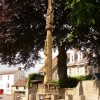
Stalbridge Cross

Stalbridge, in the Blackmore Vale near to the county boundary with Somerset, is a largish rather ordinary town but it does boast a very fine market cross. The date of which is open to question with some over romantic legends placing it as early as 1309 but the stories don’t fit with historical fact; we prefer to go with the establishment view that is it of the late 15th century. Unlike many similar monuments Stalbridge’s Cross survived the Civil War intact but in the end old-age did for it. During a storm in the winter of 1949-1950 bits of the cross head crumbled away and fell off.The cross head we see today is a restoration.

Carved out of limestone from Marnhull or Todber it stands 30 feet tall. The octagonal base has three steps above a chamfered plinth, the top step supports a square pedestal with moulding capping, the corners having been partially chamfered to give it an octagonal appearance. The tapering shaft is octagonal with pinnacles: each pinnacle has a finial at the top. A corbel from the west face of the shaft supports a carved figure but the weather of centuries makes it unrecognisable today. The shaft is crowned by a capital in the form of four winged figures grasping shields. The modern replica cross head has a canopied recess containing a representation of the crucifixion. Pevsner observes “it must in its day have been a splendidly rich piece.”

The market place was the centre of all town life and the market cross the centre of the market place. John Wesley says in his journal from the 18th century that he preached at Stalbridge Cross and tells us his followers were pelted with mud and filth, though Wesley was unharmed.

From here the Bailiff of the lord of the manor would collect tolls for the live and dead stock, butter, eggs, blue veined cheese and poultry sold at the weekly Tuesday market. The market was held by permission granted to the town in the 12th century by the Abbot of Sherborne. The town used to have two fairs: on April 16th and August 24th and these would have been announced from the market cross, as would news of major national events. The fairs died away and the market struggled on into the 20th century before transferring to Sturminster Newton.

In 1918 Lord Stalbridge sold-off all his interests in the area. The market cross was transferred to the parish council for one-shilling after some minor repairs had been carried out by a local craftsman, Mr Jeans.

The market cross at Stalbridge is one of the finest examples of its type in the country.

We have placed a photograph in the gallery section.

William and Hannah Part One – A Family Affair

Jonathan Cheeseman was an agricultural labourer, sometimes shepherd; a man of little substance. He was born in 1794 in the Dorset village of Litton Cheney, but even before his marriage in 1817 he had embarked on a series of moves from parish to parish in a small area to the east of Dorchester.   It was there, at Tincleton, in the summer of 1821 that Jonathan’s wife died.  His feelings on the loss of his wife after just four years of marriage were threaded with concern.  How could he both work and care for his two young sons left motherless?

Whatever the immediate solution, Jonathan’s situation was relieved when two years later he remarried.  His second wife was Amelia Vincent, some four years younger than Jonathan and aged about twenty-five at the time of their marriage in May 1823.  Within a year Amelia bore Jonathan a daughter.  Four years later, in 1828, Amelia gave birth to a son, William.  Unsurprisingly William would in due course become an agricultural labourer like his father.  He too at times would work as a shepherd.

As the previous century had approached its end many rural communities had begun to lose their stability. Changes in agricultural practices and mechanisation meant that Jonathan had grown up at a time when rural labour was becoming a commodity and agricultural employment increasingly insecure.  This insecurity combined with falling wages, brought social unrest and discontent to the countryside.  Jonathan’s periodic changes of home and employer possibly owed something to his temperament, but almost certainly owed as much to the conditions of his time.

At William’s birth the Cheesemans were living at Piddletown, but shortly afterwards they moved to Tolpuddle, where in 1830 Amelia had a second daughter.   It is not improbable that the family was still in Tolpuddle during the historic events there in 1834 and possibly was acquainted with one or more of the “martyrs” or their families.   Where the Cheesemans lived in the years that immediately followed is not known, only that they were included in the Athelhampton 1851 census, but finally they settled at Blacknoll at Winfrith Newburgh.

Blacknoll lies to the north of Winfrith village, at the edge of what was then a tract of wild heath.   As the land rises towards the modest height of Blacknoll Hill, there is a scattering of cottages, a few forming a row. They housed a close-knit community; several families representing a large proportion of its number.  It was for the most part a community of rural labourers and their families, largely uneducated and poor.  Many of the cottages were small, one-up-one-down dwellings that sometimes housed a family with perhaps half a dozen children.  A few of the Blacknoll families owned or leased small parcels of land, but if the inhabitants of Blacknoll were not in the desperate plight suffered by many people, this was a place untouched by prosperity.  Poverty in the countryside was acute and the produce from a garden or the benefit of additional occasional work could make a critical difference to the household economy.  

Already established at Blacknoll was the family of James and Hannah Hibbs, both of whom had their roots in Winfrith. Like Jonathan Cheeseman, who was his senior by seven years, James Hibbs, was an unschooled agricultural labourer and for the Hibbs, as for the Cheesemans, daily existence was simple and rude.
 
It was in May 1823 (just forty-eight hours before the marriage of Jonathan and Amelia Cheeseman) that James Hibbs had married Hannah Cox.  Their first child arrived within months of their marriage, but probably died in infancy.  Almost seven years elapsed before the birth of their next known child.  While it is not impossible that James Hibbs had been absent from home for a significant period, it is more probable that in the intervening years there were other children, untraced, who also had died as infants.  However, even if seven years of the marriage had been barren, Hannah then gave birth with a remarkable regularity.  In the years 1830 to 1844, she bore three daughters followed by five sons (one of whom died in 1845 at the age of four).

Then, after over twenty-four years of marriage, Hannah gave birth to her last child.  It was a daughter, who was baptised at Winfrith on 3 October 1847.  The child was given her mother’s name, Hannah.  Sadly the mother did not live to see her new daughter grow out of infancy. At the end of 1849, at the age of forty-three, Hannah, James’ wife, died.  The young Hannah was just two years old.

If initially the task of running the household and of caring for Hannah and the youngest of her brothers fell to one of the elder Hibbs daughters, it was not for long.  By 1851, before Hannah was yet four, her sisters had left home, leaving James Hibbs inhabiting the cottage with his four surviving sons, aged between six and sixteen, and the three-year-old Hannah.  It is difficult to speculate on the situation that prevailed in the Hibbs household and on the conditions under which Hannah spent her childhood.  She received at most a perfunctory education and she remained illiterate (in contrast to her mother, who could at least write her own name).  In these circumstances the freedom of childhood was short for Hannah and she was soon introduced to household chores.

In the next decade two of Hannah’s brothers left home and in 1860 her second-eldest brother died at the age of twenty-two and so by the end of 1860 there were just three persons in the Hibbs cottage, as there were in the Cheeseman household.

Jonathan and Amelia Cheeseman, aged sixty-six and sixty-two respectively, were living with their son William, aged thirty-three, but unmarried.  William was then working as an agricultural labourer.  Nearby the fifty-nine-year-old widower James Hibbs was living with his son, John, aged nineteen and his daughter, Hannah.  Although only fourteen, Hannah had long become accustomed to looking after the house and the two men.  A little over three years later the Hibbs household was to be the setting for an event that would shape not only Hannah’s life, but also that of William Cheeseman.
 
In the early part of 1864 Hannah, sixteen years old, became pregnant.  For a young woman in Hannah’s social situation her condition would have been as much a matter of practical concern as of shame.  For families living near subsistence level a pregnant daughter and then young mother would not have been welcomed and the child represented an extra burden, another mouth to feed.  The parish too would take an interest.  An unmarried mother and her child could become a drain on the meagre parish chest and an attempt would be made to discover the identity of the father and to ensure that he took responsibility for maintenance.  In many cases, of course, the imminent arrival of a child provoked a marriage (usually with the father if he were in a position to marry).  This solution, however, was not available to young Hannah.  The father of her child was her own brother, John.  At the time he was twenty-one years of age.

What was the relationship that led to Hannah’s pregnancy?  While it is not impossible that the young woman encouraged her brother, or at least did not object to his attentions, it is more likely that John simply forced himself upon her.   It is possible that this was a situation that Hannah had endured or accepted for some years.  However, such speculations are of little value. What was important was the situation and its repercussions.

Hannah was sent to the Union Workhouse at Lady St. Mary, Wareham.  In that institution, isolated from her family and community and among strangers, mostly paupers, some insane, Hannah, then just seventeen years old, awaited the birth of her first child.  Her immediate apprehension was compounded by thoughts of the bleak prospect that lay before her. She had slipped even from her lowly place in society and she would have been aware that many young women in her position would face a future of misery and abuse, always at the mercy of others.  In addition the child she carried was her own brother’s.

What were Hannah’s feelings towards her brother and father?  Did she feel resentment?  Did she feel abandoned?  Whatever her thoughts and feelings, they were at that moment all she possessed.

To be continued…….

Lyme and Christchurch – A Comparative Study of Dorset’s Bookends

One interesting aspect of studying towns is how the local geology can so often influence their development. This can be expressed either in topographical terms or in economic terms (such as earth resources providing the raw materials for certain industries.) Dorset furnishes us with a quite unique example in the pair of towns marking the extreme western and eastern ends of the county along the south coast. Lyme Regis and Christchurch could be regarded as the county’s bookends, though they are very different in character. And this distinction can be explained as a reflection of the stark contrasts in the nature of their terrains, or geology of their environments.

Lyme’s position in the west of the county has always meant that its growth has been subject to some restraint because of the hilly nature of that part of Dorset. The precipitous relief is mainly due to the presence of the hard Liassic limestone of the Jurassic period, which underlies and encompasses the town. Indeed, the road running north-west in and out of Lyme has a mean gradient of about 1 in 3 and takes several sharp turns to avoid even steeper slopes.

On the other hand, Christchurch has grown up within the much more open and gentler terrain of east Dorset, underlain by much younger and softer sands and clays of the Tertiary era. This area if not one of steep hills, valleys and coombes, but of a flatter landscape giving rise to marsh, water meadows and the infertile acid heathland extending behind Bournemouth and Poole and into the Isle of Purbeck. Settlement here therefore has never experienced the topographical restraints of the west and so easy communications and access have given free reign to the growth of Christchurch as a populous resort.

Lyme Regis and Christchurch have of course a seaside situation in common and both are, for that reason, unable to expand southwards. But whereas there are no obvious or insurmountable barriers to the growth of Christchurch in the other three directions, this is not so for Lyme. Today this town is a Mecca for tourism of a predominantly thematic nature, a specialisation which has more to do with what the local rocks contain than with any difficulty of access their topographical expression may present.

The Liassic strata which outcrops in the west Dorset cliffs literally teems with thousands of fossils, principally the remains of ammonites and marine reptiles. These vestiges of Dorset’s remotest antiquity have made Lyme a honeypot for scientists and fossil collectors for over 300 years, and today the damage and erosion arising from this intensity of casual collecting is greater than ever. Because of this immensely important resource for scientific enquiry, the cliffs at Black Ven and Charmouth near Lyme form the western extremity of the internationally important Heritage (or Jurassic) Coast SSSI. This makes the town effectively Britain’s, if not the world’s capital of ‘fossil tourism.’

Yet it is these same cliffs which are impacting on Lyme’s prospects for growth in other ways. The hard limestone bands throughout the Lias deposit which are responsible for enclosing the town with steep slopes are interspersed with soft unconsolidated clays which, when waterlogged, can easily propagate landslides. Landslips, particularly the major Downlands slip of 1839 are clearly in evidence along the urban shoreline and such is their instability that they cannot be built upon, so constricting any development eastwards and westwards, as well as to the north. In addition, sea quarrying of the Lias Ledges in the early 19th century contributed yet more to the damage of the coastal sections.

As might be expected in a hill-rimmed coastal situation, evidence of Lyme’s prehistoric past is scanty. Some New Stone Age artefacts from around 3,500 BC have been found locally, and the Romans built a villa at nearby Holcombe to be closely associated with their road (now part of the A35.) The first documented reference to Lyme is from 744, referring to a manor and salt rights. Following an initial prosperity as a medieval market and trading port, it suffered a near catastrophic recession, contraction, and de-population from the mid 17th to the early 19th century, when it recovered, through the Victorian fashion for bathing and drinking seawater. Today the town is a fashionable retirement centre, where visitors and incomers regularly outnumber the long-established population by four or five to one.

One peculiarity of the old town – seen in Coombe Street – does owe its origin directly to the serious shortage of land and cramped site conditions in the borough. This is a drangway or narrow public passage giving access to courts or cottages behind, and has encouraged much of the haphazard planning favoured by modern landscape architects. It is also significant that Lyme was inaccessible to wheeled traffic until the opening of the turnpike road in 1759.

By contrast, Christchurch is in a very different league. Here there are no high cliffs or hills sheltering the town from inland. The soft underlying tertiary strata is poorly exposed and lacks the spectacular fossils of the kind that would arrest the interest of the casual collector. Instead, the town has grown up in the midst of extensive marsh and water meadows created by confluence of the Stour and Avon, which form a natural, though not inexceedable, boundary to the borough.

Not surprisingly, evidence of prehistoric settlement at this site is far richer than at Lyme and includes Old, Middle and New Stone Age implements extending back at least 12,000 years. There are also indications that the harbour was already in use as a port facility in prehistoric times. On the south side of the harbour is the promontory of Hengistbury Head, a further very significant site of early prehistoric activity. Here on this headland of grasses and bushes growing in orange-yellow sands prehistoric people constructed a double dyke across the neck of the promontory and appear to have operated a crude flint-tool industry, leaving their wasters for today’s archaeologists to find.

Just as Christchurch is richer in archaeology, so accordingly is it in the raw resources for home grown industries. For instance, on the eastern slopes of Hengistbury Head the sands contain a formation of ironstone in the form of ‘doggers’ formerly quarried and sent to Beaulieu to be smelted into iron fittings for naval ships. Removal of many of the Hengistbury doggers and boulders from the foreshore however, encouraged a problem of coastal erosion until quarrying ceased once it became unprofitable. The now abandoned ironstone pit has been flooded to create a scenic wildlife lake.

The configuration of its coastline and the presence of a long harbour also made Christchurch as favourable to 18th and 19th century smugglers as Lyme, and fishing was still important in the 19th century, as was working on the land, brewing, glove-making, hosiery and making watch chains.

The two rivers of the Frome and Avon have provided water-power for driving mill wheels, and are also noted for their salmon catches and farms. The absence of prominent hills makes the district favourable for aviation, as at nearby Hurn airport.

Robert White (1775-1807)

On the night of the 18th of November 1806, five men assembled in a house at Corfe Castle where they blackened-up their faces and hands, disguised their clothes and armed themselves with bludgeons and a gun. At about one o’clock in the morning they broke into the home of 79 year-old Robert Nineham, a yeoman farmer and his son, and burst into their bedrooms and also the maid’s room, threatening them all with “instant death” if they did not lie still. They then proceeded to break open a bureau and several boxes and stole one hundred guineas in gold, bank notes to a value of seventeen pounds, a watch and a gun.

The house where they met was the home of Robert White and his wife Sarah and their children. Three of the other men lodged with White and were strangers to Purbeck. All the men worked on the railway being laid on a route from the clay pits to the sea.

The men were quickly apprehended and much of what was stolen was found still in their possession. Later they were brought before Sir T.M. Sutton a Judge sitting at Dorchester. The charge against them: “burglariously breaking and entering the dwelling house of Robert Nineham, of Hurpson in the Isle of Purbeck.” After a trial lasting five hours all five were convicted of the crime.

Robert White was the first son of William and Grace (nee Hinton) White who married at Corfe Castle on the 15th of February 1774. Robert was baptised on 17th of December 1775 and his siblings were: George (1777 who died in 1779); Martha (1779); George (1782); Mary (1784 who survived for only four months); Sarah (1785); Betty (1788); Mary (1790); John (1793) and Charles (1796). William White was buried on 13th of July 1820 at Corfe Castle aged 67 years surviving his wife; Grace, by three years; she was buried on 3rd of June 1817 and was also aged 67 years.

Robert married Sarah Keats on the 28th of August 1798 and their first child, a daughter (Jane), arrived four months later and was baptised on 23rd of December 1798. Their second child, another daughter named Mary Ann, was baptised on the 17th of August 1800, her short life ended in 1811. The first son, John, was baptised on 30th of September 1801 and another daughter, Harriet, was baptised on the 5th of August1802 but she died fifteen months later. Their younger boy, George, was baptised 26th of October 1804.

From this distance it is impossible to tell who the ring-leader was and if our Dorset son was led astray by visitors from other parts. It seems inconceivable though that his wife would not have known the errand he was on that night; but did she encourage him or attempt to dissuade him. He was bringing in a wage supplemented by whatever the three strangers paid him for lodging so it is unlikely the family was on the bread-line. If greed was the motivation he and his family paid a high price for his involvement in this venture.

According to reports at the time the Judge, in passing sentence of death on the men, did so “in the most impressive manner”. He pointed out to the men the great enormity of their crime and that it was all the more serious because of the aggravated circumstances they used.

Judge Sutton said “that in the interests of public justice and the security of private property he could not give them the least hope of mercy” and he entreated them to “employ the short time allotted them in this world by the most sincere penitence, in endeavouring to obtain pardon from that Almighty Being, in whose unfathomable wisdom mercy can be reconciled with justice”.  At the time it was noted that the behaviour of the prisoners “during the time of their condemnation” was very penitent and it was said they acknowledged the justice of their sentence. As it happened two of the men, George Walker and Thomas Wright were “respited a few days before the execution”, which we take to mean they were granted a “stay of execution”.

Robert White, John Alexander (30) “of a good family and is unmarried” as also was Thomas Gibbons (27) were taken from their cells at about one o’clock to the place of execution being the New Drop, on the ledge of the castle at Dorchester, where on Saturday, March 28th, 1807 they were “launched into eternity”. They were the last men to be hanged in Dorset for house-breaking.

This story ends on a poignant note. Sometime in November of 1806 Robert White and his wife Sarah conceived another child who was born about five months after her father’s execution. She was named Caroline and baptised on the 23rd of August 1807.  Her life was short, as she died in March 1820.

Maiden Newton

Is it a very large village or a very small town? There does not seem to be universal agreement on this point. Even today Maiden Newton remains something of a backwater. In the Dorset edition of Pevsner it is condescendingly described as “…a townlet with nothing to show for itself except the weathered remains of a once fine late medieval market cross.” However, based on the criterion that a settlement must possess at least one cinema to qualify as a town, then Maiden Newton probably does not, though it had – and still has – home-grown industries of its own.

Maiden Newton was founded at the confluence of the Hooke and Frome rivers, when what was then the main road north-west from Dorchester passed near the point. The discovery of a Roman tessellated pavement appears to have been the earliest evidence of settlement in the area until the early medieval royal charters established the rights to hold fairs. The unearthed Roman floor portrayed Neptune slaying a sea monster.

One of the earliest documents relating to Maiden Newton was a grant issued by Henry III to Geoffrey de Insula, conferring the right to hold a fair at the ‘Manor of Neweton’ until the King came of age. Another charter of Henry III dated 12th of December 1242 was issued to William de Insula as “a mandate to the Shire of Dorset to proclaim a fair and desire it to be held.” A further document states that Bartholemew de Insula, deceased, had held the manor of Maiden Newton, while Elizabeth, widow of John Lisle, was holding Maiden Newton in 1431.

In the 16th and 17th centuries the pasture around the village was converted to water meadows to cultivate an early crop of grass for sheep and cattle by preventing freezing in winter. The meadows occupied about 4.2 acres and are now about 200 years-old, being bounded on three sides by rivers and a railway on the fourth side. The nationally rare moth Blair’s Wainscott is locally abundant, and the water meadows are a haven for other wildlife.

The Church of St. Mary stands at the end of the parish and is built of stone in the Perpendicular style. The square, central, embattled and pinnacled Norman tower with six bells survives, one bell bearing a 17th century inscription. A Norman door with zig-zag décor also survives, but much of the rest of the church is 15th century. A decayed door in the blocked Norman doorway is said to date from 1450, making it one of the oldest in England still hanging on its original hinges.

The living includes 122 acres of glebe (church) land and residence. Registers began in 1555. There are also Wesleyan and Congregational chapels in the village. It is noted that following the outbreak of the Civil War, Charles I made a brief stay at the Rectory, and it was at this time that St. Mary’s acquired the unusual distinction of sustaining the first of what would be two sets of bullet holes from two wars 300 years apart.

Other early buildings in Newton were the Mill, and the White Hart Inn. This 17th century hostelry was a magnet for travellers and tourists, but the people of the village were unable to save it from demolition. In its day it had two storeys with dormers in the thatched roof, windows with stone mullions, and a gateway leading under the house to the stable yard. The medieval market cross, put up to mark the market area, with its square base, squarish stem and carved, weathered figures on the west face has since been moved a few yards from the middle of the road.

However, it was during the 19th century that Maiden Newton really took off in growth in size and importance. By this time it was a sprawling, not particularly pretty place with rambling streets and a somnolent air, but still one having known excitement. Its importance may have declined when the new road from Dorchester along the ridge to the east opened, had not the railway movement layed a branch of the Bristol to Dorchester line through Newton, en route to connecting Bridport.

In 1841 a National School was opened, eventually enlarged to take 200 children in 1865 and 1870. By the end of the century Maiden Newton had a railway station, police station, congregational chapel, iron foundry, cattle market and three branch banks. The old Mill was converted into a carpet factory, which was closed in 1970. Apart from pasture, Newton’s gravely soil has supported crops of wheat, barley and oats.

The impact of the railway on the demographics of this 2,854-acre parish is reflected clearly in the century’s census returns as follows: 1851: 345; 1861: 844; 1871: 856; 1891: 694. After falling to 557 in 1931, the population reached its maximum of 940 in 2000.

But Maiden Newton has one other claim to fame – as a place where, in 1952, a Royal train bearing the as yet uncrowned Queen Elizabeth II made a night stop-over on her first tour of the west country. Although the stop was not intended to be a public visit, but secret, the Parish Council obtained permission to present the Queen with an address of welcome. Today, all that remains of the line that train ran on is the track-bed, which can still be followed as a country walk south-west from the station.

Oh, those other bullet holes in the church? They were put there during the last war when a German fighter fired upon the Church, penetrating the altar window.

Pamela Digby

It is interesting to note how widely those of Dorset origin destined to be famous will eventually travel in the course of their lives. But who would have thought that a girl from a Dorset family, born 90 years ago, would have risen to such a high position in society as to become our most famous prime minister’s daughter-in-law and, ultimately, nearly the most influential non-American ever in US politics? But this indeed was the remarkable destiny of Pamela Digby.

Pamela Beryl Digby was born on March 20th, 1920 into the aristocratic Digby family of Minterne House, Minterne Magna, above the Cerne valley in rural mid-Dorset, a manor which the family had held over many generations from about the mid-16th century onwards. Pamela was the eldest of the four children of Edward Kenelm Digby (the 11th Lord Digby, Earl of Minterne) and Lady Pamela Bruce, being therefore baptized in the name of her mother.  Later, Minterne House would become the seat of her elder brother, who became the 12th Earl.

Pamela was educated through private tuition, and then at the instigation of her mother gained a qualification in domestic science. Following a year at a continental finishing school to round off her education, she settled in London for The Season of 1938, was presented at court, then landed a job as a translator (she spoke fluent French) with the Foreign Office. Her Dorset roots, however, may have lain behind the remark she is reported to have made to the high-society women of her inner circle in those early years: “I felt a real country bumpkin”.

But then in September 1939 on the outbreak of war, a phone call became the lynch-pin ratcheting Pamela up the society ladder several rungs at a time and changing her life forever. The caller was Winston Churchill’s son Randolph, then a 28-year-old army officer. Churchill had in fact intended to invite an absent friend of Pamela’s out to dinner, but Pamela instead took up Randolph’s invitation and went in her place. Mutual attraction must then have gone into overdrive that night, for just two weeks later the pair announced their engagement. Churchill Jr married Pamela on October 4th that year.

But from early on the marriage of the younger Churchills was in trouble. In the spring of 1940 Pamela’s father-in-law became Prime Minister and invited her to live in at 10 Downing Street, though it could be said that the reason was not entirely familial. By this time Pamela was pregnant and with the Blitz about to break upon London the move was probably more out of concern for the expectant mother’s safety. And it was here, taking refuge in the cellars of the PM’s London home that Pamela saw out the worst of the bombing in relative security. Her son Winston Jr, the future Conservative MP, was born at Chequers that October.

With the help of Lord Beaverbrook Pamela later secured a position at the Ministry of Supply. She was then 21 years old, but was already about to be swept up by the second of several romantic liaisons in her life. The man in question was Averill Harriman, a 49-year-old Special Liaison Officer to President Franklin Roosevelt, who had connections with the Ministry. Pamela’s affair with Harriman was a diversion from her unhappy marriage, though she did not divorce Randolph until 1947. This second affair initially lasted until December 1941, when Pearl Harbour propelled the US into the war and Harriman was recalled.

Once more becoming available, Pamela embarked upon another romantic tryst, this time with American broadcaster Ed Morrow, well known for his live roof-top reports from London when the Blitz was at its height. The Prime Minister, possibly keen to promote cordiality with the thousands of billeted American troops, is thought to have encouraged Pamela to conduct salons aimed principally at GI’s. At these salons Pamela entertained Generals Marshall and Eisenhower, as well as Anthony Eden, Hugh Gaitskell, and Edith Sitwell.

The war over, the divorced Mrs Digby Churchill and Winston Jr moved to Paris, where the salons became famous with anybody who was anybody in wealth, politics or letters. Pamela’s admirers included the Duke and Duchess of Windsor, the Rothchilds, Duff-Coopers, Cecil Beaton, Nancy Mitford, Frank Sinatra, Porfirio Rubirosa, Ali Khan, Stavros Niarchos, and Aristotle Onassis. Another client was Gianni Agnelli, heir to the Fiat fortune, with whom Pamela embarked upon an affair lasting five years. During this affair she converted to Catholicism, even adopting an Italian accent. After Agnelli, she took up with antiques connoisseur Elie de Rothchild, a romance that endowed her with expertise in antiques.

From 1955 onwards Pamela spent ever more time in the States. This led in 1960 to her second marriage, this time to theatre producer Leyland Hayward, a union that made her an authority on Broadway matters. She also took up her salons again, though this time mainly for a clientele in the arts. As Mrs Hayward, Pamela enjoyed ten years of considerably more wedded bliss than she had experienced with Randolph Churchill.

But in 1970 Hayward died. Four months later his widow was re-united with Averill Harriman, who by this time was 78 and now an available widower. With no war or upheaval to confound their marital plans the former wartime suitors were married in 1971. By this time the statesman had been in the service of every Democrat President since Roosevelt, had been Governor of New York, and had even stood as a presidential candidate himself. With Averill, Pamela travelled widely, visiting Andropov and Gorbachev in Moscow, and had acquired a great depth of knowledge about European affairs.

Harriman introduced Pamela to all the great Democrat stalwarts including Truman, Johnson and the Kennedys. Following personal involvement in the unsuccessful campaign for Muskie in 1972, Pamela then helped with Carter’s successful campaign in 1976. When Harriman’s health was failing in 1980 he is believed to have encouraged his wife to take on his political mantle, but by the time of his death in 1986 the Democrats were losing to Reagan and Bush.

With Harriman gone, Pamela established PAMPAC, a Political Action Committee to organize meetings and raise funds to elect a Democrat president. Pamela is also credited with introducing Bill Clinton to the Democratic establishment and supporting him in his campaign, just as she had backed Dukakis and Gore in 1988. It was even said that Pamela had become the most powerful woman in America after Hilary Clinton. Rumoured to have turned down an offer to be Ambassador to Britain, her knowledge of the country and its language made her the obvious choice for France’s Ambassador instead. So looking at least 20 years younger than her age, Pamela began her new consular career at the US embassy in Paris – still keeping up with her hosting!

Yet despite her youthful lust for life, Pamela Beryl Digby Churchill Hayward Harriman died in Paris on February 5th, 1997 aged 76. On the 13th she was flown back to America for burial in the National Cathedral, Washington. In her will she left her son Winston £6.2 million even though she did not approve of him leaving his own wife.

Today Minterne House is the centrepiece of extensive gardens with streams, lakes & waterfalls; parkland and 20 acres of woodland open to groups by appointment, a far cry from their quiet privacy when a girl called Pamela passed her childhood here 80 years ago.

The End of the Sydenham Dynasty

In 1661 at the age of 21 William Sydenham inherited from his grandfather the Manor House and estate at Wynford Eagle, which had been the family home since the middle of the 16th century when Thomas Sydenham came from Somerset; it proved to be a poisoned chalice and led to William ending his days in Dorchester prison.

In 1662, a year after inheriting the family home, William Sydenham married Martha Michel from nearby Kingston Russell and the couple had two sons and two daughters, though both boys died at quite a young age. In 1699 a distant relation, Ann, came to live at the Manor House and was employed as a companion to Martha Sydenham and at some time she married Martha’s brother.

For a time William’s father enjoyed positions under Cromwell earning a salary of £1,000 a year. William himself achieved high office as Squire of the Body to William III, but this may not have been enough to compensate for money spent by the family advancing parliament’s cause during the Civil War. For whatever reason, it is clear that by the middle of the eighth decade of the 17th century William Sydenham’s finances were in a parlous state and he needed to find a remedy. By 1690 he had mortgaged the Manor House and most of the estate.

It is likely William discussed his plight with family members and they would certainly have included male members of his wife’s family: one of her sisters was married to Henry Bromfield who was the major mortgagee of the estate and two other mortgagees were named Michel.

In 1700 William decided the answer was a public lottery with the Manor House being the main prize. It seems William had concluded he would not be able to hold-on to the house and estate and was looking for a way to secure his old age.

The lottery appears to have been properly organised and supervised and was held at Mercer’s Hall in London. Interestingly, one of the Trustees was Robert Michel. Two hundred thousand five shilling tickets were available for purchase and if all were sold £50,000 would have been raised. After overheads of about £4,000 and over 13,000 prizes with a total value of about £20,000 William Sydenham would be left with about £26,000.

But everything was not as it should be. On a strictly administrative level William Sydenham should have deposited the deeds of the property and land with the Trustees prior to the sale of the lottery tickets. It appears he didn’t do this, which raises the question: why didn’t the Trustees insist on having the deeds? Furthermore it seems he failed to disclose that the property was heavily mortgaged but as a member of the Michel family was one of the Trustees surely they would have known the property was mortgaged.

All this could be put down to slack administration but when we learn that Martha Sydenham’s companion, Ann, won the main prize – the Manor House – at odds of 200,000 to 1 we have to wonder if there was more than a little dishonesty on the part of someone else as well as Sydenham.

Reports at the time suggest that William Sydenham had arranged for Ann to win the Manor House and then return it to him for a cash reward. But how would William have been able to ensure who the winner would be without some help from those administering and overseeing the lottery? Evidently it seems Ann refused to hand the property back to him. Ann, at sometime, married a member of the Michel family but it isn’t clear if the marriage happened before or after the lottery (we are still searching for the marriage record).

Sydenham set out to defraud the public in an attempt to save himself from financial ruin and his family’s name; that much is clear but it is difficult to see how he could have done this on his own. At every turn in this sorry saga the name Michel crops up and one has to wonder if while William Sydenham was busy defrauding the public some members of the Michel family were equally busy plotting his downfall.

Five years after the lottery he still hadn’t handed over the deeds to the Manor House and it was for this that he was sent to prison where he died in 1709. As the apparent beneficiaries of his actions his two daughters were also locked-up.

Dr. Thomas Sydenham MA, MB – the English Hippocrates

Thomas Sydenham was one of the three foremost Dorset men of medicine (the others were Francis Glisson and Frederick Treves,) but of the 17th century, when scientific and medical knowledge was in its infancy and riddled with superstition. Of his earliest years next to nothing is known, other than that he was born at Wynford Eagle in 1624, the eighth in a family of ten children.

While still in his teens he entered Magdalen Hall in Oxford where at 18 he matriculated as a Fellow Commoner. When Magdalen later merged with Hertford College, Sydenham underwent another two years of uninterrupted studies. But the Principal was a leader of the Puritan Party at Oxford and through his indoctrination Thomas joined the movement.

As the Sydenhams were a military family, Thomas left Oxford in 1642 to fight on the Parliamentary side in the Civil War, in the ranks of which two of his brothers also served, but who were killed in action. Thomas himself was once wounded, while on another occasion he was falsely given up for dead.

He was able to return to Oxford in 1647, where he had the good fortune of an introduction to Dr Thomas Coxe, then treating his brother, and it was as a consequence of this chance meeting that Sydenham was persuaded to take up medicine. He became a Fellow Commoner at Wadham College and in 1648 was created Bachelor of Medicine. However, this BM was granted by the then Chancellor, the Earl of Pembroke, without a degree in the arts first having been taken. Sydenham then later took his MA, but when hostilities broke out again in 1648 he returned to army service for a time as a Captain.

Home again after the war, Thomas married Mary Gee at Wynford Eagle and following his resignation from an All Souls Fellowship, was free to pursue a double career in medicine and politics. After an unsuccessful attempt to enter Richard Cromwell’s Parliament as MP for Weymouth he made his home and set up his practice at Westminster. Sydenham attended lectures at Montpelier, the chief seat of Hippocratism and there learnt the cooling method for fevers, but met difficulties in 1653 when he attempted to enter the Royal College of Physicians, due to an absence of degree documentation. However upon the intervention of Robert Boyle over the admission enpasse, he passed three exams and was then registered MA and MB at Oxford.

Early in his practice Sydenham became pre-occupied with research into finding a cure for gout, a condition in which he had personal as well as professional interest since he was himself a sufferer. When the Plaque struck London in 1665 he moved his family to the country, an action which drew down upon him the approbation of the medical establishment, though he soon returned alone to fight the pestilence. Thus Sydenham showed his more typical humanitarianism and benevolence to his poor patients. He was a physician of noble sincerity. He once allowed one patient the use of one of his own horses when he believed the man would benefit from some riding exercise.

About this time Sydenham published his first book, a Latin treatise on fevers. He was noted for specialising in contagions, but also worked on the applications of quinine and a cooling method for treating smallpox. He was in no small measure responsible for exorcising from contemporary medical practice much of the superstition and quackery, which then encumbered it and was sceptical about the common practice of bleeding for most ailments.

Furthermore, Sydenham insisted that disease symptoms should be observed with great care if a correct diagnosis was to be made. It was this professionalism which gained him a great reputation at home and abroad. He would never prescribe generally accepted medicines or treatments unless they were tried and trusted remedies proved to be effective. With calm logic he advocated the study of symptoms, working with, not against, the natural order, rest, patience, courage, fresh air in the sick room and the use of common sense in applying medical knowledge.

Sydenham’s success caused his rivals to belittle his methods, when it was really theirs, not his, which were inferior. As, ironically, the Sydenham approach was readily sought after by medical men abroad, he was not unduly fazed by criticism. Hi logic furthermore won him the admiration of the Dorset surgeon Frederick Treves, who in support wrote “..he threw aside the jargon and ridiculous traditions with which medicine was then hampered and applied it to common sense.”

It was not until 1676 that Thomas Sydenham became Doctor of Medicine at Cambridge – 28 years after his BA was obtained, and it is thought that the delay was due to his pre-occupation with his practice. But the doctor had little regard for academic honours. His early abortive attempt to gain admission to the CoP as a Fellow was probably due to some internal wrangling, though this is disputed. Sydenham, nevertheless, continued to be held in high esteem.

Thomas Sydenham published five works, all of them a priceless contribution to medicine. He died at his Pall Mall home in 1689, the consequence of a severe attack of gout.

The Sydenham Family at Wynford Eagle

Around 1550 Thomas Sydenham uprooted his family from the small Somerset village of Stogumber tucked away in a valley between the Quantock and Brendon Hills in the west of that county and came to Wynford Eagle, where he took up residence in the Manor House. There is evidence that members of the Sydenham family were already in the area. Nowadays known as Manor Farm this charming old house with its interesting old chimneys, gables and mullions, not to mention the large stone eagle that adorns the impressive west façade, the emblem of the Norman, Lord Gilbert de Aquila, was rebuilt in 1630 by William Sydenham and has been weathered by the sun and winds of centuries.

On January 8th 1569/60 Thomas married his second wife Jane Ryves at Wynford Eagle. For a century and a half Thomas’s descendants prospered here holding firm when Civil War shattered the peace and tranquillity of this small parish; the war saw the loss of a mother and a son but the family survived to see quieter times again.

William Sydenham was born in 1593 and inherited from his grandfather, his own father having died when he was only one year-old. William was a rich man who married well. On the 4th of November 1611 at Wynford Eagle he was joined together in holy matrimony with Mary, the daughter of Sir John Jeffrey, Knight of Catheston Manor. Sir John’s tomb with his effigy is in the north wall of the chancel in the church of St. Candida and Holy Cross at Whitchurch Canconicorum.

Here at Wynford Eagle the couple’s early years together would have been a happy time. William and Mary had ten children; two sons were destined to become famous in their individual fields. Even to this quiet backwater tragedy and sorrow dared to come when father and sons William, Thomas, Francis and John took up arms for Parliament in the Civil War.

Their father was taken prisoner at Exeter when that town fell to the Royalists on 4 September 1643 and in August of the following year their mother Mary was murdered on the doorstep of the Manor House by Royalist troops.

Church records for the period are incomplete and some have deteriorated to a point where it is difficult to read them, nevertheless it is possible to gather information about some of the events in the lives of members of the family.

The eldest boy William was baptised at Wynford Eagle on the 8th of April 1615 and he married Grace Trenchard of Warmwell in 1637. He was a parliamentarian army officer and by April 1644 had achieved the rank of Colonel. On 17th of June 1644 the Earl of Essex appointed him Governor of Weymouth. He was appointed Lord Sydenham under the protectorate and on the restoration of the Long Parliament he became a member of the committee of safety and the council of state. He died in July 1661 and was buried at Wynford Eagle; his widow died a few days later.

On the 30th November 1644 at Poole Major Francis Sydenham spotted the man thought responsible for killing his mother, a Major Williams. Determined to revenge his mother’s slaying he with sixty of his soldiers charged at the Royalists and beat them back all the way to Dorchester where he singled out Williams, shot him and trampled him under his horse. Francis Sydenham died in February 1645 defending Weymouth. It is thought his brother Thomas may have been wounded during the skirmishes that followed the Royalist take over of the town.

Thomas was baptised at Wynford Eagle on the 10th of September 1624 and in the little parish church of St.Lawrence  in 1655 he married Mary Gee. Thomas had been at Magdalen Hall in Oxford and returned there in1647 following the end of the first Civil War. In 1651 military service again required him to leave Oxford. He became famous in the field of medicine. He died on the 29th of December 1689 at his home in Pall Mall, London. (We will shortly be publishing a biographical piece about his life and career.)

John was a Lieutenant in the Parliamentary Army but we have found little more about him other than documents suggesting he may have pursued a career in medicine and travelled abroad.

After the Royalist stronghold at Sherborne was taken by Cromwell and Fairfax there was less fighting in Dorset. The first Civil War ended in June 1646.

Elizabeth Sydenham, a daughter of William Sydenham Senior, married Roger Sydenham of Skillgate, Somerset in 1642 and her sister, Martha married William Lawrence Snr of Wraxall, Somerset in 1649.

Another sister, Marey, married Richard Lee of Winsdale in Hampshire. They had a daughter Mary who was well known as an intellectual feminist and poet. She was born in 1656 and she married Sir George Chudleigh of Ashton, Devon. Her five year-old brother died when she was eleven and a baby sister died when she, Mary, was sixteen. Her younger brother by twenty years died when he was twenty five in 1701.

The Manor House at Wynford Eagle was inherited by Colonel William Sydenham’s son William and in 1662 he married Martha Michel of Kingston Russell and they had two sons and two daughters. The financial cost of fighting the Civil War had taken a toll on the family fortunes and by the mid 1680’s William was borrowing against the family home and estates and the reputation of a great family was on the verge of being ruined. William devised a plan, perhaps better described as a fiddle or what today we would call a scam, involving a lottery where the Manor House and estate was the prize.

The story of this prominent family ended in more than tears: the family name disgraced, the house and estate lost, and William Sydenham in Dorchester prison where he remained until his death in 1709.
 

We will tell the full story of the “Sydenham fraud” in a separate article.

Wynford Eagle

You might think this quiet backwater close to Maiden Newton hardly cries out for our attention; after all its population amounts to just sixty souls (2001 census). Yet we have four articles featuring the parish and the cause of all the interest is one family who came here from Somerset in the middle of the 16th century.

The Sydenham family moved into the Manor House, a charming residence with interesting old chimneys, gables and mullions topped off by a large stone eagle, the emblem of the Norman Lord, Gilbert de Aquila, that adorns its impressive west façade.

Before their arrival though, there is evidence here of early settlement with Round Barrows and some remains from the Roman era. Of particular interest a tessellated pavement was discovered near the old Manor house and in 1935 half of this pavement was uncovered again when it was noted it had guilloche borders, foliage, and a dolphin.

Recorded as Wenfrot in Domesday Book and down through the centuries as Winfrot Gileberti de Aquila, Wynford Aquile and, in 1288, as Wynfrod Egle. Wynford is from a Celtic name for a tributary of the River Frome translating to white or bright stream. Eagle is a reference to the medieval family of Gilbert del Egla; he came from L’Aigle in France.

The parish church dedicated to St. Lawrence stands alone near the site of an earlier church. Built in 1842 by G & H Osborn its plain minimalist style is saved by the 15th century chancel arch from the earlier building. By the west porch is a late 15th century tympanum displaying an eagle (or wyverns) with inscriptions: Mahald de l’egele’ a reference to Mathilda Eagle and Alvi me feci a reference to the sculptor Alvi who produced it. The church was formerly a chapelry of Toller Fratrum and was later annexed to it as a perpetual curacy.

In the churchyard most of the memorials are to recent inhabitants of the parish and surprisingly there is no mention of the Sydenham family whose relatively brief sojourn here makes for compelling reading. A father and sons fought for Cromwell, revenged their mother’s murder by a Royalist officer and in quieter times provided the father of British medicine; but at the turn of the 17th to 18th century a scandalous lottery scam brought the family only ruin and disgrace.

The estate was later purchased by another Somerset family, the Bests, for whom the baronetcy of Wynford was established in 1829.

Note: Elsewhere in this category you will find the story of this prominent family, a biographical piece about the most famous son, and an article about the scandalous events leading to the family’s demise.