Dorset Ancestors Rotating Header Image

Biographies

The Stuart Hibberd Story

“Goodnight, everybody, goodnight”

This mellifluous farewell would have been familiar to those with radios tuning in to the then Home Service of the BBC during the post-war years. The “Golden Voice” belonged to Stuart Hibberd, one of the earliest celebrity broadcasters of the Corporation’s early and intermediate periods, who with his friend and fellow Dorsetman Ralph Wightman set an example of a standard in radio presentation, which has now largely lapsed. By the time of his death in November 1983 at the ripe old age of 90, Hibberd could look back on an illustrious career, and one not without its firsts in the field of radio.

Stuart Hibberd was born in the east of the county into a Broadstone family in 1893, and educated at Weymouth College, from where he won a choral scholarship to St. John’s College, Cambridge. On the outbreak of war in 1914 he joined the Dorset Regiment, going on to serve with distinction in the Gallipoli campaign and also with the army in India.

Having survived the war he passed a somewhat aimless and obscure five years, during which time, in 1923, he married Alice Chichester, daughter of Lt Col Gerard Chichester, a senior officer of his former regiment. But the following year Hibberd’s big break came. Spotting a newspaper advertisement placed by the just two-year-old BBC for a Broadcaster/Announcer, he applied for the job and was accepted. Despite being a rural Dorsetian the successful candidate possessed one excellent credential he spoke RP (received pronunciation) which stood him in good stead when he was engaged to fill the announcer vacancy at the then headquarters of the BBC at Savoy Hill.

At this London station Hibberd was soon promoted to Chief Announcer. With impeccable annunciation, his voice soon became the best known on the airwaves. Hibberd was one of the very earliest of the radio newscasters, at a time when the transmission of bulletins was not allowed before 7 p.m. When live outside broadcasts of dance music were begun in the mid 1920’s the studio microphone was fitted with a cut-out switch to prevent dancers from relaying illegal adverts or messages to friends.

The General Strike of 1926 burdened Hibberd and his colleagues with additional responsibilities, as newspapers were not being printed, compelling the public to rely on the BBC for all special news of the stoppage. The Savoy Hill station had to be put under heavy police guard, which was maintained there throughout the ten days of the strike. Because of the extra news, bulletins had to be extended, and senior staff was brought in to help. One rather curious stipulation the BBC made at this time was that all announcers had to wear dinner jackets. Stuart Hibberd did not object to this ruling, but nevertheless hated the tight collars and stiff, short cuffs, which creaked when he was reading on the air!

In March 1932 the Broadcasting House building in Portland Place became operational, and Hibberd made broadcasting history on the 13th by reading the first news bulletin ever transmitted from the Corporation’s new home. The 39-year-old broadcaster initially found the building depressing, though this in no way hampered his professionalism. Few in the media would have been surprised when in 1935 at the age of 42 Hibberd was awarded the MBE for his services to radio.

The Second World War inevitably brought about something of a seismic shift in the BBC’s operations and scheduling, which included the start of regular midday news bulletins. In April 1940 Hibberd was transferred for a while to the BBC’s station at Bristol. Here, he and his colleagues became closely involved with the news flooding in from the many theatres of war and were – by proxy- an indispensable part of the war effort on the home front. Possibly to avoid the stigma of being a non-combatant “reserved occupationists” Hibberd served in the Home Guard in his out of work hours until July 1942, when he was able to return to Broadcasting House. With the slow return to normality after the war, the BBC ventured into new broadcasting territory with shows such as Tommy Handley’s ITMA; Hibberd himself took part- and sang- on Children’s Hour from time to time.

During these years too, Hibberd’s thoughts and philosophy about what made good broadcasting practise crystallised in his mind. Like all experienced broadcasters he was conscious of the importance of writing for the voice, as distinct from the printed page. This had been realised in the early days of radio, when a special technique had to be contrived. But Hibberd went further: he founded a blueprint or guide to good presentation for his successors to follow. For example he advocated that broadcasters should avoid long sentences and instead script those which slide easily off the tongue. Phrases like: “the Soviet & Finnish State” or “extraordinary orderliness of the room” should be avoided. Hibberd also eschewed parentheses, believing their use should be kept to a minimum because of the difficulty in making meanings clear, and the need to vary intonation of the voice.

For their retirement Stuart and Alice made their home in Devon, where sadly Alice died childless in 1977. Stuart always maintained close ties with his native county, and was elected Vice President of the Society of Dorset Men, a position he held for the rest of his life. His book ‘This is London’ is an autobiographical reminiscence of his experiences over 26 years of his broadcasting career and his fond memories of the many personalities he met in this capacity. Referring to the programme broadcast on Christmas Day 1946, he wrote “…the outstanding performance was given by Ralph Wightman, who introduced a man named Cross from Dorchester; he was so homely and sincere in his approach, and forthright too, that I felt very proud of my native county.”

Of Stuart Hibberd himself, it was remarked that he was unusually tall for his time, one of the loftiest men to walk the BBC corridors. He was kindly and courteous, but reticent, and modest enough never to seek fame or accolades, but was always popular with the public and colleagues.

NB: In May 1957 Stuart Hibberd was featured on ‘This is Your Life.’
The Amazing Lady Charlotte of Canford

Between Bournemouth and Poole lies the heathland parish of Canford, today an area of intense development pressure. However, for most of the earlier 19th century it was an estate of thirteen thousand acres about to be transformed through the intervention of a businessman and his remarkable wife.

The wife in question was born Charlotte Bertie in 1812, the only daughter of the ninth Earl of Lindsay and his wife Charlotte Layard. When young Charlotte was only six her father died and her mother entered into a second marriage to a hard-drinking, violent clergyman called Peter Pegus, whom the wife and step-daughter were later to turn against. Charlotte junior’s response to the intrusion of this disagreeable step-father into her life was to withdraw into herself with the consolation of reading.

Whether or not this habit and her abnormal family life were contributory factors, Charlotte’s abilities expanded such that she developed a phenomenal intellect and capacity for learning, even by today’s standards. She learnt Latin, Greek, Hebrew, Persian, French and Italian; could play the piano and harp, do copper etchings, and find time to go riding, hunting and shooting. Yet her two younger brothers were mentally retarded.

Charlotte also enjoyed frequent trips to London. It was during one of these trips when she was 21 in 1833 that she was introduced to Benjamin Disraeli, who in turn presented her to a venture capitalist of his acquaintance called Josiah John Guest.

Guest was then 48 but of a very different background and age to Charlotte. He was then the owner-manager of an ironworks his grandfather had established at Dowlais near Merthyr Tydfil, and a year before he married Charlotte he had been elected the town’s MP. Over the first twelve years of their marriage they had ten children: five boys and five girls.

In 1838 Charlotte was presented at the court of the newly-crowned Queen Victoria and by the end of that year Sir John, as he was by then, had been made a baronet. Lady Charlotte also sought a position at court, but in 1844 her husband’s health began to fail after undergoing a gall-bladder operation. It was this change in their circumstances that convinced Charlotte that they should seek to make their home in Dorset.

Subsequently in 1845, the Guests purchased the Canford estate for £335,000, Charlotte immediately taking upon herself the mammoth work of re-organisation. The great architect Sir Charles Barry, who a decade before had designed the new Palace of Westminster, was commissioned to re-style Canford Manor as a Gothic mansion – an undertaking that took several years to complete.

Following the opening of the Liverpool to Manchester Railway the Dowlais Ironworks turned to making railway lines. Charlotte became much involved in the day-to-day running of the company, even adding Welsh to her linguistic tally so that she could converse with the labour force at the works. Her mastery of their mother tongue however, further enabled her – over the course of eight years – to undertake the first translation of the Welsh folklore epic The Mabinogion into English.

Sir John died in Charlotte’s arms in 1851, barely a year after the Guests were able to move into their mansion at Canford. Thereafter Charlotte took total control of the Dowlais Works, but soon after her husband’s death, she was confronted by industrial unrest caused by calls for higher wages in the face of recession and competition from abroad. A settlement was eventually reached without the need for a lock-out.

However, Canford was about to become the beneficiary of an unusual and valuable legacy of Empire. Lady Charlotte’s cousin on her mother’s side was Austen Henry Layard, an energetic, argumentative archaeologist, diplomat and Liberal MP whose father – Charlotte’s uncle – was a civil servant in Sri Lanka. While excavating at a site in Assyria in the 1840’s Layard uncovered a large cache of treasure, most of which went to the British Museum, though a residue of this find went to Canford. Through the familial connection Layard was a frequent visitor to his cousin at the mansion and eventually married one of Charlotte’s daughters, Mary Enid. Her mother again commissioned Barry to add an extension to Canford specifically to house the Assyrian Collection.

About this time Charlotte employed a 27-year-old Fellow of Trinity College called Charles Schreiber as a tutor for her first child and oldest son, Ivor, who was soon to go to university. But when he was struck down by a near-fatal illness Charlotte nursed him back to health, an act which, though the tutor was 13 years her junior, established a solid bond of love between them. In 1855 Charles and Charlotte married. Ivor eventually fulfilled all his mother’s expectations of him, but many of her other children were to cause Charlotte much consternation in the first four years of her second marriage. Ivor took over the management of the ironworks after leaving Cambridge with a first-class degree. In 1885 Charles was elected MP for Cheltenham.

Lady Charlotte’s retirement from managing Dowlais left a void in her life which she filled by collecting a plethora of household articles that included china, tea-caddies, thimbles and snuff-boxes.She travelled abroad widely in her search for new additions to her collection. Disraeli again met Charlotte at a reception in 1870 and through his recommendation Ivor received a peerage the following year.

Throughout the hard winter of 1881 Charlotte was confined to Canford at a time when Charles’ health was in decline from lung problems. That year his wife had undertaken the last of her collecting trips and began the mammoth task of cataloguing her collection. On his doctor’s advice, Charles went out with Charlotte to South Africa in 1884, but died in Lisbon on the 6th of January from the effects of a rough voyage. For Charlotte this tragedy was compounded by the devastating news, borne in a letter from Ivor shortly before, that a fire had broken out at Canford and gutted a large part of the mansion.

Lady Charlotte returned to face the ordeal of the fire damage and Charles’ funeral. She was then 72 and decided that she must split her collection – thereafter known as the Schreiber Collection – 50/50 between the British and Victoria & Albert Museums, though the cataloguing would take up the rest of her life. Apart from two stays with the Layards in Venice she had completed her travels by 1890.

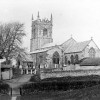
From this time on Lady Charlotte’s declining years were spent with her youngest daughter Blanche, Countess of Beesborough. Lady Charlotte Guest Schreiber died in 1895 and was buried in Canford Churchyard beneath a great white three-tier “mastaba” type granite tombstone topped with a full-length raised crucifix.

Truly a fitting memorial to one of Dorset’s most remarkable Victorians.


[We have placed in the gallery two photos by Chris Downer of Canford Magna parish church.]

Sydney Smith – Musician and Composer

Sydney Smith was born on 14th of July 1839 in South Street, Dorchester, the second of three sons born to Frederick and Helen Smith. He was destined for a career and fame in the world of music. Like his older brother, Frederick, he followed in the steps of his father who was a professor of music and dance. Their younger brother, Walter, trained as an assistant bookseller; he died aged just 25 years.

The parents of these three boys, Frederick Smith and Helen Boyton came to Dorset shortly after their marriage at Clifton, Bristol. Frederick Smith was originally from Deal in Kent and Helen Boyton from Clifton. Their father died in 1870 and is buried in Dorchester Cemetery. Sydney’s brothers Frederick and Walter are buried next to their father.

Sydney and his brother received their early musical tuition from their parents. Notices in the Dorset Chronicle in the late 1840’s refer to a series of concerts given by Frederick Smith (on violin) with his sons Boyton (on piano) and Master Sydney (on ‘cello.) [Frederick also had his mother’s maiden name and was known as Boyton Smith.]

In 1855, possibly as the result of winning a Mendelssohn scholarship, Sydney had a place at the famous Leipzig conservatory; he was sixteen. He spent the following three years there studying piano and cello.

Returning to Dorchester in 1858 his talent was recognised by the eminent violinist, Henry Blagrove, who had once been in the employ of Queen Adelaide and was later associated with the Royal Academy of Music. A year later following advice from Blagrove he moved to London and found lodgings in Upper Seymour Street. He quickly established a name for himself as a recitalist and was much in demand in society circles as a teacher of the piano. There followed the best part of three decades when his name was a household word; in today’s world he would have been a much sought after celebrity.

In 1867 Sydney married Hanna Birch. She was originally from Buckinghamshire and the daughter of a druggist in business at George Street, London W.l. She was a singer with the choir of the Philharmonic Society which is probably where the couple met. A year later at 45, Blandford Square, London, their first daughter was delivered and baptised Blanch Edith.

A son, Leonard Sydney, was born to the couple in 1870 and their daughter Linda May was born in 1872. The following year they lost their first child, Blanch, to rheumatic fever and another son, Granville Boyton Sydney was born, followed in 1875 by Eustace and their last child was born in 1878.

In 1886 Hanna died of Bright’s disease after five years of failing health. She was buried at Kensal Green Cemetery on the 16th of July 1886 in the grave of her first daughter. According to her death certificate her passing was notified to the registrar by Blanche Augustine Pinget.  Miss Pinget was 25 and had nursed Hanna through her last days but she had an earlier association with the family when she was nurse to the Smith’s children.

Possibly there was more to this relationship because a little over a year after Hanna’s death  Blanche Augustine Pinget became the second Mrs Smith at a ceremony at St. John’s Parish Church, Hampstead on the 28th of October 1887. After their marriage the couple lived at 28 Birchington Road, Kilburn.

This move from the fashionable heart of London may have been forced on the couple. Sydney was suffering from a “severe malignant tumour of the spine and ribs.” He had to give up his teaching and concert career which would have resulted in a considerable drop in income and there were no royalties to rely on although he had composed nearly 400 works.

Celebrity quickly dims and this was certainly the case for Sydney Smith. The tragic illness and the resulting hardship forced him to apply to The Royal Society of Musicians for assistance and they helped in a small way.

Sydney Smith, in his day a famous composer of popular music, was buried with Hanna, his first wife and his daughter Blanch in a grave marked by an un-inscribed cross. His star diminished by the changes in musical taste at the end he merited a short obituary in The Musical Times. He is remembered today in musical circles; his work, and that of his contemporaries is kept alive by the Sydney Smith Archive.

We have placed a photograph of Sydney Smith in the photo section.

Edgar Lane – Musician of Distinction

“Dorset has lost a distinguished musician, one who shed lustre on the profession with which throughout his lifetime he had been associated” (Southern Times, February 11th 1938.) So ran this obituary to one of the two most distinguished musical figures to be associated with Dorset in the 19th and 20th centuries. Nor was Edgar Alfred Lane only remembered and honoured by the provincial papers, as the Daily Telegraph, Daily Express, and Yorkshire Post also paid their respects. Yet today, even in his adopted county, this composer is virtually forgotten, sharing the fate of the brilliant organist-composer he succeeded as organist of Holy Trinity Church in Dorchester – the renowned Boyton Smith.

For some twenty-seven years it was Edgar Lane who would take up where Boyton Smith had to leave off when death plucked at is sleeve but Lane was not native to Dorset. He was born into a Norfolk family in Great Yarmouth on a date usually held to be September 3rd 1865, though his birth certificate proves it was September 23rd 1864. Edgar was the eleventh of the thirteen children of Benjamin Lane and Elizabeth Kemp Lane. His grandfather was James Christmas Lane, while his great-grandfather, another Benjamin, was the captain of a schooner taken prisoner by the French during the Napoleonic wars, but later released after the British victory at Waterloo. Edgar’s eldest brother, Benjamin, had emigrated to Australia even before Edgar was born.

Edgar’s schooling was nevertheless quite elementary, though he was certainly not lacking in brains – or precocious talent. He became one of the youngest church organists ever at Holy Trinity Church, Caister-on Sea, Norfolk when just 11. At Great Yarmouth Town Hall in 1881 he conducted his first concert when only 16 (the census of that year showed he was also working as a coal merchant’s clerk.) When not yet 20 he was appointed sub-organist at Ripon Cathedral. Two years later in 1886 he took up the post of organist and choirmaster at St. Peter’s Church and Magdalen College School, Brackley, Northants, where it is noted he was a keen cricketer. It was here also that he met his future wife, Sarah Jane Clarke, a talented pianist.

Edgar and Sarah appear to have had a peculiarly long engagement, for they were still engaged in 1892 when Edgar was appointed organist and choirmaster at St. Peters in Dorchester and so subsequently began the long residence in the county where he would remain for the rest of his life. The couple eventually married in April 1893, taking up residence in a house in Cornwall Road with an excellent frontal view of the Borough Gardens, where Edgar would relax and play croquet.

Their first child, Geoffrey Edgar, was born in 1894, but about 1896 when their second son Ronald James, was born the Lanes moved to a much more spacious house at 50 High West Street where orchestras and choirs could practice. In that year too the Dorset County Chronicle reported that Lane had been appointed conductor of the Dorset Vocal Association in place of Boyton Smith. To commemorate Queen Victoria’s Diamond Jubilee in 1897, Lane composed and conducted a special piece ‘For Sixty Years our Queen’ for a concert with massed choirs held at Maumbury Rings. Respectively in 1899 and 1902 the Lane’s last two children, Margaret and Arthur Noel were born.

Those heady ‘90’s, when the older children were growing up, saw Lane emerge as a kindly child-loving family man who loved to indulge his youngsters with “rubbishy rhymes.” His philanthropy was manifest in his arranging each Sunday for Margaret and Ronald to take a fully cooked meal to a lady in reduced circumstances living in Maumbury Road. This lady, Mrs Harding, was none other than Thomas Hardy’s earliest love and the inspiration for ‘A Pair of Blue Eyes.’

In the 1901 census Lane’s occupation is given as “Professor of Music/Organist/Principal of Dorchester School of Music.” That year he formed a choral society in Weymouth and, soon after, the Madrigal & Orchestral Society, whose concerts at the corn Exchange attracted large audiences. He resigned from St. Peters as organist in 1906 to become Warden of St. Mary’s, a church that formerly stood on the site of the present Dorford Baptist. While still in this position Lane was appointed organist at Holy Trinity in 1909.

By this time Edgar Lane had become well established as a private music teacher of organ, piano, violin, cello and singing, as well as pursuing a career as a composer and conductor. Although Lane’s salary from his organ post amounted to no more than £80 per annum, magnanimously he would not charge for lessons if he considered a pupil was hard up or if his or her parents could not afford the fee.

In 1911 the Dorchester Madrigal Society, then in its eighth season, held two grand concerts on May 30th that year, which included a Coronation March in E flat Lane had written. The combined Dorchester and Weymouth Choral Societies staged a performance of “Merrie England” at the Pavilion Theatre that included Edgar’s patriotic song “For the Empire” on December 11th, 1913. When the Great War was just five months old in December 1914, afternoon and evening performances of the sacred cantata “The Daughter of Jairus” were sung in Holy Trinity Church under Lane’s direction (singing the tenor solos himself because there was a shortage of singers.) By this time the Lanes had moved to a sub-let property out at Charminster called “The Yews” and though this meant Lane having to cycle into town, it was a cheaper home to rent.

In the midst of the appalling carnage of the Somme offensive on July 12th 1916, the Dorchester Madrigal Society, in association with the King’s Own Royal Lancaster Regiment, gave two concerts at the Corn Exchange. On December 7th that year, also at the Corn Exchange, Handel’s Messiah was performed. It was during these dark war years that Lane was appointed Music Master and, when military service led to a shortage of teachers, a form master as well at Dorchester Grammar School.

Following the end of the First World War in 1919 Lane established the Weymouth Operatic Society, which was then merged with the Madrigal Society. The years 1922 to 1931 saw Lane mainly pre-occupied with training his choirs and giving singing tuition to children in various schools in the area, though there were the occasional concerts to conduct. One of these, on August 8th 1930, was a performance of Mendelsshon’s Elijah in Colliton Park. It is interesting to note that one of Edgar Lane’s singing pupils was Gertrude Bugler who, as a strikingly beautiful farmers wife in her twenties, was then an amateur actress playing Tess in the productions of ‘Tess of the D’Urbervilles’ in Dorchester.

But 1928 brought personal tragedy. With the death of Thomas Hardy in January, Lane lost a close friend and associate, for it had been through Hardy that the Lanes had acquired their first Dorchester home in Cornwall Road. Lane became involved, as had Boyton Smith before him, in writing incidental music for productions of Hardy’s stories. As the writer’s wealth had grown through publication of his works, he became more of a man of property, including the Cornwall Road house, which he rented out to Edgar Lane. Hardy was then Lane’s landlord as well as his commissioner of works! The second blow for Edgar was distinctly more personal. When grown up Geoffrey, the Lane’s first child and eldest son went to sea, first as a rating in the Royal Navy then later as a purser on a P&O liner. Though said to have never had a day’s illness in his life, Geoffrey Lane contracted pneumonia late in 1928 and died.

For one of Hardy’s last birthdays in the 1920’s, Lane arranged for the choir of Holy Trinity to give the writer a personal recital of anthems and hymns at Max Gate. Later in that decade, when the Prince of Wales (the future Edward VIII, later Duke of Windsor) visited Dorchester and Max Gate, Lane wrote a special piece for the occasion.

In 1931 Edgar formed the South Dorset Festival Choir, but had not been conducting it for long when, soon after his last festival in 1935, failing health forced him from the podium. In 1936, following two serious operations, Lane went to Sussex to convalesce. By 1937 the composer was sufficiently recovered to return to conduct one more concert in the Borough Gardens featuring a march to mark the coronation of George VI he had written while in hospital. But the remission was brief. Soon after this event Edgar Lane again fell ill and on February 10th 1938, following further operations, he died.

Throughout his very busy life Edgar Lane was not in a position to take advantage of the kudos that came from publishing light music and the few years after 1906 found his family in quite dire financial straits. More than did Boyton Smith, Lane suffered from the march of progress in technology as the advent of the home gramophone, its records and radio broadcasting impacted heavily on the popular sheet music market. Furthermore it is not known whether Lane was ever awarded an honorary degree, though he certainly spent many hours of evenings pouring over books in an exhaustive effort to work towards attaining such a qualification.

Edgar Lane’s involvement with Hardy was probably inevitable rather than accidental, since Boyton-Smith proved to be the ‘link-man’ in mutual association with both. But it is also thought that Lane had an even more intimate relationship with the great writer than had Smith, for Margaret Lane has noted that Hardy and her father “had many musical evenings together.” Furthermore, Lane, as we have seen, twice received invitations to take a choir to Max Gate, and two Hardy settings by Lane “Men Who March Away” and “Songs of Joyance” have been located. The latter was written for the Prince of Wales’ visit and the composer also set some of William Barnes’ verse to music. But few recordings and manuscripts of his music have survived: only four of Lane’s own scores have been traced, while four Barnes settings are listed in the 1932 Dorset Year Book. Lane’s daughter accounted for this paucity by noting that much of Lane’s own and commissioned work for Hardy was accidentally included among works of another composer who was destroying them on a bonfire. It is thought that further Lane scores also perished in a fire at Max Gate. However, Lane’s setting of “Fight the Good Fight” which won for the Dorset Choral Association the ‘Prize Tune Award’ of 1925 was included in the inventory taken of the items in Hardy’s study after the writer’s death.

Overall, it appears that Lane’s music was primarily written for public consumption at major ceremonial occasions reflecting the fact that orchestras, bands and choral societies he wrote for were invariably present to mark these important events.

In conclusion it could be said that anyone who, over a career of some 44 years, had held two church organist positions; a church-wardency; a music master/form mastership of a grammar school; founded and coached several choirs; taught voice and four instruments, organised and conducted several concerts and found time to compose his own and commissioned music, play cricket and croquet, keep chickens and turkeys and grow his own vegetables, could wear himself out before his time or ruin his health. Edgar Lane did ultimately ruin his health, possibly as a result of overwork, but he achieved all of the above and a few more.

Lane’s surviving manuscripts, letters, performance billings, etc, together with copies of Margaret Lane’s short biography are now kept in an archive THE EDGAR LANE COLLECTION available for inspection in the general section at the Dorset History Centre, Dorchester.

Frederick William Boyton Smith – Part Two

Smith had an unusually stylised signature which, while distinctive was yet legible. His forename was scored through with a backstroke from the “B” that also served to cross the “T” in Boyton, before passing through the loop of the “H” in Smith, to extend some way beyond; the hook of the “H” was then doubled back in a broad sweeping arc to entablature the whole name of Smith. (See photo in photo section.)

How well Frederick W.B. Smith and Thomas Hardy knew each other has long been a matter of uncertainty and speculation. What is known for a fact is that the two men were born within three years – and within three miles – of each other, and were virtually fellow townsmen of Dorchester who most likely often saw each other in passing without being aware of each other’s identity. And while Boyton Smith was no writer, Hardy was an amateur musician, having learnt the violin and how to sight-read music from his father who had been a player in the family’s gallery band at Stinsford Church.

The two men however, were evidently in almost daily passing contact from as early as the late 1850’s, for the office of the architect John Hicks, where Hardy was working as an articled apprentice and to which he would have walked each day, was situated in South Street, where Smith was then living. This office was also next door to the home of the great schoolmaster poet and scholar William Barnes. But it is likely that the intermediary who brought Smith and Hardy together was Walter Fletcher, a long-time walking companion of the latter, who also happened to be a friend of both Boyton and Sydney Smith. Fletcher was present during Sydney’s last visit to his elder brother in 1877, and it is probable that, quite independently, Smith was acquainted with many of the same people in Dorchester as Hardy was. He would therefore be familiar with many of the same aspects of life in the neighbourhood, and would have been involved in many of the same organisations.

An example of this close involvement came in 1904, when Boyton Smith was commissioned by the Society of Dorset Men in London to set ‘Praise o’Dorset,’ a poem by Barnes, to music for the occasion of their inaugural meeting. For the 1922 Dorset Year Book the Society’s founder and vice president, William Watkins, wrote a piece in which he imagined himself fifty years on at the annual dinner in 1971 and commented: “..it is glad beyond measure to hear the well-known strain of Boyton Smith’s setting to Barnes’ ‘Praise o’Dorset.”

In 1907 Thomas Hardy OM, JP was appointed President of the SDML, and in a journal letter of November 23rd of that year described Smith’s musical efforts on the organisation’s behalf, giving the composer’s address as Wollaston Road, Dorchester, having moved from High West Street, showing that by that year the composer and the writer were evidently known to each other and in rudimentary contact with each other. This interaction is likely to have increased exactly a year later, when the Dorchester Debating and Dramatic Society (later The Hardy Players) staged a production of Hardy’s ‘The Trumpet Major’ under the direction of a local chemist and JP, A.H. Evans. This production is of interest since it included four settings by Boyton Smith of Hardy’s poetry: ‘Budmouth Dears;’ ‘My Love’s Gone a-Fighting;’ ‘The Night of Trafalgar’ (from The Dynasts,) and ‘Valenciennes’ (from Wessex Poems.) Smith also provided a harmonisation of Harry Pouncy’s setting of Hardy’s ‘The Sergeant’s Song,’ also from Wessex Poems.

The tune of Budmouth Dears seems to have struck a popular chord with London Society, for in a letter to Pouncy in February 1908 Hardy mentions that: “it is true that the song Budmouth Dears has hit the London taste – all reviews quote it nearly.” But it had been one particular scene from The Trumpet Major, enacted in isolation, that had inspired the Rector of Holy Trinity, Rowland Hill, to include it as a piece of whimsy at that year’s May Fair. At this point it is thought that Boyton may again have become involved, since by this time he was Holy Trinity’s organist. In a December 1912 production of The Trumpet Major at the Cripplegate Institution in London, music of the Boyton Smith songs was reproduced in the programme of this performance.

A more intensive collaboration between Hardy and Smith certainly occurred about September 1910 when Smith harmonised some books of traditional carols once owned by Hardy’s father and grandfather. The carols were used in a production of Under the Greenwood Tree under the title of ‘The Mellstock Squire’ in November 1910, on which occasion Hardy received the freedom of Dorchester. Significantly, there exists in the Hardy Memorial Collection in Dorchester a photograph showing Hardy at a rehearsal of this play. The harmonisations of the carols appears to have been completed in early October and were much appreciated by the Dorset County Chronicle as well as Hardy himself, for Smith’s manuscripts were found among the author’s papers in his study after his death.

It appears that Boyton Smith and his father had leanings towards arranging Dorset’s traditional folk music, though many of these pieces never made it to publication. A list produced by the SDML, includes ‘Merry Bleake o’Blackmwore,’ a setting of Barnes by Smith, and ‘That Do Vollow the Plough,’ a traditional air that Smith harmonised. It is likely that this interest in folk music was responsible for involving Smith with the Society, since among the Society’s objectives to promote or encourage were a fuller knowledge of folk-lore, literature, natural history, art and music. Hardy himself, in a letter of 26th December 1907 to A.M. Broadley confirmed he was “…looking for some old Dorset psalm tunes, either composed by Dorset men, much sung in Dorset, or bearing names of Dorset places for the Society of Dorset Men in London.”

Fellow Durnovarians of Boyton Smith became enthusiastic officionados of his music and obviously relished the local associations it invoked. For instance, in the November 2nd, 1905 edition of the Dorset County Chronicle it is noted that at the previous evening’s Old Grammarians Annual Dinner, those present sang their favourite anthem Praise o’Dorset to Smith’s music. Hardy was a member of the Old Grammarians, for he held the position of Governor of Dorchester Grammar School. The Smith setting of Praise o’Dorset was also played during a forthcoming Hardy Players production of The Woodlanders.

Naturally, William Barnes had been a life-long mentor, fellow townsman and friend of Hardy, and it seems likely that Boyton Smith also set further works of Barnes to music as well. After all, Sydney and Boyton Smith attended Barnes’ school, and their parents also had close association with him. Following an enquiry about Dorset songwriters from Major William Arnold, Hardy replied in a letter of November 23rd 1907: “Mr Boyton Smith of Wollaston Road, Dorchester, has lately at the request of the Society of Dorset Men in London, melodised some of Barnes poems which are sung with great success at the Society’s meetings and he might be willing to do the same with any you might choose…Barnes’ poems in Dorset dialect, some of them set to music by Mr Boyton Smith.” That Hardy clearly approved of Smith’s settings of his poetry and incidental music for his productions is shown in the writer’s recommendation of the composer to Major Arnold and Granville Barker as one who could portray Dorset as equally well in music as Hardy had in the written word.

But in return, what was Boyton Smith’s opinion of Hardy’s work?  Clearly Smith’s settings were undertaken as commissions from local societies, and not merely because he was inspired to write them as unsolicited labours of love. It is possible that the settings would not otherwise have been a commercial proposition, for he was a typical Victorian composer of light pieces for the sheet-music market. Since even Kipling – who of course was an author and poet – once confessed to Hardy that he did not understand the people and places in his Wessex novels, would it have been likely that an upper-middle class composer like Smith could have appreciated the plots and characterisations of rustic novels? Smith, as far as is known, had no interest in, or little time for reading, but he was not alone in pursuing a career of composing for the Victorian parlour.

On February 23rd, 1911 the county Gazette bore the following sorrowful statement in an obituary column: “It is with sincere and deep regret that we have to record the death of Mr Boyton Smith which, after a short illness, happened at his residence in Wollaston Road on Friday night within a week of his 74th birthday.”

Smith had passed over on the 17th, and throughout the three columns that followed this paragraph, many facets of his character and work were cited. It is recorded that his “masterly knowledge” of organ playing gave the congregation at Holy Trinity the opportunity to hear a proper interpretation of liturgical music. So much was music a life-long love of Smith that he devoted every hour to it. No labour was begrudged, and his genial disposition and inspired enthusiasm met with a ready response from choir men and choir boys of Holy Trinity across the twenty-two years of his association with the church. Indeed, such was his devotion to music that he persisted in it to the limit of his endurance in his declining years, and it was a sad day when, through advance of age and frailty, Boyton Smith was compelled to resign his position as organist. Not least among those who mourned his passing would have been Cannon Hill, who brought to Smith a friendship as close as the friendship towards the minister’s predecessor, Henry Everett, had been.

Smith dearly loved his home town, where he was furthermore a generous and charitable citizen ever ready to help any good cause, his great talent contributing to the object in hand. His acts of kindness were many and this aspect of his personality won him the hearts of many. For Boyton, loftier ambitions would always subordinate to unselfish consideration for his fellow citizens. Yet out of a patriotic duty, he managed to find time for service in the Dorchester Corps of the Volunteers that in those early days saw the enrolment of many Dorchester townsmen. The obituary further noted that Smith had served as the first ever Weymouth representative of Trinity College, London, for a number of years. As a tribute, the music for the first Sunday service at Holy Trinity following Smith’s passing was of a special character. The Dead March (from Saul) and his arrangement in G of the Te Deum was impressively played by his organist successor, Edgar A Lane. On this occasion the special preacher was Arthur Hippersley Smith of Langton, East Yorks, son of the Curate in Charge, Revd. P.A. Hippersley Smith. At evensong canticles were sung to the composer’s favourite tunes, as well as a rendition of his beautiful anthem “I Will Lay Me Down in Peace.” Following the Blessing the choir sang the sublime quartet and chorus “Blest are the Departed” (from Spohr’s “Last Judgement.”) Special services of remembrance were also held at St. Peters and All Saints.

Frederick W Boyton Smith left his wife Penelope and five children behind, the most prominent of whom was his surviving son Sydney, who was by the time of his father’s death the Revd S. Boyton Smith, vicar of St. Clements Church, Bristol. The others were Florence (Mrs Edward Salisbury of Streatham;) Margaret Ada (Mrs G.H. Lock of Shrewsbury;) Helen (Mrs Philip Harding) then living in Canada, and Frances (Miss Boyton Smith.) From these, Boyton Smith had eight grandchildren.


Click on this link to hear Phillip Smith play Boyton Smith’s ‘ Isle of Beauty.’ http://www.youtube.com/results?search_query=Phillip+Sear+Boyton+Smith&aq=f

Frederick William Boyton Smith

Today he is virtually forgotten, yet he fathered no fewer than one hundred and ninety three short salon pieces and organ works. Information about his remarkable life is distinctly hard to obtain, yet he was a contemporary and associate of Thomas Hardy, and set many of the writer’s poems to music. Now, after more than a century, the obscure and remarkable persona of Frederick Boyton Smith has been partly rediscovered through exhaustive researches at the Dorset History Centre and lengthy behind-the-scenes correspondence with Ms Susan Bell, to whom the author of this biographical portrait would like to acknowledge thanks for all her helpful information about Frederick Boyton Smith and his brother Edward Sydney Smith.

Frederick W Boyton Smith was born in Dorchester in September or October 1837, and is recorded as having been baptised on October 13th in Dorchester’s St Peters Church. Frederick was clearly born into a musical family, for his father, also named Frederick William Smith, was a musician; his mother, Helen Boyton and her sister Clara (who was a teacher of music) were the daughters of Richard Boyton, a professor and teacher of piano. Helen was originally from Clifton, Bristol, where she married Boyton’s father in September 1835. To avoid confusion with his father, Frederick jr. is usually known as Boyton Smith. The 1861 census shows that Boyton Smith’s father was originally a Kentish man from Deal, had moved with Helen to Dorchester. He is recorded as being ‘a professor of music and dance.’

At the age of four, Boyton is recorded as living with his parents and brothers Sydney and Walter at Cornhill, Dorchester, but by 1851 the family had evidently moved to 16 South Street. However, the census that year does not include Boyton, as by this time he was studying the organ under George Townshend Smith at Hereford Cathedral, and instead is noted in that town’s census as visiting the home of one Mary Ann Watt on census day. It is thought that Boyton was probably a boarder at the Cathedral school rather than living in with Townshend Smith, but it is uncertain whether he received further training in the subsequent years. By the time of Dorchester’s 1861 census the Smiths had moved to 53 High West Street and Sydney Smith had left for Leipzig in 1855 to study piano, violin, cello, harmony, counterpoint and composition.

Boyton Smith, too, by 1861 had left Dorchester to live in with a spirit merchant’s widow called Ann Gare and her two daughters in Chard, Somerset. The connection seems to have been through Boyton, who by now was recognised as a professor of music, possibly working for the British National School where Mrs Gare was Mistress. One of her daughters, Janette, is recorded as being an assistant at the school, which was situated close to the Gare home in the High Street.

While Boyton and Sydney would have learnt music from their parents at an early age the former’s earliest known published piece was a transcription for piano of a two-part song by Mendelssohn called “Greetings” in 1861. The rest of the decade continued to be a productive and fruitful time for Boyton, during which time forty compositions were published. These were variable pieces suitable for the drawing room, many being for the piano, but also including arrangements based on operatic songs and melodies. There are also songs based on the poetry of Longfellow, Kingsley and Goethe and one piece of sacred music. Most of these works were published by Chappell & Co, Edwin Ashdown, Weeks & Co, or Novello. Of especially high value to Gilbert and Sullivan officionado’s is an arrangement of a lost song from a comic opera by Sullivan called “The Chieftain,” first performed at the Savoy Theatre in 1894.

Boyton appears to have had a penchant for giving his pieces titles in French such as “Sur le Lac Morceau de Salon pour Piano.” This reflects a trend for all things French at the time among upper class Victorian ladies and a good deal of published sheet music in the 1860’s either came from Paris or else purported to come from there.

Yet despite his prolific output in catering for the 19th century demand for drawing room pieces, Boyton Smith and his music are largely forgotten, and even in his home town his name is largely unrecognised and his achievements undocumented.

In 1864 Boyton Smith married a Clifton woman. Penelope Mary Ann Rawle, Penelope had been born in Clifton in 1842, but the 1861 census clearly shows that by then Boyton’s future wife was working as a governess at Burton, Winfrith Newburgh. The birth of a son, Sydney, was registered in Dorchester in 1865 showing that the family was living there by then. The Dorchester Holy Trinity Baptism Register notes that Sydney was followed by Florence (1867), Helen (1868) and Margaret Ada (1869.) The 1869 record gives Boyton’s occupation as organist (he was appointed Organist at Holy Trinity) and his address as Alexandra Terrace, Dorchester.

In February 1866 Boyton’s younger brother Walter, a bookseller by trade, died from nephritis aged only 25. By 1871 the family was living at 39 South Street, close to the home of Helen, Boyton’s mother, who had been widowed the previous year. The census shows that another son, Frederick, was added to the family only one month before and the presence of three servants show that by then Boyton Smith was well-to-do in his capacity as a professor of music. Indeed, the 70’s again saw the publication of another forty or so small compositions and works for the organ. These included sacred music such as “Lo! I will Give you Rest;” “Andante con Moto” (an organ piece) and arranged piano duets such as “The Flying Dutchman.”

However, most of the forty compositions of the 70’s hang on lightweight pieces for the parlour in the manner of “L’Echo du Tyrol” fantasy for piano, or “Jeanne de Arc,” a gallop de salon. “The Love Who’s All to ME” was a popular ballad, while “The Ash Grove” was a well known aire. Yet Boyton was also moved to write music designed to help beginners and students, seen in, for example, “The Pianists Daily Practice” and “The Russian National Hymn.”

But the 1870’s also spelt tragedy for Boyton Smith. The family had evidently moved to Melcombe Regis soon after the 1871 census day, for the Cemetery Chapel there records the burial, on January 2nd, 1872, of the infant Frederick at only 9 months and in January 1876 the burial of a later infant son, baptised Frederick Walter aged only ten weeks. The family’s address was then 2 Frederick Place, Melcombe, but by 1881 it was Lawn House in Lennox Street, where Boyton’s other daughters Helen and Ada also resided. Here another baby, Frances, was born in 1881.

During the years in Melcombe Boyton’s occupation is given as Music Teacher, where his pupils would have attended at Frederick Place. During the 1880’s Boyton was still composing and arranging, his tally for the decade being about another 45 pieces. The Boyton Smith’s with their daughter Helen were still living at Lawn House on census day 1891, their youngest daughter Frances by that time being a boarder at the same school in Wyke Regis that Helen had attended ten years earlier. It is possible that by this time too, Sydney, was studying for a BA in Durham, for the same ‘S Boyton Smith’ appears as President of the St. Cuthbert’s Society, on that city’s St. Cuthbert College’s register in 1895.

Though only 50 when he died in 1889 Edward Sydney had by the end of his life established himself as a prolific composer in his own right, searches having brought up details of four hundred and sixty-seven published compositions. We will publish a brief biographical piece about Sydney Smith shortly.

The end of the 19th century saw the publication of a great volume of sheet music for the middle class amateur to play at home. During this period Boyton Smith published his “Fantasia” based on four more Sullivan operas as well as other opera-based arrangements and waltzes. Yet a discernible shift in genre from parlour to sacred music is evident in Smith’s repertoire during the 1890’s. In all, seven pieces of church music for Novello’s Parish Choir Books and organ pieces such as his Grand March in D were published. The latter is still played occasionally as the recessional at church weddings, though its composer’s name has long since become disassociated with it.

Sometime before 1901 Boyton Smith had evidently moved back to Dorchester; for he is listed in that year’s census as living at 56 High West Street. Very near his parent’s former home at No. 53. He was then 64 years old, still a professor of music, though one ‘employed on his own account.’ Living with him was his wife Helen, her 84 year-old spinster aunt Mary Jane Rawle and one servant. The couple’s elder daughter Florence had become Mrs Edward Salisbury living in London with her husband, their four-year-old daughter, and sister Frances, then twenty years old. Florence and Edward had married in 1887 in a ceremony witnessed by both Sydney and Frederick Boyton Smith. Ada had married George Herbert Lock and was living with her husband, two daughters and sister Helen, then 32, in Shrewsbury. In 1893 Ada had published a composition of her own called “Romance for Violin and Piano” under the name of Ada Boyton Smith. Boyton Smith’s son Sydney went into the Church, becoming an Anglican clergyman who married an Irish woman from Enniskillen called Mary Cooney. By peculiar coincidence the 1901 census shows that Mary’s father William was living in Clifton with her and Sydney, so maintaining a Bristol connection within the family.

At the time when Boyton Smith embarked on his career as a composer, other European composers, whether of piano music or more ambitious works for orchestra, were much in vogue, while England was regarded as something of a musical backwater or desert, which not even the great Godsends and legacies of Elgar, Parry or Vaughn Williams could entirely dispel. The only way a young English composer could hope to gain recognition or financial reward was through the composition of pieces for gifted amateurs. Over the decades Boyton Smith recognised the opportunities that the growing popularity of British musical comedy presented. By the beginning of the 20th century this medium had established itself as the most successful school of operetta in Europe. But as the century progressed the nature and character of Smith’s repertoire changed. Music with commercial potential diminished in importance, a luxury of omission Smith perhaps felt he could afford now that his children were financially independent.

Between 1900 and 1919 Boyton published another twenty-eight pieces of music, half of these being sacred music for the Church. But during this period too, another highly important and ultimately world-renown figure was about to enter his life. He was not a composer or primarily anyone with a career in music; nor was he some distant nonentity from afar off, but a world-renown contemporary who had lived and worked in Boyton Smith’s own town and neighbourhood throughout both their lives. Two men who had made names for themselves in their own ways and had perhaps rubbed shoulders without getting to know the measure of each other.

So did Frederick William Boyton Smith join the throng of the many notables who were friends or associates of the great Thomas Hardy…

To be continued…

[Cut and paste or click on this link to hear Phillip Sear play Boyton Smith’s ‘Isle of Beauty.’ http://www.youtube.com/results?search_query=Phillip+Sear+Boyton+Smith&aq=f

Francis Glisson

Dorset has given birth to several prominent men in the world of medicine, but probably the earliest of these was Francis Glisson, born the second son of William Glisson at Little Rampisham in 1597. Although it is known that his early education was at Mr Allot’s school in Rampisham, the family history and early life of Francis Glisson is otherwise obscure. However when he was twenty in 1617 he entered Caius College, Cambridge, graduating in 1621 with a BA, and then proceeding to take an MA in 1624. His academic study was further advanced with his incorporation as MA at Oxford in 1627, going on to take an MD at Cambridge in 1636.

Having qualified as a physician, Glisson remained in Cambridge for the next four years, lecturing on comparative anatomy and physiology. During these years he was also elected to a lectureship on these subjects at the College of Physicians in London. About 1640 he moved to Colchester, but when Cromwell’s army besieged that town in 1648 during the Civil War, he was appointed as mediator to General Fairfax. This proved unsuccessful as a number of houses were burnt down, though Glisson’s was not among them. But with Colchester impoverished and in ruins, Glisson resolved to move to London. The capital would remain his home base for the rest of his life.

When he reached London, Glisson leased a house in the parish of St. Bride, Fleet Street. Here he had ample unhindered opportunity to devote his energies to epidemiological study, since he never married and so had no family commitments. He continued his active schedule of lectures often in other places around the country, including several visits to his native Dorset. It was in this county that he first became aware of the deformative condition known as rickets in the children of poor labourers, an observation which led him to devote much time to the study of this “new” disease, though it was known to a Roman Physician as early as 98AD.

Glisson had noticed that the main symptoms in children were misshapen bones and enlarged joints, but at that time no-one had any real idea of the cause. But Glisson may have been the first to suspect that rickets had something to do with a deficiency in the diet, although he thought that over-feeding was a likely cause. By this time Glisson had become respected and admired by his contemporaries as a writer on childhood diseases, and proposed that a greater consumption of milk and other dairy foods could prevent the condition, which it is now known is caused by lack of vitamin D.

In 1650, Glisson published ‘The Treatise on Rickets,’ his definitive work on the disease, based on the cumulative data of five years of study. This work, which ran to 416 pages of original observations, won great acclaim in the medical establishment. Even today, over three hundred years later, there is little to add about the disease.

By nature Glisson was a forceful character as well as a brilliant medical man. For example, it is recorded that he tenaciously demanded payment of arrears in his salary while Professor at Cambridge after he had not been paid for five years. He persisted until an order in council was issued in Whitehall ordering payment to be made.

At 53 Glisson had made a firm mark on the scientific establishment and his fame had spread widely. But his duties in Cambridge were becoming restricted by the widening scope of his interests. He therefore appointed, in 1675, the Master of Caius, Dr Brady, as deputy Professor of Physic. Glisson himself was deeply involved in the College of Physicians where, since 1656 he had been censor. This post was followed by a two-year term as President of the CoP from 1667. On leaving the Presidency Glisson donated £100 to the College Building Fund to help relieve a shortfall caused by the theft from the treasure chest in the plague year of 1665 and to restore the college building destroyed in the Great Fire the following year.

One way in which Francis Glisson showed that his interests were not confined to physiology was his membership of an elite band, which held meetings of enquiry into natural and experimental philosophy. From this sprang the foundation of the Royal Society, with Francis as one of its first fellows.

Francis Glisson was foremost a doctor and anatomist, turning his attention next to the physiology of the liver. ‘Anatomia Hepatis’ described in meticulous detail the normal and morbid structure of the liver, particularly its fibrous membrane, which was likened to a bag, and ever after known as ‘Glisson’s Capsule’ in his honour. Glisson was doctor and friend to Anthony Ashley, 1st Earl of Shaftesbury, whose patronage and help at various times he appreciated. Dr. Glisson was also physician to the Earl’s family.

An entirely different work by Francis Glisson followed in 1672 with the publication of ‘Tractatus de Natura Energetics,’ a deeply erudite investigation into Aristotelian philosophy. The work was dedicated to Earl Ashley and reflects Glisson’s love of scholarship to a greater degree than his earlier writings. Ten years before its publication the London Society had been granted a charter by Charles II at its Gresham College home. Here, early fellow members included Thomas Willis, Robert Boyle, Sir Christopher Wren and first president, Lord Brouncker.

Even at the age of 75 Glisson was still writing. Drawing on a lifetime’s experience of lecturing, ‘Tractatus de Ventriculo et Intestinis’ was his last treatise, which he dedicated to Cambridge University and the CoP, with whom he had been associated for so long.

Francis Glisson died in October 1677 and was buried in St. Bride’s Church. Thus the man from such humble beginnings in a Dorset village became one of the country’s outstanding scientists of materia medica. Doubtless his monument in the Fleet Street church is a fittings memorial to this eminent Dorestian who never returned to cross the divide on his native patch of Wessex.

Isaac Gulliver – Dorset’s Smuggler King

He was a smuggler, as was his father before him. He flouted the law of his day, yet always managed to present a façade of respectability. Isaac Gulliver, it has been said, was “the gentle smuggler” the Raffles of the Hanoverian duty-free culture; an audacious genius of an illicit occupation.

In the 18th century the Napoleonic wars forced the price of continental wheat and liquor to a prohibitive level for the poor. As journeymen’s wages were also very low there was a great incentive for many men and some women to smuggle as a means to supplement a meagre income. Since agricultural wages were typically only 3s to 6s a week the prospect of making 10s a night by smuggling proved irresistible. Venturers were often in league with captains and were regularly running the risk from or confrontation with excise officers or “Preventive Men”, as they were sometimes known.

But Gulliver was in a league of his own regarding his resourcefulness in the lengths he could – and did – go to give customs the slip on at least three occasions. He is said to have had himself carried through the streets of Poole in a barrel. On another occasion he even feigned death by whiting his face with chalk and lying in an open coffin while excise officers were raiding the house he was in.

Little however is known about Gulliver’s early life in the Wiltshire border village of Seamington near Melksham where he was born on September 5th 1745, the son of a man himself actively involved in smuggling in the Poole area. At this time Bournemouth as a developed resort did not exist, and the narrow wooded valleys (chines) which ran down to the shore were ideal for concealing un-shipped contraband. Coy Pond at Westbourne was a popular rendezvous for smugglers, and Gulliver’s father. And later Isaac himself regularly used this and Branksome Chine for concealing their offloaded cargoes.

When Isaac was 19 in 1765, his father made a will. By this time his son possessed a strong physique and constitution, and had begun to follow in his father’s footsteps. 1765 saw him in collaboration with Robert Trotman, another smuggler who was shot dead in mysterious circumstances on the Poole shore, causing suspicion to be cast upon Gulliver as the possible murderer on the night in question. But as with so many of the other accusations which were to follow in the years to come, Gulliver’s possible complicity in the killing could not be proved. He was also said to have been implicated in a confrontation between 40 smugglers and 6 dragoons at about this time, which resulted in the outlaws’ horses being stolen. Trotman was buried in Kinson Churchyard.

By the time his daughters had arrived Isaac was in league with William Beale and Roger Ridout. Running much contraband on the shore between Poole and Christchurch. As his wealth from smuggling accrued, Gulliver was in a position to enter into property speculation and investment on a grand scale, as well as being a moneylender for mortgaging.

In 1775 for instance, Gulliver bought Pitts Farm and other properties and lands in the Kinson area. Prior to this he also held land at Cudsell and Ensbury and had styled himself as a wine merchant and innkeeper at Thorney Down. Between 1775 and 1783 he bought Eggardon farm from the Revd. William Chafin and had sub-let 75 acres of land at Kinson while living at the King’s Arms for a while as a tenant. In 1783 he sub-let the shop he ran as a winery at Kinson.

The same period also witnessed notable incidents arising from the smuggling operations on the coast. In 1777 a man called Levi Payne stole Gulliver’s 10 year-old grey horse and £21.16s collected on his behalf. In response Gulliver, who was living at Thorney Down at the time, advertised a handsome reward for the return of his property. But in 1778 he offered 10 guineas as a bounty and 5 guineas “to drink the King’s health” to any young men who were prepared to serve in the Navy or Army. December 1779 found Gulliver boarding at the White Hart in Longham while he was selling off some horses.

A few months later customs officers raided a granary thought to have been near the Dolphin Inn at Kinson. 541 gallons of brandy and rum, with 1,871 lbs. of raw coffee were seized from J. Singer, one of Gulliver’s servants. Then in 1782 Gulliver’s name appeared on a customs list for un-shipping 4 pipes (480 gallons) of wine without payment of duty. About four years earlier the King’s Commissioners for Customs in London asked their counterparts in Poole for a report on Gulliver’s activities, but for neither of these indictments were the authorities able to make any charge stick.

But there were few who did not benefit from Gulliver’s activities. The gentry were directly or indirectly the recipients of his imports. And by 1780 Gulliver had established a network of distribution points as far west as Lyme Regis. He also had a force of about 10 men in his service, called “Whitewigs” after the distinctive uniforms of white coiffures and smocks, which they wore.

The broad, solid redbrick and cobble tower of Kinson Church has a band of dripstones around it which today are worn and chipped, but the damage is not due solely to time and the elements. It was caused by knocks from kegs of liquor being winched up the tower, probably under cover of darkness by Gulliver’s men during the heyday of Dorset smuggling.

Gulliver even planted trees on the ancient Eggardon Hillfort to act as a landmark for the luggers making for the coast with their cargoes. Then the contraband would be landed at West Bay, Swyre or Bexington. The Preventive Men were well aware of the activities of Gulliver and his cahorts, but virtually no action was ever taken to curb them. Possibly a certain amount of bribery went on to account for this, but the smugglers had to be caught in the act to be arrested and charged.

In 1784 customs raided a barn at Kinson, generally believed to have been at Pitt Farm, which Gulliver had ought from Mary Barnes. Another tenant of Mary’s was John Potter, whose wife Hannah was questioned by the officers at the Dolphin Inn.

In 1788 Gulliver put his Kinson home up to let and by the following year he was living at West Moors. Three years later he was at West Parley, where he is noted for bringing an injunction against the unlawful removal of the Hampreston/Parley parish boundary marker. But in the 1790’s he moves to Long Crichel to lead a quieter life.

In 1796 Gulliver’s second daughter Ann married Edmund Wagge of Burton House, but found herself a widow after only three years. Gulliver himself was to experience a family tragedy when in November 1798 at the age of only 24 his son Isaac died and was buried at Wimborne. Gulliver officially retired in 1800 but an 1867 edition of the local paper The Poole Pilot carried a story that at the turn of the century Gulliver had landed a record amount of contraband from three luggers anchored near Bournemouth Pier.

The year 1815 saw the Gullivers settled at Kinson House (now superseded by modern flats) and the retired smuggler entering into a legal agreement for a cottage in Kinson to which was attached an ancient enclosure called Le Cocqs, situated behind the Kinson Baths. Gulliver’s daughter Elizabeth, who had married a respectable Wimborne banker, called William Fryer, made her marital home at Pelham House. In 1822 Gulliver was awarded a deed of land at Bourne Farm, Canford, but could scarcely have lived to enjoy it. Ominously, on Friday, 13th of September that year, he died and was interred in Wimborne Minster. The Canford Award revealed that he owned or leased over 390 acres in the Kinson area. His 12,000-word will revealed that he also held extensive property in Wiltshire, Hampshire and Somerset.

(See our story Sixpenny Handley, published 26th November 2012 in Sixpenny Handley category.)

William Holloway – the forgotten poet

Ask any Dorset native to name their two most pre-eminent literary figures and most likely they would reply: “Thomas Hardy and William Barnes.” Less well known however is another William who seems to have slipped into the position of becoming the County’s forgotten third poet: William Holloway.

Holloway was born at Whatcombe, a manor in the parish of Winterborne Whitchurch about four miles from Blandford, presumably early in 1761 as there is a record of his baptism at Whitchurch on June 23rd of that year. William was the last child of Lawrence and Frances Kains Holloway, whose other children were another son, Thomas and a daughter, Elizabeth. His great-uncle, also called William, was serving as Whitchurch’s Churchwarden at the time of the poet’s birth.

Few details of William Holloway’s earliest years were recorded, other than that he was orphaned in early childhood, his father dying before William was two years old. Following the death of his mother not many years after, William was adopted by his grandmother. His years at school however, were happy ones, during which time he acquired some grounding in Greek and French, and came to admire and inwardly digest the works of Milton, Gray, Shakespeare and James Thompson.

While still a young man, William Holloway left his grandmother’s home and care to settle in Weymouth. He took up an apprenticeship with a local printer, eventually being put in charge of the printing shop attached to Weymouth’s Circulating and Musical Library owned by the obese larger-than-life public figure of John Love. It is thought that from an early age William had already begun to write verse, though his first published work, a eulogy on the local Halsewell shipwreck disaster, did not appear until 1788, when he would have been about 37. A small book of verse under the title of The Cottager appeared the following year, these early works being published by his employer John Love.

On November 1st in the year before his poem about the Halsewell was published, Holloway married a spinster of Melcombe Regis, Christian Jackson, at St. Mary’s Church in that parish. They had four children, all girls: Elizabeth, Lucy, Mary and Hannah, of which only Elizabeth appears never to have married. By this time Holloway had matured into a tall, dark quite handsome man. A contemporary print shows him as having a long swarthy face, dark eyes and a pronounced aquiline nose.

In 1798 George III and his entourage paid their first visit to Weymouth, an occasion which spurred Holloway and several local amateur poets to contribute odes on the event to the Salisbury-based Western Country Magazine. During 1790 and 1791 Holloway contributed five of the descriptive verses for twelve Weymouth views, originally published by Love in collaboration with the engraver James Fittler but subsequently collected together and re-issued as a single volume.

By 1792 The Halsewell and The Cottager had been sufficiently well received by the public to cover Holloway’s expenses, such that Love could proceed with publishing The Fate of Glencoe, a historical ballad. In his preface to this work Holloway exemplified much of the half-veiled modesty that characterised this unprepossessing bard throughout his life. He made it plain that the work was penned amid “the hurry of business” and “interruptions of active life.” Though essentially a studious and serious thinker, Holloway also relished the dramatic arts and theatrical life, once composing a short epilogue for a play staged at Weymouth’s Theatre Royal as well as the lyrics for a song to open a new theatre at Dartmouth.

But in October 1793 Love suddenly died, pitching his respectable partner Holloway into one of those dramatic life-course shifts that so many people experience. Under probate Love’s business stock went up for sale and in his will Holloway inherited his printing equipment and materials for a fee of ten guineas a year, in effect inheriting his employer’s works and library. But for various reasons Holloway was not able to avail himself of this opportunity for proprietorship. Instead he then entered upon a phase of his life which he was later to recall as a time “when fortune frowned.”

In an attempt to break free of what he felt had become a professional blind alley Holloway threw up his Weymouth associations and moved with his wife and daughters to Leadenhall Street in London. In June 1798 he landed a job as a clerk at the office of the East India Company in the same street. His position was well-paid and to all accounts not burdensome, since the clerks had privileges such as free breakfasts and postage as well as enough spare time to read papers. But it is likely that Holloway owed his position to Weymouth’s Steward family, who had close associations with the EIC, and Holloway did dedicate two poems to Francis Steward, a former mayor of the town.

Over the 33 years Holloway was in the service of the EIC the greater part and culmination of his poetry was written. Thematically he was soon reverting to nostalgic elegies on his native county such as The Rustic Farewell: a Fragment in the Dorset Dialect; The Peasants Fate (reprinted four times) and Scenes of Youth. Years later he entered into partnership with another poet, John Branch, to produce a small four-volume work on natural history.

Holloway honourably retired from the EIC at the age of 60 in 1821, though it was another ten years before the company would grant him a pension. The poet did not, as might have been expected, retire to Dorset, but to Hackney, then just a village about three miles from Leadenhall Street. Personally and domestically he was cared for by his eldest daughter Elizabeth, his wife Christian having died some years before. Holloway’s other three daughters all married London men and settled in the capital. Rock Place, his home on Tottenham Road in the Hackney hamlet of Kingsland was even then becoming enclosed by the town-house developments that would eventually absorb the village into the greater metropolis. But when he moved in, Holloway could still look back towards the fringes of London across fields of waving corn.

In 1852 Holloway had to undergo the intense emotional pain of watching his beloved Elizabeth descending into an early grave, even as he himself had begun inevitable decline. After his own end came on July 21st 1854, Holloway was buried in Stoke Newington Cemetery beneath a memorial stone mistakenly inscribed with his age as 96 instead of 93, though today almost illegible from erosion. In his will Holloway left £100 to be shared out between his surviving daughters and grandchildren. Although his obituary in The Times acknowledged his work at East India House, it did not commend, or even name a single one of his volumes of verse.

And perhaps it is this, added to the fact of his early departure from his home county that explains why William Holloway was fated to become a forgotten poet. It has been Holloway the print-shop manager and mercantile clerk the press and public had remembered – not Holloway the author of a considerable literary output. But through his poems he has kept alive such poignant vignettes of rural life in Regency and Victorian Dorset: its hay-making, dairying, crafts, maypole dancing, village weddings; the schoolboys fishing a stream or truanting to watch the village blacksmith.

Besides the aforementioned, Holloway’s other anthologies are Poems on Various Occasions (1798); The Baron of Lauderbrook (1800); The Chimney Sweepers Complaint (1806); The Minor Minstrel (1808) and the Country Pastor (1812).

John Pouncy

Although beginning his working life as a house decorator, John Pouncy became a pioneer in the development of photography, a creative but somewhat immodest genius who had to contend with rivalry over the inventor-ship of the process he was convinced he could rightly lay claim to. He also had a sympathetic and philanthropic side to his character that was once put to good use when he lent nursing assistance at the local hospital during an epidemic of cholera. John Pouncy’s was a fascinating and innovative nature, at first somewhat restrained in the full potential of its expression by his first mundane occupation, but the course of his life was first to take a drastic turn.

Pouncy was born in Dorchester on July 16th 1818, the son of William Pouncy, a Piddletrenthide labourer and his wife Mary. In 1843 he married Mary Ann Sprackley, the mother of his first child Walter, though she died in 1846. Just four years later Pouncy met and married Mary Catherine Wills, who presented him with another son and four daughters who all apparently died young or before reaching adulthood.

Until 1854 Pouncy was painting and decorating houses, glazing windows, gilding and carving, but then the new science of photography so gripped his imagination that he resolved to dedicate the rest of his life to it. From then on, and for the next four years, he had to support his new occupation with the earnings from his first one. As late as 1859 the Dorset County Chronicle carried a report “…Mr Pouncy’s proper profession is that of a house painter.”  Three years earlier Pouncy announced through the Chronicle that he intended to publish a photo-illustrated gazetteer of Dorset featuring pictures captioned with historic commentaries.

But John Pouncy had another aim: to resolve through experimentation a major drawback of early photography: that of fading. At the time photographic prints were produced by the salts of silver process, an emulsion notoriously susceptible to fading, and which would hinder Pouncy’s intention to produce permanent visual records of Dorset. To circumvent the shortcoming, Pouncy resorted to photo-lithography, itself a still very imperfect process. Yet Pouncy’s attempt to unite lithography with photography met with some success with the publication in 1857 of his book “Dorsetshire Photographically Illustrated” – the first English publication ever to feature photo litho-graphic illustrations.

Dorset Photographically Illustrated is a remarkable achievement for the time. It is original in technique and so not at all what would be expected from one who semi-abandoned the painting and decorating trade for a discipline in which he had no prior training. The book features 80 illustrations, each with two or more pages of historical narrative and 200 double-panel 8” x 11” pages. The text is peppered with erudite classical quotations from nature poets such as Cowper, Thomson and Wordsworth, and the writing is that of one trying to impress the reader with his learning. What comes across is the mind of an intelligent, practical autodidact who clearly shows an overriding preoccupation with landscapes. Indeed, Pouncy was only concerned with photography for professional reasons; he nurtured no desire to undertake commissioned work for illustrating the publications of others.

Despite the success of the book Pouncy was sufficiently dissatisfied with the quality of the prints to attempt further improvement through experimentation. Spurned on by the offer of an award from the Photographic Society of London to anyone who could solve the problem of fading. Pouncy worked on a process, the basic principle of which had been discovered by Mungo Ponton in 1839. Ponton had noticed that paper coated with potassium bichromate became photo-reactive. Pouncy then coated paper with bichromate, but added gum Arabic and vegetable carbon to it. Having reported his results to the Photographic society in 1858, Pouncy then patented his process. He then continued to perfect the process over the next four or five years, and in 1863 he took out another patent, though acrimony was following not far behind as the question of who had truly been the inventor of carbon printing arose.

Pouncy did however receive some recognition for his pains from Thomas Sutton, editor of the journal “Photographic Notes,” and in 1859 he was finally awarded the French silver Duc de Luynes Medal. It is probable that John Pouncy did have a legitimate claim as the inventor of carbon printing, and he himself certainly thought so, even believing that he could rightly lay claim to the gold Duc de Luynes medal, awarded to a French rival, Alphonse Poitevin eight years later.

Besides the Duc de Luynes prize Pouncy was awarded medals from Scotland (1863), Prussia (1865) and Edinburgh (1867); furthermore his studio received patronage from the Prince Consort, Albert, and the Prince of Wales. It is widely suspected that a photograph of Thomas Hardy as a boy of 16 in the author’s archive was taken by Pouncy – not by any means the sole connection between the two men, as will presently be noted.

But the dispute over rival claims of inventor-ship and bickering within the profession that Pouncy experienced, diminished his ardour for the new art soon after the 1863 patent was granted. Throughout the 1860’s he was still ‘moonlighting’ as a decorator, but the premature deaths of his sons by his second wife left Pouncy with only Walter to inherit his photography business. And in September 1872 the transition from father to son was done and dusted.

What Hardy did in writing to exteriorise Dorset, Pouncy did likewise in his photographs. And it is through this common life-mission that the two men’s paths inevitably converged. Consequently there exist several firm pieces of evidence that Hardy knew of Pouncy’s work and book, even if the latter had never taken that teenage portrait of the famous writer. These points can be summarised as follows:

(1) In Hardy’s novel “A Laodicean,” the central character William Dare is a photographic inventor seemingly modelled directly upon John Pouncy. In his carrying about of camera, tripod and equipment, Dare appears to be doing precisely what Pouncy would have done in preparing for his book on Dorset.

(2) When compiling Dorsetshire, Pouncy was in consultation with the architect John Hicks over matters of style and restoration. At exactly this time (July 1856) Hardy became apprenticed to Hicks for his architectural training.

(3) In 1881 Hardy was contemplating producing a book of his own on Dorset, very much along the lines of Pouncy’s, though in collaboration with Henry Moule.

(4) Even more compelling evidence that Dorsetshire was known to Hardy comes from the book itself. In its description of Kingston House, Pouncy explains how the brick building came to be faced in Portland stone: “…on one occasion before the notion had even entered the worthy owner’s head that Portland stone might be used advantageously to veil the brick walls of his mansion he was conversing with his illustrious visitor about the house.. The King [George III] however, did nothing but utter the words “Brick Mr Pitt, Brick…..” Hardy appears to be reproducing the same incident in almost identical wording in “The Hand of Ethelbert:”  “…to a stone mask worn by a brick face a story naturally appertained…one which has since done service in other quarters. When the vast addition [i.e. the modern manor house]…had just been completed, King George visited Enchworth. The owner pointed out the features of his grand architectural attempt and waited for commendation. “Brick, brick, brick, said the King…Thin freestone slabs were affixed to the whole series of fronts by copper cramps and dowels.”

John Pouncy died in March 1894, aged 75, after contracting a cold that developed into bronchitis. In its obituary the Dorset Chronicle & Somerset Gazette stated that he was a successful worker whose long study of his subject and its intricacies imparted much valuable information to the younger generation. Even in his last weeks of illness he was not content to stay indoors but would set out in the winter cold that probably hastened his untimely end.

Walter Pouncy, John Pouncy’s only surviving son and business heir, was born in Fordington in 1845. The 1891 census for Dorchester records that he married Eliza Rudduck, a Reading woman, at Leeds in December 1881, and lists his occupation as that of “Photographic Artist.” By the time of the census Walter would have had full control of his father’s business (thereafter renamed W. Pouncy’s Photographic Institution) for 19 years.

Walter seems not to have possessed either his father’s inventiveness or his flair for controversy; he therefore did not cut a noticeable dash in Dorchester society. Nevertheless he maintained and built upon John’s archive of Dorset landscapes over another four decades and, perhaps like his father, personally knew and took studio portraits of Hardy.

Pouncy also made slides for illustrated lectures given by Harry Pouncy, a distant relative and namesake, on the subject of Wessex. When in 1914 the Dorset County Chronicle published a large landscape panorama of Maiden Castle taken by Walter (his chef d’oeuvre) it credited him with being simply “the doyen of Dorchester photographers.” A large collection of his pictures is in the possession of the County Museum. Walter Pouncy died in 1918, exactly a century after the birth of his father.