Dorset Ancestors Rotating Header Image

Biographies

John Hutchins

Visitors to Dorset’s History Centre in Dorchester, formerly the Record Office, can see and consult a history of Dorset in four massive volumes. The pages of these gargantuan tomes represent the life work of a remarkable clerical historian who died over 230 years ago, and a challenging project with a chequered history quite as intriguing as the life of its author: the Reverend John Hutchins. His four-volume work is the definitive archive for the county of his day, yet this clergyman’s monumental task suffered setbacks and came close to not reaching the presses at all.

On Sunday, July 25th 1762, 64-year-old John Hutchins, then rector of Holy Trinity Church in Wareham, was away conducting a service at Swyre Church near Bridport when fire broke out in one of Wareham’s many timber buildings. Fanned by wind, the fire rapidly engulfed a large area of the town including the rectory, where Mrs Hutchins was at home. At what must have been great personal risk the rector’s wife left and re-entered the blazing building more than once to salvage whatever she could of her husband’s transcripts and notes – including those for the developing history of Dorset – each time emerging with armfuls of the irreplaceable documents. Not all of the papers could be salvaged but enough were saved to enable Hutchins to continue his work on the project. But for this courageous act of a devoted wife, Hutchins history of Dorset may never have seen completion. Holy Trinity’s Rectory, insured for £300, was the fourth building to catch alight, but the fire left 132 other buildings either badly damaged or reduced to charred embers.

Hutchins attention and interest were first turned to studying the history of Dorset through the unusual channel of a request for a piece of genealogical research. In the mid 1730’s the then Lord of the Manor of Milton Abbas, Jacob Bancks, asked Hutchins if he would conduct enquiries into the history of the Tregonwells – the family of Banck’s mother – on his behalf. This soon led to Hutchins examining collections of earlier documentary material about Dorset. Bancks then encouraged the minister to start collating and writing a comprehensive historical treatise on the county.

In 1736 another noted antiquarian and historian of the day, Brown Willis of Blandford, returned to Dorset and further persuaded Hutchins to undertake the task of writing the county’s history. Three years later Willis devised a six-point questionnaire, together with an appeal for help, which he then distributed throughout the county. Thus John Hutchins came to begin his great undertaking. But what manner of man was this who’s unflagging motivation put his county down on paper for all to consult in the centuries to come?

John Hutchins was born in Bradford Peverill on the 21st of September 1698, the son of the Revd. Richard Hutchins, then rector of All Saints in Dorchester. Richard’s wife, John’s mother, died when John was only eight years old. When older, John was sent to be educated at Dorchester Grammar School, from where he went up to Oxford to study towards taking holy orders, graduating with a BA in 1722.

Hutchins first clerical position was as curate at Milton Abbas, and it was likely during this time that Jacob Bancks was responsible for his preferment to his next ministry as rector of Swyre by 1729. Again, through Banck’s influence, Hutchins secured the living at Melcombe Horsey, where by this time his writing of the history of Dorset was already underway, though the move to Melcombe proved to be a setback in his studies. He did however marry Anne Stephens, daughter of the rector of Pimperne, while at Melcombe. John and Anne had just one child, a daughter they baptised Anne Martha.

The Hutchins last and most enduring move was to Wareham, when John was appointed rector of Holy Trinity (with St. Martins and St Mary’s) in 1744. It was said of him that he was “a sound divine, rather than an eminent, preacher.” Little is known of his parochial activities before coming to Wareham but he seems to have been a conscientious parish priest. However, Hutchins was not without his difficulties during the Wareham years. The town was a stronghold of non-conformism, and furthermore one of Hutchins curates had to be committed to an asylum. Then with Hutchins in absentia came the day of the great fire and his wife’s Anne’s heroic act of salvage.

However in 1761, a year before the fire but when the History has been in writing for about 25 years, Hutchins received a generous subscription enabling him to research archives in London and Oxford. With occasional assistance from others, Hutchins would be pre-occupied with collating and writing his history for the rest of his days. Throughout these long years he would have little time from preaching, or energy for other writing.

By early 1773 Hutchins health had broken, being paralysed after suffering a stroke. Thereafter Anne Martha helped her father finish the work, writing his letters and other documents as he probably dictated them to her, but this naturally hampered and delayed the completion of the work. Just three weeks after he had written its dedication on 21st June, the author of The History & Antiquities of the County of Dorset died aged 75. He lies beneath an inscribed floor slab of King Edward’s Chapel in St. Mary’s. Wareham.

The first edition of the history of Dorset was published the following year under the supervision of Dr William Cuming of Dorchester and the antiquarian Richard Gough. Meanwhile, Martha had met (though it is not known how) and fallen in love with John Bellasis, a soldier in the East India Company. While Gough and Cuming were concerned for the welfare of widow and daughter, Bellasis was equally concerned to support his fiancée’s mother financially, as well as promoting his late father-in-law to be’s work and memory. Gough then arranged Martha’s passage to India in March 1775 where, re-united with Bellasis, they were married in Bombay Cathedral in June 1776.

Bellasis joined the EIC in 1769. By the time of his fiancée’s arrival in October 1775 he had been promoted from Ensign of Artillery to Lieutenant; he would ultimately become a Major General and Commander-in-Chief at Bombay.

While on an extended two-year leave in England with Martha from 1791 Bellasis arranged for Gough to supervise the publication of a new edition of the history of Dorset with William Morton Pitt MP and Thomas Bartlett Jr, Town Clerk of Wareham, acting as his chief Dorset representatives and helpers. In 1792 he arranged for a mural monument to his father-in-law’s memory to be set up in St. Mary’s.

Anne Hutchins died in 1793 and John and Martha returned to an India they would never leave again for the rest of their days. They had six children, all of whom survived infancy. Anne Martha Bellasis died on May 14th 1797, and in 1803 her widowed husband sent home a preface for the second edition of the History at his own expense; he died in 1808. After the first two volumes of this edition had come off the press a fire broke out at the print works, destroying Volume 3 and unsold copies of the previous two volumes. Fortuitously the printer held one copy of Volume 3 at his home, and this volume was re-printed. The fourth and final volume, The History & Antiquities of Sherborne in the County of Dorset, published by Nichols, Son & Bentley of London, came out in 1815, and the third edition of the set was issued between 1861 and 1873.

Before John Hutchins time the recorded history of Dorset was random and fragmentary. His legacy was to be the first person to marshal the hotch-potch of miscellaneous documents about the county then in existence into a single exhaustive reference. He was, for instance, the first to put forward a speculative account of the possible origin of the Cerne Giant, but also became involved journalistically in the tradition of the Chesil sea-monster called Veasta, and wrote about such historic features as Kingston Lacy and Badury Rings.

In this respect, perhaps, he was a man ahead of his time.
A Cardinal’s Progress – The Life of John Morton of Stileham

On Easter Sunday in April 1471 a small ship docked at Weymouth after a stormy crossing of the Channel from Brittany. Queen Margaret of Anjou was returning to England with her son Prince Edward of Lancaster on a mission to raise an army against the Yorkists at Tewkesbury. Their escort inland for this critical event in the Thirty Year’s War was a rising Dorset born clerical statesman soon to have an important influence on the course of England’s dynastic history – John Morton.

Morton was born in Stileham, Milton St. Andrew, Dorset, in 1420. On his mother’s side he was a descendant of the Turberville family of Bere Regis (the D’Urbervilles of Thomas Hardy’s Tess. Who are commemorated by a stained glass window in the Church.) His grandfather and other members of the family are also buried in the church.

Educated at Cerne Abbey and Balliol College, Oxford, young John graduated in law and went on to study for the priesthood. By 1446 he had become one of the University’s commissioners and was subsequently appointed Moderator of the Civil Law School, Master in Chancery and Chancellor of the Duchy of Cornwall by the time he was about 30. From here on Morton emerged as a most distinguished clerical lawyer, holding several preferment positions, including that of Vicar of Bloxworth. He was to have an important effect on the country’s affairs in the latter half of the 15th century.

This chiefly came about through Morton becoming committed to supporting the Lancastrians during the Wars of the Roses. He probably realised that the cause of the Lancastrian Henry VI was lost, but held office under him and lent his support nevertheless. But after the Yorkist victory at the battle of Towton in 1461, the Earl of Warwick deposed Henry and put Edward IV on the throne. The new king took Henry prisoner and Morton escaped to France wit Henry” other followers, spending several years in exile there with Queen Margaret.

It appears that sometime before 1470 Morton decided to seek the King’s pardon. This Edward granted, and Morton returned from France. But as the King was also aware of Morton’s ability and loyalty to a cause, Edward further appointed him Master of the Rolls, then Bishop of Ely (he plays a minor role as such in Act 3, scene 4 of Shakespeare’s Richard III.) After Edward had been on the throne for a few years he quarrelled with Warwick, who deposed him and restored Henry. But at the battle of Barnet in 1471 Warwick was killed and Henry died, presumed murdered, in prison soon after.

It was at this point that Queen Margaret and Prince Edward returned to England to be escorted by John Morton to Cerne Abbey en route to Tewkesbury. But at the Battle there later in 1471 Edward IV inflicted a defeat upon the Lancastrians and Queen Margaret was taken prisoner, but after paying a ransom was allowed to return broken hearted to France.

For Edward, Morton had been a valued advisor whose duties often took him abroad. When Edward died in 1483 his 12-year old son Edward, Duke of York briefly succeeded as Edward V. But his Uncle Richard, Duke of Gloucester, imprisoned Edward and his younger brother in the Tower where, according to tradition, he had the princes murdered so as to claim the throne for himself as Richard III. The new king’s suspicions about Morton’s loyalty outweighed any regard he had for his abilities as a statesman. On the pretext of some cleverly contrived charge or excuse, Morton was committed to prison, first in the Tower, then later Brecknock Castle. For some months his life would hang by a slender thread, and he faced being murdered, had he not managed to escape.

After this timely breakout Morton joined and sided with Henry Tudor, Earl of Richmond in Brittany, where he helped to plan the Earl’s invasion to oust Richard from the throne. The fatal engagement came at Bosworth, where Richard was killed and Henry came to the throne as Henry VII. As a reward for his loyalty Morton became the first Tudor’s most trusted advisor, being promoted from Commissioner to Chancellor of Oxford University.

Thus Morton helped to establish the Tudor dynasty, but his effect on the course of English history did not end there. He effectively brought the dynastic civil war to its end, ushering in a new age of peace and material progress by advocating in 1486 the marriage of Henry to Elizabeth of York – the future mother of Henry VIII – so symbolically uniting the two royal houses. That year also Morton was appointed Archbishop of Canterbury. The following year he became Lord Chancellor and, in 1493, a Cardinal.

Morton helped Henry accumulate substantial reserves while becoming wealthy himself at the same time. The Cardinal was intensely dedicated to ambitious building and restoration projects, into which he poured much of his personal assets. He rebuilt the palaces of Wisbech and Hatfield, and funded those of Lambeth and Canterbury.

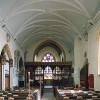
Another re-building venture close to his own heart was the re-ordering of Bere Regis Church, where he constructed the timber roof as a memorial to his parents and also left a legacy for the upkeep of the paintings. He is represented personally in the bosses, the central boss being specially carved to portray the unification of the York and Lancastrian houses. But one of Cardinal Morton’s greatest achievements was the excavation of a great leet or drainage ditch through the East Anglian fens between Peterborough and Wisbech and named Morton’s Dyke after him.

Another facet of the Cardinal’s character was his ingenuity in procuring “benevolences” from the poor and wealthy alike, a practice which gave rise to the expression “Morton’s Fork”. If he heard a nobleman was rich he would say “I hear you are a very rich man, and are surely able to spare some money for the King.” He would then “turn the prong” to the nobleman who lived frugally and say “you are a careful thrifty person who must have saved much money, and some you will be able to spare for the King.” Neither then escaped their obligations to the royal coffers. But Morton did restrain certain financial policies that Henry proposed.

The opinions of contemporary writers about the Cardinal vary considerably however. Many saw him as a strange character, one accusing him of acting “from base and sordid motives,” even of sorcery. As a young man the statesman and writer Sir Thomas More served in the Morton household. He later wrote that Morton was “a man not more venerated for his high rank than for his wisdom and virtue.”

Other writers said he was energetic, sometimes brusque with polished manners, exemplary as a lawyer, one possessed of a great mind and a phenomenal memory. Through discipline and hard study he improved the talents which nature had bestowed upon him. He was a wise man, according to Bacon, but “a harsh and haughty one.” Morton could also be summed up as being accepted by the King, envied by the nobility, but hated by the people.

Cardinal Morton died at Knole, Sevenoaks in Kent in 1500 in his 80th year, and was buried in the crypt of Canterbury Cathedral.

Peter Beckford – Squire of Steepleton

Regular users of the A350 between Blandford and Shaftesbury are routinely confounded and irritated by a series of hazardous left and right hand bends just north of Stourpaine and someway south of Iwerne Minster. Such bends often arise when the course of a road has been determined by the furlongs and headlands of medieval open-field systems. But the Stourpaine – Iwerne bends are considerably more recent being part of a landscaping re-organisation around an estate owned by one of Dorset’s more flamboyant Hanoverian country squires – Peter Beckford.

Beckford was born in 1740 into an aristocratic family who had made their fortune from the ownership of sugar plantations in Jamaica. His father was Julines Beckford and his mother Elizabeth Ashley, was the daughter of the MP for Bridport. Julines elder brother, known as ‘Alderman’ Beckford was a highly influential figure in Parliament and in the City, reputed to be at the time the wealthiest commoner in England.

Peter spent his later childhood at Steepleton, a house and estate now lying in the loop formed by the road-bends near Stourpaine. Julines Beckford had bought the mansion in 1745 when he became attracted to the brick stables and kennels already on the estate. Steepleton was then still a modest residence but later Julines bought the adjoining estates of Durweston and Shillingstone. This suited Peter’s father, as he was a keen huntsman, but he also indulged a passion for sports, languages, art and music, interests his son inherited. He further added another wing to each end of the house in about 1758.

As a young man Peter Beckford went on a grand tour of Europe and spent a number of years in Italy when he was portrayed with one of his dogs by the painter Batoni and met Muzio Clementi, a musical prodigy who Beckford brought back to live with him at Steepleton. Clementi remained in Dorset for the next seven years before moving to live and work in London.

Beckford was also interested in political economy and Government, being elected MP for Morpeth in 1767 but as he was not of the temperament to apply himself to political duties he later stood down from the seat. In 1773 he married Louisa, the nineteen-year-old daughter of George Pitt of Strathfield Saye (later the 1st Baron Rivers,) but the union was beset with some unhappiness. For a while the couple lived in London, but Beckford’s dislike of the high society of the capital compelled him to return to Stepleton. At heart it was in the role of country squire that he was most content. The Beckford’s first three children died in infancy, but eventually the couple had two surviving children: a son William Horace and a daughter, Harriet.

The incidence of the road re-organisation came about when the landowners of the estates adjoining Steepleton wanted to build a straight and wider road but on a course that would take it across part of the Stepleton estate. They therefore sent their surveyors to Beckford to explain the plan and hoped that he would approve the work, but the Squire of Stepleton was secretly adamant that he would not do so. In a display of insincere hospitality he caused the surveyors to forget the purpose of their visit by entertaining and mildly intoxicating them with glass after glass of spirits. Eventually the surveyors were left with no option but to re-route or improve the road around Steepleton’s tortuous boundary.

Like most of his family Beckford never visited the plantations he inherited in Jamaica, and so had no idea how the life of the slave-labourers contrasted with the cosy, privileged existence of an English country squire. His cousin William had taken the artist George Robertson out to Jamaica in 1774 where he painted a number of landscapes intended to portray the lush vegetation of the island, but which did not give any hint of the poverty and hardships of the slave underclass who worked themselves into early graves to create wealth for their master in England.

However, Beckford’s time abroad as an absentee landlord of extravagant spending beyond his means had led to his estates in England and Jamaica becoming run down and unprofitable. The income from the Jamaica plantations had been falling since the 1770’s as the land became exhausted and the price of slaves and stores increased. For example a Negro slave who cost £25 in 1755 cost £60 by 1770, and the government had increased the import duty on sugar. A series of five devastating hurricanes between 1780 and 1786 compounded the slump. The value of the estates plummeted, and absentee proprietors like Beckford were at the mercy of unscrupulous managers.

To ameliorate growing insolvency Beckford sold the Durweston part of his estates to Henry Portman of Bryanston in 1774, and was forced to mortgage two of the plantations to Baron Rivers for £4,000 in 1778. Hope for the Beckford fortune lay in William Horace’s being able to inherit the Pitt estates one day when Louisa’s brother George – a bachelor unlikely to marry died. But Horace had inherited much of Louisa’s immature and unstable mentality. Beckford’s heir became a profligate gambler who ran up great debts unknown to his father, and eventually had to appeal to his uncle George for £12,000 secured on Peter’s Dorset properties in order to bail him out.

Meantime, out of boredom Louisa was diverted into an affair with William Beckford, the future builder of Fonthill Abbey, though Peter chose to ignore the adulterous relationship. After becoming totally estranged from her husband Louisa went to live in Bath. His wife away, Peter spent his time hunting and building up a pack of hounds (of which he knew each by name.) He commissioned the painter Francis Sartorious, who specialised in animal studies, to portray himself on horseback, with his dogs around him. Beckford also, between 1779 and 1781, wrote a book in the form of a series of letters to a friend called ‘Thoughts on Hunting,’ a treatise that became a best seller.

In 1783 Beckford learnt that Louisa had contracted tuberculosis, and in the hope that a warmer climate might restore her health, he took her to Italy. Louisa however, succumbed and died of the disease in Florence in 1791. She was buried in the English cemetery at Leghorn. But Beckford remained abroad in Italy until forced to return to Stepleton for good when the French under Napoleon invaded northern Italy in 1799, although he returned to Stepleton for short visits a number of times in the proceeding years. His son Horace by then 22, and daughter Harriet returned with him.

Peter Beckford died a sad old man, burdened with worry and debts, at the age of 69 in 1809 and was buried in the church at Steepleton. Though he was a man of many talents, they did not bring him happiness. He lies beneath a tomb with a square entablature bearing the Latin inscription ‘PB Sibi et Suis MDCCCIX’ (Peter Beckford; To Him and To His; 1809.)

William Horace inherited the Pitt estates in 1828, and in accordance with his father’s will assumed the name Pitt-Rivers, becoming the 3rd Baron Rivers. The inheritance however, proved to be debt-ridden, and he drowned himself in the Serpentine, Hyde Park, in 1831. Stepleton remained part of the Pitt estate until 1919, when it was bought by Sir Ranulf Baker of Ranston; he later sold off the house and park.

Tom Roberts – The Painter Who Captured a Continent

He was born into the hurly-burly of early Victorian Dorchester but laid to rest in the colonial soil of Tasmania. He showed small promise of any artistic talent as a child, yet at the end of his days his works were better known throughout the largest island outpost of the British Empire than in the land of his birth. And no-one, least of all his parents, could have imagined that his future would lie in committing the raw primeval beauty of the antipodean outback to canvas.

Thomas William Roberts was born in Dorchester on March 9th, 1856, the son of a printer and reporter, Richard Roberts, then a sub-editor of the Dorset County Chronicle. Richard had married Tom’s mother, a Londoner named Matilda Agnes Cela Evans, in Shrewsbury early in 1851, and the census of that year showed that at that time he was still living with his parents, Thomas Roberts (50), described as a Brass Founder and his wife Hannah (48) both born in Shrewsbury. By 1861 however, Richard and Matilda had moved to Dorchester, having taken up residence in house in Fordington High Street. Their household consisted of Thomas, then 5, a one-year-old daughter, Alice Matilda, and an 11-year-old housemaid named Mary Wills.

Tom attended Dorchester Grammar School where he received a thorough grounding in the classics, learning quotations in Latin he was able to recall years later. During these schooldays his greatest accolade was winning a prize for scripture he later explained, “not by answering the question directly but by imaginatively writing on a related subject.”

On 30th December 1868, when Thomas was about 13 his father who was then editor of the Dorchester newspaper died aged only 41 at Wollaston Villas, All Saints Dorchester, leaving the family impoverished. His widow  then courageously resolved that she and her children should leave to seek a new life in the then developing colony of Australia. A married sister  had herself emigrated to there some years before, so that the sisters could be re-united. Tom Roberts’ first home in his adopted country was a modest one in Dight Street, Collingwood, a suburb of Melbourne.

But the position Roberts was now in determined that he could not resume any schooling, but had to find some employment at once. He soon found a position as an assistant to a local commercial photographer, but the job entailed long hours for small pay. To supplement a meagre income his mother took on the job of making school satchels as an outworker under her brother-in-law, who ran a leather goods business. During this time Tom would help his mother in the evenings by cutting out the straps for the bags. He would later write that his mother “was the bravest woman I ever met.”

After a time, Thomas’ “bulldog” qualities helped him find better employment with Stewarts, the leading commercial photographers in Melbourne. Here he progressed rapidly and showed an early artistic bent when, for a commercial portrait, he hit on the idea of using a background of tea-tree boughs instead of the conventional classical one of mock pillars and curtains fashionable at the time.

The government had embarked on a programme of establishing design schools in the state capitals and Melbourne (Victoria) was no exception. By the time he was just 19 Tom had become Stewarts deputy manager yet he took a course to study design at a new state design school founded at Collingwood, where he won the annual prize in 1875.

From this school Roberts progressed to the National Gallery Art School, usually known by its pet-name of “The Tank.” Here his talent caught the attention of the drawing class overseer, Thomas Clarke, who advised him to go to study in Europe. The gallery had only an un-coordinated training and no life-class, the training consisting mainly of copying the gallery’s own mediocre pictures. Taking the school’s dissolute students under his own wing, Roberts broke away to set up on his own.

Stewart allowed Tom to attend a half-day-a-week painting class, where he exhibited his first major picture in the photographic studio. The sale of this picture, together with earnings from local newspaper reproductions and other monochrome drawings, paid Roberts his passage back to England in 1881.

The following year found the now fully professional, dedicated 25-year-old artist studying hard at the Royal Academy. His drawings were in demand from ‘The Graphic’ and other periodicals. But then another person entered his life who was to have a marked influence upon him: painter Bastien Lepage, a protégé of the French impressionists under who’s spell Roberts himself was to fall. Studying their work, Roberts then eschewed the conventional academic school for a broader horizon.

The flourishing painter’s next move was to undertake a tour of Spain in the company of Dr. William Maloney, the artist John Russell and Sydney Russell, an architect. At one time the four nearly became embroiled in Spain’s political upheavals as partisans, but an encounter with Barrau and Casas, two first-rate pupils of Gerome was to have an outstanding impact on Roberts and his Australian contemporaries in turn. They taught him that in painting he should first seek ‘the general impression of colour.’ On his return from Spain Robert’s sketches of the country made a deep impression on Arthur Streeton and Charles Condor, two fellow artists with whom he was soon to share a close professional relationship.

However for a time Roberts fell in with an artist called McCubbin, with whom he set up a painting camp at Box Hill, Melbourne. Here they were joined by Louis Abrahams though Roberts, not content with mere landscapes, sought to record the active life of the bush. After a time Roberts and McCubbin rented a coastal shack at Mentone near Melbourne, where the former first encountered Streeton, a talented lithographer, and invited him to make a trio at Mentone. Visiting Sydney, Roberts then fell in with Charles Condor, who extended the specialist school to a quartet.

In 1887 Streeton realised that a derelict 8-roomed timber house he had come across on a hill above Heidelburg would be the ideal homebase for a painting school. The building commanded a spectacular view over the Yarra basin to the Blue Hills, and Streeton was soon joined by Roberts and Conder. It was here, between 1889 and 1891 that Roberts painted two of what are considered his finest canvases: “The Breakaway” and “Shearing the Rams.” In 1895 he began another great impressionistic bush ranging picture “Bailed Up,” but then put it aside for another 30 years before finishing it.

Conder later left the school to work in Paris, but not before the group staged an exhibition of 9×5 inch “cigar-box lid” impressionistic paintings in Melbourne. By then Australia was in the grip of a recession, though Roberts was largely unaffected and in 1896 became engaged to and married a local woman, Elizabeth Williamson. Their only child, a son Caleb, was born in 1898.

In 1901 Tom Roberts was again preparing to return to England when he held, at the Society of Artists rooms in Pitt Street, Sydney, an exhibition of paintings for sale at between two and seventy guineas. But then the landing of a prestigious commission forced the artist to abandon his travel plans. It was federation year, the event marking the historic unification of the seven colonial states into the Commonwealth of Australia. To mark the occasion the Australian Art Society commissioned a Melbourne artist for an 18×12 foot canvas for the opening of the Parliament building by the Duke of York. When this painter had to withdraw due to illness Roberts was offered the commission instead.

The artist then embarked on a tour of the country, sketching all the political figures and scenes to be featured. Although the fee was 1000 guineas, Roberts would come to regret his decision to accept the mammoth project, which would take him two years to complete. The picture is now mounted in St. James’ Palace, London.

By now Roberts was back in England with his family in hopeful expectation of further portrait commissions. Troubled by the notion that his technical skill was falling below his earlier high standard, he seriously considered painting ‘pot-boilers’ for the London market. The dark clouds passed however, after friends prevailed upon him to exhibit at the Walkers Gallery in New Bond Street.

On the outbreak of the First World War, Tom Roberts and his friends rushed to enlist in the volunteers. Tom was posted to carry out menial tasks at Wandsworth Military Hospital, giving up painting entirely for he was never offered an official artist position. Demobbed as a Sergeant in the RAMC, he returned alone to Australia in 1919 for a one-year extended vacation, retreating to the Dandenong Ranges to seek solitude and inspiration for more landscapes. The following March he held a one-man exhibition, returning yet again to England at the end of 1920 to rejoin Elizabeth and Caleb.

This last furlough in his mother country lasted three years until 1923, whereupon Roberts returned with his family to his beloved Dandenongs, this time for good. He built a cottage home “Talisman” in the village of Kallista, and resumed his painting, seemingly amid a whirl or renewed creative energy and discernment. In 1927, when Roberts was 72, Elizabeth died, yet the aging painter could not remain inactive, and the following year he visited Apollo Bay, the Goulburn Valley and Tasmania.

Jean Boyes, for sometime a friend of Tom, became the widower’s second wife in August 1928, the couple making a new home for themselves in Tasmania. In 1930 they returned to Kallista, and it was here, on September 14th, 1931 that Thomas Roberts died, aged 75. In accordance with his will his body was taken back to Tasmania and buried in the quiet churchyard of the village of Illawarra.

Truly, Thomas Roberts was ahead of his time as a pioneer global commuter in an age when many country people would never travel more than a few miles from their place of birth. His is a legacy Dorset can be proud of in having given birth to him.