He was “a tall man, above two yards high, with dark brown hair scarcely to be distinguished from black.” That is the description of the 21-year-old King Charles II posted about the countryside by Cromwell’s men as they looked everywhere for him, encouraged in their search by the prize of £1,000 on his head.
The King realized on the 3rd of September, 1651 that the “battle was so absolutely lost as to be beyond hope of recovery.” Almost alone except for Henry Lord Wilmot the King escaped from the Worcester battlefield and headed for Wales but finding the River Severn too heavily guarded he turned south towards Bristol, where he hoped to find a ship to take him to France. No ship could be found in Bristol and it became clear he must use a south coast port to make his get-away.
Charles owed much to the loyalty and imagination of his Roman Catholic supporters in whose houses he stayed as he made his way south. He reached Abbots Leigh, the home of Sir George Norton, on the 12th of September where he was recognised by the butler, John Pope, who suggested Trent for his next refuge. It was quiet, had no particular strategic value for the Parliamentarians and it was in a straight line from Bristol to the coast and only a score and ten miles away from a safe passage to France; it was the ideal bolt hole while plans were made for his escape.
Trent is one of those border parishes that over the years has gone to bed in Dorset and awoken in Somerset and vice-versa. Since 1895 Trent, a short step north-west of the town of Sherborne, has been in Dorset but in the mid 17th century it was a part of Somerset and The Manor House was home to a family well known for their Royalist sympathies: the Wyndhams. Edmund Wyndham had married the King’s nurse, Christabel Pyne, and had served under Lord Wilmot during the early days of the Civil War.
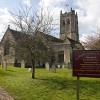
Lord Wilmot travelled ahead to warn the Wyndhams. Travelling behind and staying overnight at the Castle Cary home of Edward Kyrton the King was accompanied by Jane Lane and Henry Lascelles. The party arrived at Trent about ten on the morning of the 17th of September. Playing the role of servant to Jane Lane the King was wearing a suit of grey cloth; the small group was quickly ushered into the house and out of sight of any busy-body neighbours. The Manor House is only 100 yards from the parish church.
Francis Wyndham was despatched to arrange a passage for the King. He called first on Sir John Strangeways at Melbury but neither he nor his sons could offer any suggestions although they contributed £100 to the royal purse. Wyndham travelled on to Lyme Regis and for a consideration of £60 secured a passage with a Stephen Limbry, who was taking a cargo from Charmouth to St. Malo on the 22nd of September. The cover story was that a merchant and his servant were escaping from their creditors.
The King, Juliana Conigsby, Wyndham, Lord Wilmot and Henry Peters, Wyndham’s servant, departed from Trent. They met Captain Ellesdon, who had made the introduction to Stephen Limbry, at a house on the hills above Charmouth where final plans were made. But not for the last time an element of farce crept into the best laid plans in the King’s bid to reach France.
Francis Wyndham and his servant waited throughout the night on the beach at Charmouth but Limbry failed to make the rendezvous. The King with Wilmot and Juliana Coningsby playing the role of eloping lovers took rooms at the Queen’s Arms. The party left Charmouth for Bridport in the morning and, it seems, not a moment too soon for the blacksmith had noticed Lord Wilmot’s horse had been shod in three counties including Worcester.
Henry Peters was sent to Lyme Regis to find out why Limbry had not appeared. It seems his wife had guessed her husband was embarked on a dangerous mission and decided to lock him in his room and threatened to report him if he attempted to escape.
At Bridport there were Parliamentarian troops waiting to leave for the Channel Islands so the party couldn’t stay there and set off again, fortunately deciding to leave the main Bridport to Dorchester road and head for Broadwindsor just before a troop of Roundhead soldiers led by a Captain Macey began a search for them.
The landlord of the Inn at Broadwindsor knew Wyndham and gave them a room upstairs. Farce again played a part but this time working to the King’s advantage. The constable arrived at the Inn with forty Roundhead soldiers to billet. At about midnight one of the women following the soldiers gave birth in the Inn to a particularly noisy baby. The parish officials, overseers and churchwardens, were more interested to find out who the father was and avoid a charge on the parish chest than they were to investigating rumours that the King was in the vicinity. In all the confusion the royal party made their escape and returned to Trent.
His presence was the cause of much anxiety and apprehension to the lady of the house and her mother-in-law, Lady Wyndham, as they guarded against all contingencies. It is recorded that on the King’s first arrival at The Manor House Ann Wyndham was overcome with emotion by the sight of “so glorious a prince thus eclipsed” and paid him “the homage of tears.” The consequences of capture were serious indeed for the King but all of his supporters who actively assisted him, if caught, would likely suffer a similar fate. One has to wonder if the Wyndhams were as overjoyed to have him as their guest a second time.
The local tailor warned them that local supporters of Cromwell had their suspicions about the guests and that a raid on the Manor House was planned. On another occasion Anne had seen a troop of Roundhead soldiers in Sherborne and entreated the king to go to his privy chamber, probably a priest’s hiding place. Colonel Wyndham let it be known that his guest was his relative Col. Bullen Reymes and he would show himself at church that Sunday.
Lord Wilmot had been despatched from Broadwindsor to Salisbury to rendezvous with other supporters and make plans to get the King away via the port of Shoreham. On his return to Trent Henry Wilmot was not best pleased to find that it was his turn to play a role; that of Col. Bullen Reymes, who he resembled in build and stature.
Now it was the turn of black comedy rather than farce too come to the King’s aid. The King in conversation with the diarist Samuel Pepys after the restoration recalled hearing the church bells ringing to celebrate his death. He told Pepys: “There was a rogue, a trooper come out of Cromwell’s army that was telling the people he had killed me, and that was my buff coat which he had on; upon which, most of the village being fanatics, they were ringing bells and making a bonfire of joy of it.” The King may have owed his life to that rogue trooper who having hood winked the local Protestants for his own aggrandisement had successfully diverted their attention from the guest at the Manor House.
On the 6th of October Charles was able to take his leave “of the old Lady Wyndham, the Colonel’s lady and family, not omitting the meanest of them that served him.” He set off with Juliana Coningsby riding pillion behind him, accompanied by Col. Robert Phelips of Montacute and Henry Peters. They made for Wincanton and Mere and on, without mishap, to Shoreham on the Sussex Coast where on the 15th of October he set sail on the brig ‘Surprise’ and into exile that was to last for nine years.
Some in the villagers of Trent must have guessed who was staying with the Wyndhams and for whatever reason hesitated to turn Charles in. The local Protestants and especially those of non conformist persuasion would have been livid when they realised he had been living amongst them and they had failed to capture the Papist King.