Dorset Ancestors Rotating Header Image

Real Lives

The Lady Who Wouldn’t Drown

At the beginning of the 19th century Wareham and Poole were linked by a ferry route across Poole Harbour. One source of information about this run could be said to be the annals of its disasters. One such tragedy can be read about in a broadsheet printed in Poole by J. Moore after word reached the paper of the sinking of the Wareham ferry in the harbour on Thursday, 2nd of October 1806, in which 13 people including two under twenty years of age were drowned.

The 2nd of October 1806 was a stormy day of high wind, fog and rain. The ferry had departed from Wareham between five and six o’clock deeply laden with ten women and two men as passengers; the ferry’s owner Mr. Gillingham; and two boatmen, William Turner and Charles White, making 15 aboard in all. Between six and seven o’clock, after it was already dark, a fog had descended and a strong wind ahead blew hard upon the starboard side, causing the ferry to run aground across the channel just as the vessel entered the Wareham River at first and last boom.

The passengers then crowded towards the mast and rigging, while the men got aloft, but the boat sunk within a few minutes. The current, running against the sails, drove all under water, forcing those who had climbed the mast for safety to plunge into the harbour.

But only Mr. Everett was able to escape. However, he noticed that Mrs White was floundering in the water beside him. Clutching the young woman, he attempted to swim to the nearest shore with her – 100 yards from the Purbeck side – but the heavy coat she was wearing forced him to let go of her. Just then an oar floated nearby. Everett caught it and lay Mrs White upon it, using it as a kind of crude life raft. After battling the waves for one-and-a-half hours the two were washed ashore.

Following a rest, Everett made for the nearest house to summon assistance, only to be snubbed by uncooperative occupants. He then walked the two-and-a-half miles into Wareham, where he was able to get help. At Wareham a Captain Bartlett “immediately hastened with everything necessary” and brought Mrs White to his own home. Mrs White soon made a full recovery from her ordeal and was re-united with her joyous husband and children at Church Knowle.

The original broadsheet reporting this accident was in the possession of the Barnes Family of Poole, as Jane Barnes, 33 at the time and presumably a relation, was one of those who lost their lives when the ferry sunk. Charles White, the boatman who also drowned, is buried at Wareham in a grave in which his wife Elizabeth and daughter Mary were later interred.

The thirteen who were drowned were:
William Gillingham (52); William Oxford (37); William Turner (52); Charles White Jr. (33); Elizabeth Pindar (27); Betty Brown (39); Amelia Randall (19); Edith Randall (24); Elizabeth Mintern (38); Elizabeth Forster (27); Mary New (33); Jane Barnes (33), and Sophia Dorey (19).

‘Tapper’ Toms (1854 – 1924)

Henry Thomas Toms grew up to be one of life’s characters. He was known as Harry Toms and later in life acquired the nickname of “Tapper”. Some thought he was a little eccentric; certainly he was one of those old-time independently minded individuals with curious ways we rarely see in our villages today.

He was the son of William Toms, a thatcher from West Lulworth who went to Winfrith Newburgh, a neighbouring village to find a wife. He married Mary Roberts at St. Christopher’s church, Winfrith, on the 8th of October 1833.

William took his bride home to Lulworth and on the 25th of May 1834 their first child Henry was baptised at Holy Trinity Church at West Lulworth. A further ten children would follow: John in 1836, Martha in 1837, Mary in 1838, Joseph in 1841, George in 1843, Sarah in 1846, Jane in 1848, Fanny in 1851.  We have not carried out a forensic examination of the family history but it appears the first child Henry and the second child Martha died in infancy and we believe Fanny died aged about 6 years.

Then in 1854 William and Mary had another child they named Henry Thomas. Mary probably thought her days of nursing children were over but she would have been mistaken, because six years later at the age of 45 she again found herself pregnant and in due time a further son, Walter George, arrived. In 1871 Mary Toms then 56 years of age and a widow for these past six years was living in West Lulworth with her sons 16 years-old Henry Thomas and 11 year-old Walter George. Mary passed away in 1880.

Harry Toms worked as a general and sometimes agricultural labourer. It was the custom in those days to lay a neat hedge, but not Harry, who excused his work by saying “I don’t hold wi’ trimming hedge sticks, a good rough hedge ‘ull kip out cows”. Not surprising then, that he was not always fully employed and his work was said to be “average”, perhaps the result of losing his father at a young age before he could learn his father’s trade.

When trimming hedges he always found a walking stick to add to his collection, each stick had a ‘frost’ nail driven into the end of it to prevent slipping. He always used a stick and the noise of the nail on the hard road earned him his nickname – “Tapper”.

He was a man of regular habits and idiosyncrasies. Nightly he would “tap” his way to the Red Lion Inn at Winfrith where he would enjoy some ale and a smoke before setting-off home again, always leaving at 9 p.m. “Tapper”, we are told, never bathed and was often “itchy” and people got used to seeing him rubbing his back against a post. When summer came he would “tap” his way to the sea to wash his shirt, which he would wring out as dry as he could and then put it back on, it was dry by the time he got home. He believed sea water would not give anyone a cold and surprisingly he was always healthy. He told the time by the trains (try doing that today!). People described him as an interesting talker often using words that had long passed out of fashion.

In his later years he was employed on the farm of Mr. George Atwil at Winfrith and he made his home in an empty cow stall. It seems “Tapper” never slept in a bed or ate his meals from a table and he refused both when offered by Mr. Atwil. He would collect his meals from the farmhouse and ate in his cow stall and when he turned-in for the night he would remove his boots and sleep fully clothed covered with old coats in the feeding trough. It seems there was not a woman in Lulworth, Winfrith or Owermoigne who would entertain the prospect of taking  “Tapper” for a husband.

We know “Tapper” was working at Atwil’s farm until at least 1916. When he became too old to work he was taken to the Workhouse at Wareham where he died in 1924. He was described as a “queer looking man, short, wiry, rather humped-backed, with busy eyebrows that overhung his sharp little eyes, and a ginger beard, and he wore a trilby hat with its crown always pushed up”.

The Bennetts of Lyme Regis

Sometime in the year 1774 or possibly 1775 a young man still in his teens bade farewell to his parents at the family home in Chard, Somerset, and walked the twelve miles towards Lyme Regis on the south coast, to begin a new life of independence. Since it is thought that the boy already had an aunt living in Uplyme, just over the Devon border to the north of Lyme, he first lived with them, though he would later move down to become a man of property and renown in the town itself.

The youth was John Bennett, and his move to Lyme sometime after 1776 proved to be the starting pistol for a productive life spanning almost eight decades in the service of the town. However, John was just the outstanding ancestor; for he went on to sire a kind of dynasty of civic notables who in no small way through their own family lines temporarily replenished Lyme’s dwindling population during the years of its early 19th century revival as a health resort. Lyme built ships, caught fish, mended nets, wove silk, and traded cloth; here also William Pitt lodged, Jane Austen danced, Princess Victoria stayed and Mary Anning hammered fossils out of rock. Bennett’s arrival clearly coincided with an auspicious time for civic betterment and reconstruction.

From his relation’s home in Uplyme John would descend the steep hill to the town to work as an apprentice to a cordwainer (shoe-maker). This was an honourable trade of seven years indenture or training, and Bennett was no exception to the tradition of literacy and erudition among its practitioners; indeed he was noted for his steady handwriting and signature. John was also a competent violinist, who was soon playing at dances held at Lyme.

In September 1788 John Bennett married Maria Denning, a local women the about 25 years old in St. Michael the Archangel Church. Their first child was Henry, born in 1790, who was followed by Maria (1791); Elizabeth (1793); William (1794); Eleanor (1796); Mary (1797); Sarah (1798; Ann (1799); John (1801); Thomas (1803) and William (1804). Five of these children would survive childhood, but the first William died as a baby, as did Mary and Sarah in infancy soon after.

By 1800 Mr Bennett’s shoe-making business was prospering and in 1802 he rented a house on Bridge Street, off Cockmoile Square, next door to the home of the Anning family. Fossil-collector Mary was then just three; the two families never inter-married however, Mary dying a spinster. However, it has been suggested she may have fostered an interest in fossils in some of the Bennett grandchildren.

For another local family it was a different matter. Mr & Mrs Govis, regular customers of Mr Bennett, had a daughter, Mary, to whom Henry was strongly attracted – so much so that their first child, Henry Jr. was actually conceived before his parents wedded in November 1812. By this time Mr Bennett had deeply committed to administering St Michaels as a churchwarden and as a member of the town council. As Lyme became something of a mecca for health-bathing, he took possession of one of the town’s three public baths. When he wasn’t pre-occupied with his business, the Corporation, and the Church, Mr Bennett had to fight a lifelong battle defending his other properties from storm damage and coastal erosion.

Henry and Mary’s second son Edwin was born in December 1814, being followed by John (1817); Emily (1820); William (1821); Frederick (1824); Caroline (1825); Elisha (1829) and Augustus (1832). Of all John and Maria’s 11 children, Henry was the only one of two to establish solid, contiguous lines of descent. The other was John, who after his marriage to Eleanor Woodman in July 1825 had six children by her: Ellen-Kate (1826); John (Woodman) (1827); Charles (1830); Maria (1831); Joseph (1834), and Rose (1836). Born in Cerne Abbas in 1799, Eleanor came to know John as a friend of his younger sister Ann, with whom she entered into partnership running a millinery shop in Lyme. Between them these Bennett brothers would disperse the Bennett genes to other parts of the country and abroad.

Contrary to his father’s hopes. Henry Sr evidently had no leanings towards a cobbler’s life, finding his true vocation as a schoolmaster; being also a talented musician, he filled the position of organist at St Michaels and taught children music. His younger brother was not so fortunate. Mr Bennett taught his son the cordwaining business, but in 1837 John drowned when a boat returning him from Charmouth capsized in a squall.

Soon after their marriage John and Eleanor bought Malabar House, a fashionable property where in later years Eleanor was to become a warm-hearted mother-figure to her own children and some nieces and nephews. Now a widow she kept up her shop, though in 1832 Ann had married widower, Richard Cox, a saddler by trade in Bridport, and moved with him to that town, leaving Eleanor to run the millinery shop on her own. By Richard her sister-in-law had three children: John (1834); Emily (1836) and Richard (1838).

Of John and Eleanor’s own children Ellen-Kate married john Sharpe, a solicitor’s clerk from Norfolk in August 1853. She bore him seven children: John Woodman; William, Eleanor; Alice; Charles; Clara and Rosalie, between 1854 and 1858. Eleanor Bennett’s Charles married Elizabeth Smith in 1852 and emigrated to Australia, but died only eight years later from wounds sustained in a bizarre shooting accident in 1860. Buried in Geelong Cemetery, Melbourne, he left Elizabeth with two sons and a daughter to bring up. Maria, Eleanor’s second daughter, married Richard Loveridge, a London cheese-monger in May 1856. The couple had grandparents in common, for Richard’s grandfather, also called Richard, married old Mr Bennett’s sister Eleanor; he was therefore, Mr Bennett’s great-nephew. Richard and Maria had four children born between 1857 and 1862: Eleanor, Anne, John and James, but by the latter date these children were orphaned. They were adopted by grandmother Eleanor, and so went to live with her at Malabar House.

That left John, Joseph and Rose. John married Sarah Longhurst in Hackney in October 1870; at the time he was living and working with Joseph in Devizes, who like him had not remained in Lyme beyond childhood, but unlike him, had no recorded issue. Joseph married Jane Wing, a London girl, in the capital in January 1857. They had seven daughters and four sons. Rose married Thomas Brown, Lyme ironmonger, in January 1862. Their son and daughter were born in a house on the Cobb before the couple eventually went to live in London.

Of Henry and Mary’s branch of the family, Henry Jr married twice: first, Priscilla Loveridge in April 1835, and after her death, Martha Murley in October 1846. By Priscilla (apparently un-related to Mr Bennett’s sister’s family) Henry had three children: Henry Alfred; Esther, and Myra, between 1838 and 1841. He too became a schoolmaster and succeeded his father as organist at St. Michaels.

Henry’s brother Edwin married Emma Dunster, daughter of a local builder, in October 1834. The Dunsters, however, were better known as a Lyme family in the printing trade, and for a time Edwin went into partnership with them as Bennett & Dunster. By 1839 they had left Lyme, leaving the business to Daniel Dunster. Edwin and Emma had five sons and five daughters.

William, fourth son of Henry Sr married Elizabeth Spear, a London-born Bridport woman 20 years his junior, on Boxing Day 1864. The couple had four children: William Henry; Mary; Esther; and Minna, between 1865 and 1883. William became a prominent figure in Lyme and by 1880 he would be almost the last of the Bennetts still living in the town. One of his later duties was to collect harbour dues, but he was a gifted painter, mainly of the local land and seascapes, though he also painted portraits of his grandparents, old John and Maria.

Elisha married Sarah, though it is not certain who she was, whether Sarah Longhurst or someone else. After his brother’s re-marriage Elisha became a master mariner in South Shields. According to the recorded selective genealogy of the family neither he nor his siblings John, Emily, Frederick and Caroline, are shown as having any descendants, and of these, only Elisha married.

With the death of William in 1881 and Elizabeth’s move to Bridport with the children, the perpetuation of the Bennett line effectively ceases. Henry Jr’s last son Augustus is a progeny of particular significance, for he was the last Bennett to be living in the town at the time of his death in 1911. Eleanor Woodman Bennett, the home matriarch of Malabar House, died April 28th, 1873 in her 74th year.

As for John and Maria, the patriarch and matriarch of the extensive Bennett clan, they died in 1852 and 1831 respectively – but not before seeing about 20 of their 72 descendants born. Demographically, the family is interesting in that it appears to buck the trend for the period in two respects. Not because of the size of the generations, for ten to twelve children was the norm in the late 18th and 19th centuries. It is that at least one Bennett bride –Henry senior’s Mary – did not go to the altar as a virgin, and also the atypical longevity of John Bennett himself, in that he lived long enough to become a great-grandfather.

However, any diligent search for Bennett graves in the churchyard is likely to be futile. Although family members were buried in Lyme cemetery and at St Michaels, the area of consecrated ground at the latter that formerly included the Bennett plot has been reclaimed by the sea through landslipping.

William Wareham (1860-1961)

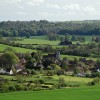
As the government announce plans to scrap the official retirement age and raise the age of entitlement to a state pension and scientists tell today’s children they can expect to live for over a hundred years, this is a good time to look back on the life of an ordinary Dorset man who achieved his century at a time when most would have settled for three score years and ten.

Born at Iwerne Minster in 1860 and baptised at the parish church of St. Mary, William Wareham was the third child of Benjamin and Sarah Wareham. His two older siblings were Sarah and Mary and he was followed by Lavina, Charles, and Richard. His father sent him to school for half-days and made sure he had a basic education and learnt the three ‘R’s.

Someone visiting him in his later years was surprised to find this labouring-man’s bookcase filled with the works of Adam Smith, J.S. Mills, Karl Marx, Engels, William Morris, and others. William would recall how, when he was eight-years-old, he worked twenty-eight hours a week for a clergyman who paid him one shilling. He told of having to mow a lawn on a blistering hot summer’s day while the house owners relaxed and played a leisurely game of croquet. The memory of the many social injustices, the hard work for meagre wages, the poverty and the hardship suffered by the working classes, particularly in rural areas, stayed with him throughout his long life. As he grew older he determined to expand his knowledge of politics and economics and was especially interested to learn how they affected agriculture and the rural communities that worked the land.

His father, Benjamin, told him of the time in 1848 when the common was enclosed and how he was one of those obliged to carry out the unpleasant task. William had much in his character that was in common with the thoughts and aspirations of those Dorset heroes known collectively as the Tolpuddle Martyrs.

In 1885 he married Anna Maria, the daughter of Frederick and Rebecca Coombes. William and Anna enjoyed nearly sixty-years together before Anna passed away in 1944. It was a further 17 years before William died in 1961. They are buried together in the churchyard at Iwerne Minster. They had a large family: Margaret (1887 married William Baker in 1913); Norah (1888); Charles (1888 married Ethel Burden in 1912); Sydney (1891); Ellen Mary (1892 known as Nellie married William Martin in 1913); James (1894); John (1896 married Edith Lewis in 1922); Annie (1898); Walter Richard (1901 married Florence Harvey 1926) and Robert (1903).

William by all accounts was not impressed by modern amenities. He shunned electricity, preferring his oil lamp and he would not have water connected to his home and used to get his supply from a nearby pump which dispensed pure spring water. He would have nothing to do with cars, wireless or television.

His garden was one of the best kept in the parish of Iwerne Minster where he lived for most of his life and which he tended right up to his death. At 32 rods in length – that is over 500 feet to you and me – it was more than a cabbage patch and he certainly couldn’t be accused of taking things easy or putting his feet up in his old age. William was an agricultural labourer until the late 1890’s when he became a roadman; in the 1911 census he is described as a road contractor.

William Wareham had an appetite for life. His life was straight forward and uncomplicated. He worked hard, was a teetotaller and a non smoker: things those of us approaching but wishing to linger a little longer outside of God’s waiting room would do well to ponder.

William & Hannah Part 3 – Separate Paths

When their eldest son William met with his fatal accident in May 1881 it is almost certain that William and Hannah Cheeseman (by then Chisman) were again living at Winfrith.  They were not however to resettle there immediately and within at most eighteen months they had again moved. 

William was once more hired as a shepherd, this time at Church Knowle on the Purbeck Hills, some eight miles to the west of Winfrith. Two years after the death of young William, Hannah bore her last child, a son, who was born at Church Knowle in 1883.  Hannah was by then aged thirty-five, while William was fifty-five.

It is known that at least one of his sons did not consider William to be a good father.  Indeed there is a suggestion that William was in fact a drunkard. When the Chismans were living at Blacknoll it is very possible that James Hibbs and William’s mother Amelia had been a restraining influence.  However, with their deaths that influence had ended and perhaps the material situation of William and Hannah had simultaneously deteriorated.  The move to Milton Abbas, the return to Winfrith and the further move to Church Knowle indicate a less settled state and family tensions could have been heightened by the death of the eldest son.

After the birth of their last child in 1883 matters clearly worsened.  Did an ageing William resent his younger wife’s energy?  Did a deeper resentment and memory of the circumstances of their marriage irritate him? Was he naturally a drunkard, or was he provoked by circumstances? Was he angered by some element in Hannah’s behaviour?  The questions readily present themselves, but the situation in the Chisman household remains hidden.  There is, however, one certainty:  William and Hannah were to part.
 
The date and circumstances of their separation are not known.  Perhaps it was after a return from Church Knowle to Blacknoll that Hannah left William, taking the children with her. Perhaps the family had moved to Portway at Winfrith and William had then deserted them.  All that is certain is that at some point before the end of 1890 Hannah found herself installed at Portway Farm with some of her children.  Hannah had become the head of the household and of William there was no sign.

Subsequent events sadly afford no reason for believing that Hannah’s separation from William was without animosity.  If the situation had been such that William had been forced out of the family home it would have been a very difficult episode.  In Victorian England the husband was (and was expected to be) the master of the household.   It is most probable that it was Hannah that had departed.  If so this would reflect her resolve and perhaps William’s condition.  It is possible that Hannah received help from her own brothers, one of whom is believed to have owned land in the vicinity.  (If any help had come from her brother John it would indeed have been an extreme irony.)

Even had she received support, Hannah nonetheless found herself with the responsibilities of a mother, married only in name and without the help of a husband.  Yet the relative positions of Hannah and William had changed and would continue to do so.  Since a disgraced Hannah had returned to Blacknoll some twenty years earlier the wheel had almost turned full circle.  Whatever William’s feelings had been towards Hannah at the time of their marriage, he must at least have seen that marriage as assuring himself of support and comfort in old age.  That was now a hope or expectation shattered.

Portway lies close to Winfrith village as it is approached from Blacknoll.  The beginning of 1891 saw Hannah at Portway Farm, with her eldest daughter Annie, then aged twenty-one, and her three remaining sons, aged fourteen, eleven and seven years.  Her other two daughters had left home, but one was working as a domestic servant at nearby Fossil Farm House.  It is clear that despite the adverse circumstances Hannah was coping.  It is even possible that without William she enjoyed a relative prosperity.  Perhaps at Portway Farm she was indeed a small tenant farmer.

William Chisman’s condition, however, was very different. Now in his sixties, he was probably living at Blacknoll, alone, and possibly finding it increasingly difficult to work to keep himself.  His final years were truly a period of decline. For a person alone, with no means and no family support, employment was imperative.  If through ill-health, unreliability or simply lack of employment William had been unable to work, then his situation was precarious.  It would seem that this was the path that William trod and eventually, unable to support himself, he entered his last haven before the grave.  By at latest the end of 1900 William was a pauper and an inmate of the Union Workhouse, Wareham, the very place where over thirty-five years earlier the seventeen-year-old Hannah Hibbs had given birth to her illegitimate son.

If William’s wife or children knew where he was, it appears there was no contact between them.  If he had not abandoned his family, they had certainly abandoned him.  William died on 23 January 1903.  He was aged seventy-six.  His body was not brought ‘home’ by his family, but was buried in a churchyard near the workhouse.  He had bequeathed his children only his name, Chisman.
 
Some years earlier Hannah had moved the short distance from Portway Farm to Fossil Farm Cottage.  There in 1901, as head of the household, she and her two youngest sons occupied four rooms.  Her sons were then young adults aged twenty and seventeen.  The elder worked as a ‘farm carter’; the younger as a farm labourer.  At least one of the two youngest Chisman daughters had already married.  Although Annie remained a spinster, she was no longer in the household.

In the next few years Hannah’s two youngest sons married and it seems likely that Hannah went again to live with her daughter, Annie, somewhere in Portway.   Certainly mother and daughter were both resident in Portway at the time of Hannah’s death.  Hannah, born ten years after Queen Victoria had come to the throne, lived on through the Edwardian years, dying just a month before the death of Edward VII.

Hannah died on the 29 March 1910. She was aged sixty-three.  Her death certificate records that she was the ‘widow of William Chisman, Shepherd’. 

Hannah had grown up at Blacknoll and spent much of her married life there.  Then after the brief periods at Milton Abbas and Church Knowle she had returned to Winfrith to settle finally at Portway, at the edge of Winfrith Newburgh village.  At the other end of the village stands the church where Hannah had been christened and married and which had witnessed the christening of all but one of her children.  Fittingly Winfrith churchyard became her final resting place.

Hannah’s grave lies inconspicuous, close by the lych-gate.  It is marked by a modest, but dignified headstone: a silent witness made poignant by knowledge of the life it commemorates.  The stone bears no reference to her husband William.

William and Hannah Part 2 – Marriages of Circumstance

On 13 December 1864, Hannah Hibbs gave birth to a son. The child was named Frank Edwin Hibbs.  The birth took place in the Union Workhouse at Wareham.  The child’s father, Hannah’s own brother, John, had also left the family home, but his circumstances were very different from Hannah’s.  Five months earlier, in July 1864, John had married.

The workhouse had provided a refuge for Hannah, but she could not remain there indefinitely. What was to be become of her and her child and in what manner did Hannah’s situation exercise the mind of her father?  He had lost the benefit of her services in the cottage, but did he want her to return and could he let her do so?   Her absence from home would have been evident to neighbours and the reason apparent.  Moreover, any attempt to conceal the paternity of Hannah’s child would not have prevented speculation among the Blacknoll community.  Yet Hannah was to return to Blacknoll.

The sequence of events that unfolded over the next three years is unclear. However, early in 1867, just two years after the birth of Hannah’s child, the Hibbs’ neighbour Jonathan Cheeseman died, aged seventy-four. Perhaps James Hibbs and the newly-widowed Amelia Cheeseman were already on friendly terms.  Possibly James had confided in Amelia and sought her advice about Hannah.  Whatever the nature of their previous acquaintance, following the death of Jonathan a closer relationship developed between them.  It would not have been unreasonable for James and Amelia, widower and widow, to have sought mutual solace and support.

It is not known whether Hannah had by then returned to Blacknoll, with her child.   However there can be little doubt that she was the subject of discussion between James and Amelia and it is not unlikely that it was Amelia who proposed a remedy to Hannah’s predicament.  Whether Amelia took the initiative or whether the proposal arose in another manner, Hannah’s situation was to be resolved.  She would marry Amelia’s son, William Cheeseman, a bachelor twenty years Hannah’s senior. William had first encountered Hannah as a young girl or at latest when she was just adolescent.  He would have seen her grow into a young woman.

For William the prospect of entering his later years alone, without help or companionship, must have been unwelcome.  Perhaps his nature had prevented his marrying previously; perhaps a lack of opportunity. Yet even had he felt strongly the wish to marry, could he in normal circumstances have contemplated marriage with Hannah or, importantly, she with him?  But circumstances were not normal and Hannah’s feelings towards William and marriage were probably of little account.  Practical considerations would have prevailed.  . 

William and Hannah were married at Winfrith on 6 August 1868.  Hannah was aged twenty and William was forty (though on the marriage certificate claimed to be only thirty-seven).

Their marriage was not the only one to take place in Winfrith church in that summer of 1868.  Exactly one month later, on September 6, Hannah’s father, James, and William’s mother, Amelia, became man and wife.  James was sixty-seven years of age and Amelia was seventy.  The witnesses at the marriage ceremony were their newly-married children, William and Hannah.

William and Hannah set up home at Blacknoll.  Hannah, long used to domestic chores and living in a male household, was perhaps better prepared than William.  The latter now found himself in an entirely new situation as head of a household and with a young wife.  He also found himself with a stepson.  More than that, it was the child of his wife’s brother, a younger man well-known to William and a man whom he would continue to encounter.  Some sense of resentment on William’s part would be understandable.  It is not impossible that this might have reinforced any feeling he harboured that Hannah was indebted to him for having rescued her from her plight.

William Cheeseman began his married life in a less uncertain world than that into which he had been born.  In 1837 the young Victoria had come to the throne and by the second half of the nineteenth century Britain was a confident and prosperous nation.  Not every citizen, however, shared in that prosperity. Life for agricultural workers remained far from idyllic.  Employed as a farm labourer, William would have led a relatively hard working life for poor wages and would have been fortunate if he enjoyed security of employment.  It is possible that the Cheeseman’s situation had been eased if, as seems probable, William’s elderly father-in-law, James Hibbs, owned or rented a little land, which through subletting or exploitation, would have augmented meagre incomes.

In July 1869, within a year of their marriage, William and Hannah had their first child, a daughter, Amelia Annie, known as Annie.   A year later Hannah gave birth to a son.  He took his father’s name, William.  By 1878 a further two daughters and a son were born to the couple.   Surprisingly perhaps the Cheesemans’ younger son was given the name John.  If William had felt antagonism towards Hannah’s brother, would he have allowed his own son’s name to remind him of John Hibbs?   Meanwhile, however, Frank, the child of Hannah and John, had left the Cheeseman home to live with his own father and his stepmother.

Interestingly, in this period the surname of the family was evolving. In the church records the children remained Cheeseman, while in the civil records the family name had become Chisman.

This period also saw the passing of the older generation.   In December 1875 Hannah’s father, James Hibbs, had died and was buried at Winfrith. He was aged seventy-five.  He and Amelia had enjoyed seven years of marriage.  Widowed for a second time, Amelia lived only a further eighteenth months and died in June 1877, aged seventy-eight.  She too was buried at Winfrith.

Then, sometime between the latter part of 1878 and early 1880, William and Hannah moved with their children from Blacknoll to Higher Hewish, in the parish of Milton Abbas. It is possible that the deaths of James and Amelia changed the circumstances of William and Hannah; possibly releasing them from an obligation of care, possibly removing from them the use of land.  At Higher Hewish William took employment as a shepherd and probably received better wages than he was getting at Winfrith.   The family had earlier connections with Milton Abbas, where Jonathan Cheeseman had once worked, and the choice of Higher Hewish was probably determined by the fact that William’s half brother also worked there in that period.

At Milton Abbas in December 1880 Hannah bore another son, George. Any joy at the birth of a further son was to be short lived.  A few months later, in May 1881, the Chisman’s eldest son, William, was killed in an accident in which he was run over by the wheel of a coach.  He was just ten years old.

At that time child mortality through illness or accident was high, but that fact would have been of little comfort to the family.  The children had lost a brother; and Hannah, having just brought a son into the world, saw another taken from her.  William too could not have been indifferent to the death of his eldest son and namesake.
 
Young William’s fatal accident took place at Winfrith, suggesting that the family had returned there; a suggestion reinforced by the fact that William was once more working as a farm labourer.  It is possible that the Chismans had never intended to stay long at Higher Hewish.  It is equally possible that William had been hired there for a fixed period and that for some reason was not re-engaged.

Whatever circumstance prompted the return to Winfrith, events of the ensuing years would suggest that all was not well in the Chisman household.

To be continued……..

William and Hannah Part One – A Family Affair

Jonathan Cheeseman was an agricultural labourer, sometimes shepherd; a man of little substance. He was born in 1794 in the Dorset village of Litton Cheney, but even before his marriage in 1817 he had embarked on a series of moves from parish to parish in a small area to the east of Dorchester.   It was there, at Tincleton, in the summer of 1821 that Jonathan’s wife died.  His feelings on the loss of his wife after just four years of marriage were threaded with concern.  How could he both work and care for his two young sons left motherless?

Whatever the immediate solution, Jonathan’s situation was relieved when two years later he remarried.  His second wife was Amelia Vincent, some four years younger than Jonathan and aged about twenty-five at the time of their marriage in May 1823.  Within a year Amelia bore Jonathan a daughter.  Four years later, in 1828, Amelia gave birth to a son, William.  Unsurprisingly William would in due course become an agricultural labourer like his father.  He too at times would work as a shepherd.

As the previous century had approached its end many rural communities had begun to lose their stability. Changes in agricultural practices and mechanisation meant that Jonathan had grown up at a time when rural labour was becoming a commodity and agricultural employment increasingly insecure.  This insecurity combined with falling wages, brought social unrest and discontent to the countryside.  Jonathan’s periodic changes of home and employer possibly owed something to his temperament, but almost certainly owed as much to the conditions of his time.

At William’s birth the Cheesemans were living at Piddletown, but shortly afterwards they moved to Tolpuddle, where in 1830 Amelia had a second daughter.   It is not improbable that the family was still in Tolpuddle during the historic events there in 1834 and possibly was acquainted with one or more of the “martyrs” or their families.   Where the Cheesemans lived in the years that immediately followed is not known, only that they were included in the Athelhampton 1851 census, but finally they settled at Blacknoll at Winfrith Newburgh.

Blacknoll lies to the north of Winfrith village, at the edge of what was then a tract of wild heath.   As the land rises towards the modest height of Blacknoll Hill, there is a scattering of cottages, a few forming a row. They housed a close-knit community; several families representing a large proportion of its number.  It was for the most part a community of rural labourers and their families, largely uneducated and poor.  Many of the cottages were small, one-up-one-down dwellings that sometimes housed a family with perhaps half a dozen children.  A few of the Blacknoll families owned or leased small parcels of land, but if the inhabitants of Blacknoll were not in the desperate plight suffered by many people, this was a place untouched by prosperity.  Poverty in the countryside was acute and the produce from a garden or the benefit of additional occasional work could make a critical difference to the household economy.  

Already established at Blacknoll was the family of James and Hannah Hibbs, both of whom had their roots in Winfrith. Like Jonathan Cheeseman, who was his senior by seven years, James Hibbs, was an unschooled agricultural labourer and for the Hibbs, as for the Cheesemans, daily existence was simple and rude.
 
It was in May 1823 (just forty-eight hours before the marriage of Jonathan and Amelia Cheeseman) that James Hibbs had married Hannah Cox.  Their first child arrived within months of their marriage, but probably died in infancy.  Almost seven years elapsed before the birth of their next known child.  While it is not impossible that James Hibbs had been absent from home for a significant period, it is more probable that in the intervening years there were other children, untraced, who also had died as infants.  However, even if seven years of the marriage had been barren, Hannah then gave birth with a remarkable regularity.  In the years 1830 to 1844, she bore three daughters followed by five sons (one of whom died in 1845 at the age of four).

Then, after over twenty-four years of marriage, Hannah gave birth to her last child.  It was a daughter, who was baptised at Winfrith on 3 October 1847.  The child was given her mother’s name, Hannah.  Sadly the mother did not live to see her new daughter grow out of infancy. At the end of 1849, at the age of forty-three, Hannah, James’ wife, died.  The young Hannah was just two years old.

If initially the task of running the household and of caring for Hannah and the youngest of her brothers fell to one of the elder Hibbs daughters, it was not for long.  By 1851, before Hannah was yet four, her sisters had left home, leaving James Hibbs inhabiting the cottage with his four surviving sons, aged between six and sixteen, and the three-year-old Hannah.  It is difficult to speculate on the situation that prevailed in the Hibbs household and on the conditions under which Hannah spent her childhood.  She received at most a perfunctory education and she remained illiterate (in contrast to her mother, who could at least write her own name).  In these circumstances the freedom of childhood was short for Hannah and she was soon introduced to household chores.

In the next decade two of Hannah’s brothers left home and in 1860 her second-eldest brother died at the age of twenty-two and so by the end of 1860 there were just three persons in the Hibbs cottage, as there were in the Cheeseman household.

Jonathan and Amelia Cheeseman, aged sixty-six and sixty-two respectively, were living with their son William, aged thirty-three, but unmarried.  William was then working as an agricultural labourer.  Nearby the fifty-nine-year-old widower James Hibbs was living with his son, John, aged nineteen and his daughter, Hannah.  Although only fourteen, Hannah had long become accustomed to looking after the house and the two men.  A little over three years later the Hibbs household was to be the setting for an event that would shape not only Hannah’s life, but also that of William Cheeseman.
 
In the early part of 1864 Hannah, sixteen years old, became pregnant.  For a young woman in Hannah’s social situation her condition would have been as much a matter of practical concern as of shame.  For families living near subsistence level a pregnant daughter and then young mother would not have been welcomed and the child represented an extra burden, another mouth to feed.  The parish too would take an interest.  An unmarried mother and her child could become a drain on the meagre parish chest and an attempt would be made to discover the identity of the father and to ensure that he took responsibility for maintenance.  In many cases, of course, the imminent arrival of a child provoked a marriage (usually with the father if he were in a position to marry).  This solution, however, was not available to young Hannah.  The father of her child was her own brother, John.  At the time he was twenty-one years of age.

What was the relationship that led to Hannah’s pregnancy?  While it is not impossible that the young woman encouraged her brother, or at least did not object to his attentions, it is more likely that John simply forced himself upon her.   It is possible that this was a situation that Hannah had endured or accepted for some years.  However, such speculations are of little value. What was important was the situation and its repercussions.

Hannah was sent to the Union Workhouse at Lady St. Mary, Wareham.  In that institution, isolated from her family and community and among strangers, mostly paupers, some insane, Hannah, then just seventeen years old, awaited the birth of her first child.  Her immediate apprehension was compounded by thoughts of the bleak prospect that lay before her. She had slipped even from her lowly place in society and she would have been aware that many young women in her position would face a future of misery and abuse, always at the mercy of others.  In addition the child she carried was her own brother’s.

What were Hannah’s feelings towards her brother and father?  Did she feel resentment?  Did she feel abandoned?  Whatever her thoughts and feelings, they were at that moment all she possessed.

To be continued…….

Robert White (1775-1807)

On the night of the 18th of November 1806, five men assembled in a house at Corfe Castle where they blackened-up their faces and hands, disguised their clothes and armed themselves with bludgeons and a gun. At about one o’clock in the morning they broke into the home of 79 year-old Robert Nineham, a yeoman farmer and his son, and burst into their bedrooms and also the maid’s room, threatening them all with “instant death” if they did not lie still. They then proceeded to break open a bureau and several boxes and stole one hundred guineas in gold, bank notes to a value of seventeen pounds, a watch and a gun.

The house where they met was the home of Robert White and his wife Sarah and their children. Three of the other men lodged with White and were strangers to Purbeck. All the men worked on the railway being laid on a route from the clay pits to the sea.

The men were quickly apprehended and much of what was stolen was found still in their possession. Later they were brought before Sir T.M. Sutton a Judge sitting at Dorchester. The charge against them: “burglariously breaking and entering the dwelling house of Robert Nineham, of Hurpson in the Isle of Purbeck.” After a trial lasting five hours all five were convicted of the crime.

Robert White was the first son of William and Grace (nee Hinton) White who married at Corfe Castle on the 15th of February 1774. Robert was baptised on 17th of December 1775 and his siblings were: George (1777 who died in 1779); Martha (1779); George (1782); Mary (1784 who survived for only four months); Sarah (1785); Betty (1788); Mary (1790); John (1793) and Charles (1796). William White was buried on 13th of July 1820 at Corfe Castle aged 67 years surviving his wife; Grace, by three years; she was buried on 3rd of June 1817 and was also aged 67 years.

Robert married Sarah Keats on the 28th of August 1798 and their first child, a daughter (Jane), arrived four months later and was baptised on 23rd of December 1798. Their second child, another daughter named Mary Ann, was baptised on the 17th of August 1800, her short life ended in 1811. The first son, John, was baptised on 30th of September 1801 and another daughter, Harriet, was baptised on the 5th of August1802 but she died fifteen months later. Their younger boy, George, was baptised 26th of October 1804.

From this distance it is impossible to tell who the ring-leader was and if our Dorset son was led astray by visitors from other parts. It seems inconceivable though that his wife would not have known the errand he was on that night; but did she encourage him or attempt to dissuade him. He was bringing in a wage supplemented by whatever the three strangers paid him for lodging so it is unlikely the family was on the bread-line. If greed was the motivation he and his family paid a high price for his involvement in this venture.

According to reports at the time the Judge, in passing sentence of death on the men, did so “in the most impressive manner”. He pointed out to the men the great enormity of their crime and that it was all the more serious because of the aggravated circumstances they used.

Judge Sutton said “that in the interests of public justice and the security of private property he could not give them the least hope of mercy” and he entreated them to “employ the short time allotted them in this world by the most sincere penitence, in endeavouring to obtain pardon from that Almighty Being, in whose unfathomable wisdom mercy can be reconciled with justice”.  At the time it was noted that the behaviour of the prisoners “during the time of their condemnation” was very penitent and it was said they acknowledged the justice of their sentence. As it happened two of the men, George Walker and Thomas Wright were “respited a few days before the execution”, which we take to mean they were granted a “stay of execution”.

Robert White, John Alexander (30) “of a good family and is unmarried” as also was Thomas Gibbons (27) were taken from their cells at about one o’clock to the place of execution being the New Drop, on the ledge of the castle at Dorchester, where on Saturday, March 28th, 1807 they were “launched into eternity”. They were the last men to be hanged in Dorset for house-breaking.

This story ends on a poignant note. Sometime in November of 1806 Robert White and his wife Sarah conceived another child who was born about five months after her father’s execution. She was named Caroline and baptised on the 23rd of August 1807.  Her life was short, as she died in March 1820.

The End of the Sydenham Dynasty

In 1661 at the age of 21 William Sydenham inherited from his grandfather the Manor House and estate at Wynford Eagle, which had been the family home since the middle of the 16th century when Thomas Sydenham came from Somerset; it proved to be a poisoned chalice and led to William ending his days in Dorchester prison.

In 1662, a year after inheriting the family home, William Sydenham married Martha Michel from nearby Kingston Russell and the couple had two sons and two daughters, though both boys died at quite a young age. In 1699 a distant relation, Ann, came to live at the Manor House and was employed as a companion to Martha Sydenham and at some time she married Martha’s brother.

For a time William’s father enjoyed positions under Cromwell earning a salary of £1,000 a year. William himself achieved high office as Squire of the Body to William III, but this may not have been enough to compensate for money spent by the family advancing parliament’s cause during the Civil War. For whatever reason, it is clear that by the middle of the eighth decade of the 17th century William Sydenham’s finances were in a parlous state and he needed to find a remedy. By 1690 he had mortgaged the Manor House and most of the estate.

It is likely William discussed his plight with family members and they would certainly have included male members of his wife’s family: one of her sisters was married to Henry Bromfield who was the major mortgagee of the estate and two other mortgagees were named Michel.

In 1700 William decided the answer was a public lottery with the Manor House being the main prize. It seems William had concluded he would not be able to hold-on to the house and estate and was looking for a way to secure his old age.

The lottery appears to have been properly organised and supervised and was held at Mercer’s Hall in London. Interestingly, one of the Trustees was Robert Michel. Two hundred thousand five shilling tickets were available for purchase and if all were sold £50,000 would have been raised. After overheads of about £4,000 and over 13,000 prizes with a total value of about £20,000 William Sydenham would be left with about £26,000.

But everything was not as it should be. On a strictly administrative level William Sydenham should have deposited the deeds of the property and land with the Trustees prior to the sale of the lottery tickets. It appears he didn’t do this, which raises the question: why didn’t the Trustees insist on having the deeds? Furthermore it seems he failed to disclose that the property was heavily mortgaged but as a member of the Michel family was one of the Trustees surely they would have known the property was mortgaged.

All this could be put down to slack administration but when we learn that Martha Sydenham’s companion, Ann, won the main prize – the Manor House – at odds of 200,000 to 1 we have to wonder if there was more than a little dishonesty on the part of someone else as well as Sydenham.

Reports at the time suggest that William Sydenham had arranged for Ann to win the Manor House and then return it to him for a cash reward. But how would William have been able to ensure who the winner would be without some help from those administering and overseeing the lottery? Evidently it seems Ann refused to hand the property back to him. Ann, at sometime, married a member of the Michel family but it isn’t clear if the marriage happened before or after the lottery (we are still searching for the marriage record).

Sydenham set out to defraud the public in an attempt to save himself from financial ruin and his family’s name; that much is clear but it is difficult to see how he could have done this on his own. At every turn in this sorry saga the name Michel crops up and one has to wonder if while William Sydenham was busy defrauding the public some members of the Michel family were equally busy plotting his downfall.

Five years after the lottery he still hadn’t handed over the deeds to the Manor House and it was for this that he was sent to prison where he died in 1709. As the apparent beneficiaries of his actions his two daughters were also locked-up.

The Sydenham Family at Wynford Eagle

Around 1550 Thomas Sydenham uprooted his family from the small Somerset village of Stogumber tucked away in a valley between the Quantock and Brendon Hills in the west of that county and came to Wynford Eagle, where he took up residence in the Manor House. There is evidence that members of the Sydenham family were already in the area. Nowadays known as Manor Farm this charming old house with its interesting old chimneys, gables and mullions, not to mention the large stone eagle that adorns the impressive west façade, the emblem of the Norman, Lord Gilbert de Aquila, was rebuilt in 1630 by William Sydenham and has been weathered by the sun and winds of centuries.

On January 8th 1569/60 Thomas married his second wife Jane Ryves at Wynford Eagle. For a century and a half Thomas’s descendants prospered here holding firm when Civil War shattered the peace and tranquillity of this small parish; the war saw the loss of a mother and a son but the family survived to see quieter times again.

William Sydenham was born in 1593 and inherited from his grandfather, his own father having died when he was only one year-old. William was a rich man who married well. On the 4th of November 1611 at Wynford Eagle he was joined together in holy matrimony with Mary, the daughter of Sir John Jeffrey, Knight of Catheston Manor. Sir John’s tomb with his effigy is in the north wall of the chancel in the church of St. Candida and Holy Cross at Whitchurch Canconicorum.

Here at Wynford Eagle the couple’s early years together would have been a happy time. William and Mary had ten children; two sons were destined to become famous in their individual fields. Even to this quiet backwater tragedy and sorrow dared to come when father and sons William, Thomas, Francis and John took up arms for Parliament in the Civil War.

Their father was taken prisoner at Exeter when that town fell to the Royalists on 4 September 1643 and in August of the following year their mother Mary was murdered on the doorstep of the Manor House by Royalist troops.

Church records for the period are incomplete and some have deteriorated to a point where it is difficult to read them, nevertheless it is possible to gather information about some of the events in the lives of members of the family.

The eldest boy William was baptised at Wynford Eagle on the 8th of April 1615 and he married Grace Trenchard of Warmwell in 1637. He was a parliamentarian army officer and by April 1644 had achieved the rank of Colonel. On 17th of June 1644 the Earl of Essex appointed him Governor of Weymouth. He was appointed Lord Sydenham under the protectorate and on the restoration of the Long Parliament he became a member of the committee of safety and the council of state. He died in July 1661 and was buried at Wynford Eagle; his widow died a few days later.

On the 30th November 1644 at Poole Major Francis Sydenham spotted the man thought responsible for killing his mother, a Major Williams. Determined to revenge his mother’s slaying he with sixty of his soldiers charged at the Royalists and beat them back all the way to Dorchester where he singled out Williams, shot him and trampled him under his horse. Francis Sydenham died in February 1645 defending Weymouth. It is thought his brother Thomas may have been wounded during the skirmishes that followed the Royalist take over of the town.

Thomas was baptised at Wynford Eagle on the 10th of September 1624 and in the little parish church of St.Lawrence  in 1655 he married Mary Gee. Thomas had been at Magdalen Hall in Oxford and returned there in1647 following the end of the first Civil War. In 1651 military service again required him to leave Oxford. He became famous in the field of medicine. He died on the 29th of December 1689 at his home in Pall Mall, London. (We will shortly be publishing a biographical piece about his life and career.)

John was a Lieutenant in the Parliamentary Army but we have found little more about him other than documents suggesting he may have pursued a career in medicine and travelled abroad.

After the Royalist stronghold at Sherborne was taken by Cromwell and Fairfax there was less fighting in Dorset. The first Civil War ended in June 1646.

Elizabeth Sydenham, a daughter of William Sydenham Senior, married Roger Sydenham of Skillgate, Somerset in 1642 and her sister, Martha married William Lawrence Snr of Wraxall, Somerset in 1649.

Another sister, Marey, married Richard Lee of Winsdale in Hampshire. They had a daughter Mary who was well known as an intellectual feminist and poet. She was born in 1656 and she married Sir George Chudleigh of Ashton, Devon. Her five year-old brother died when she was eleven and a baby sister died when she, Mary, was sixteen. Her younger brother by twenty years died when he was twenty five in 1701.

The Manor House at Wynford Eagle was inherited by Colonel William Sydenham’s son William and in 1662 he married Martha Michel of Kingston Russell and they had two sons and two daughters. The financial cost of fighting the Civil War had taken a toll on the family fortunes and by the mid 1680’s William was borrowing against the family home and estates and the reputation of a great family was on the verge of being ruined. William devised a plan, perhaps better described as a fiddle or what today we would call a scam, involving a lottery where the Manor House and estate was the prize.

The story of this prominent family ended in more than tears: the family name disgraced, the house and estate lost, and William Sydenham in Dorchester prison where he remained until his death in 1709.
 

We will tell the full story of the “Sydenham fraud” in a separate article.