Dorset Ancestors Rotating Header Image

Real Lives

Thomas Hine and His Fine Brandy

For those living in Beaminster the name of Hine would have a familiar ring, especially if they live in Hogshill Street. The White Hart brewery, almost half way up the street on the right, was formerly the premises of the Hine family – specifically Thomas Hine, founder of the Cognac-distilling business that bears his name.

Thomas the distiller was born in 1775, one of seven sons of another Thomas Hine and his wife Elizabeth, who also had four daughters (the baptisms of five of these eleven children were recorded in the Congregational Chapel register.) The father, Thomas senior, was descended from the senior of two lines or branches of the family that can be traced back to one Thomas Hine, then landlord of the Three Horseshoes inn in Powerstock, and his first wife Edith. The family line, in which the last Thomas (the Cognac maker) belonged, began with the marriage of the landlord’s son, Thomas Jr, to Elizabeth Daniel in 1762. Elizabeth was the great-granddaughter of the Royalist rebel James Daniel who fought on the side of Monmouth at Sedgemoor.

Thomas Jr became a cloth maker in Beaminster, dealing in products that included drab cloth, sheeting, blanketing, serge, flannel, hankies, thread and buttons. His premises were at what is today No 21 Market Square. Aside from his trade, Thomas was also a leading light of the town’s Congregational Chapel for 50 years. In 1767 his name appeared on a list as a subscriber, collecting funds for repairs to the meeting house. He was admitted as a communicant in 1777 and made a deacon in 1796.

The following year Jeremiah Newman, a surgeon of Beaminster, sold 19 Hogshill Street (later known as Devonia) to Thomas. This building was raised on the site of three former timber houses that had burnt down in the Beaminster fire of 1781. Elizabeth Hine died in 1814, and when Thomas died in 1817 Devonia came into the possession of his eldest son James, who in turn would pass it down to his brother Richard within a year.

Cognac maker Thomas Jr became the best known of the sons of Thomas and Elizabeth. As a young man he may have worked for some time as a cloth maker in his family’s tradition, though unlike some of his brothers he did not remain at home to pursue his father’s occupation. Instead he evidently cultivated an abiding fascination for all things Gallic, notwithstanding the intense animosity prevailing between England and Napoleon’s ascendant Frankish Empire at the time.

Out of a desire to learn the French language and culture, Thomas crossed the Channel in 1793 when the revolution was already underway, and proceeded to Jarnac, soon after which, war with England broke out. Consequently, expatriate Britons or visitors found themselves being promptly incarcerated as prisoners of war, and in September 1793 Hine was himself arrested and imprisoned in nearby Cognac.

As it happened this town, in the French Department of Charente, had been a centre for the distilling of high-quality brandy since the 17th century (the names Cognac or Armagnac incidentally, have also since become applied to the casks or barrels in which brandy is matured.) However, Hine had friends at the town hall and through their good offices and intervention Thomas was released in May 1794.

Once freed, Hine found employment with the local business of Ranson, Delamain & Co., brandy producers of Jarnac. This brought him into romantic contact with Delamain’s daughter Francoise Elizabeth and three years later in 1797 they were married. Not long before or after, Thomas became a partner in the business, and Ranson, Delamain & Co became Thomas Hine & Co., from where the couple’s descendants spread the name of Cognac throughout the world. Thomas had found his vocation for life, and came to serve as an honorary citizen on Jarnac’s Municipal Council for many years until his death in 1822.

Thomas’s eldest son by Francoise became the first first-generation descendant of an English immigrant ever to be elected mayor of a French town. Today the sixth generation of Thomas Hine’s descendants maintain the distilling business at the Jarnac headquarters, from where they distribute their product to 150 countries.

The two lines of the family remaining in Beaminster however, finally ceased in 1939 with the death of Richard Hine, the town’s chemist, but also a photographer, Congregationalist and popular local citizen. He also wrote a history of Beaminster that was published in 1914. When the chapel was closed and converted to use as the museum, memorabilia of this Hine was put on display in the ground floor gallery. Richard was not a descendant of Powerstock innkeeper Thomas by his first wife Edith as the Cognac-making Thomas had been, but by his second wife Lydia.
The Murderess and the Mosaic

It is rare for a woman condemned to death for murder to leave behind any permanent mark in the form of a work of art. However, for about 130 years St Peter’s Church on the Isle of Portland has been the home of just such a labour of devotion to the Christian faith – or to atonement for a cardinal sin.

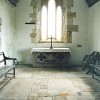
Set into the floor of the chancel in St Peters there is a mosaic pavement. Like all other parts of the building it is the work of a felon, a convict from the island’s prison, but one who’s criminal circumstances are more unusual than most others. For there has been a long-held tradition that the mosaic was laid by Constance Kent, who when just sixteen years of age stabbed her step-brother to death in a toilet at the family’s home at Rode, Wiltshire.

Constance Kent was born in 1846. Her father was Samuel Kent, said to have been an illegitimate son of the Duke of Kent, father of Queen Victoria, while her mother was the Duke’s first wife. On her mother’s death in 1854 Kent married Miss Pratt, governess to both Constance and her younger brother William. By 1860 another five children had arrived, and a sixth was expected.

When she was sixteen Constance told school-friends she was constantly unhappy at home. On the night of 29th to 30th of June 1860 Constance’s four-and-a-half year old brother was taken from his bed in the nursery to an outside privy, where he was stabbed in the back and had his throat cut. A blooded nightdress belonging to Constance was found and despite no apparent motive she was arrested, but later released due to lack of evidence.

When the Kents moved to Wales Constance entered a convent in France for three years, and then moved to another convent in Brighton. Voluntarily she approached Bow Street magistrates to confess to the murder, but it is suggested that a minister, a Reverend Wagner at the convent, put pressure on her to confess. As a doctor had judged her mental state to be normal, it is likely that Constance’s motive for the murder was jealousy of the children of her father’s second marriage.

Constance was tried at the assizes at Salisbury, found guilty and initially sentenced to death, though this was commuted to life imprisonment on Portland. Between her arrival in 1864 and her release in 1885, she laid the mosaic to be seen in St Peters Church.

Benjamin Jesty

In 1805 Benjamin Jesty travelled from Dorset to London where he was the guest of Dr. Pearson of the Vaccine Pock Institute, who recognised Benjamin as the first person to vaccinate against smallpox – some 20 years before Edward Jenner.

The society had arranged for the artist Mr. Sharp to paint a portrait of Benjamin while he was in London, something he found very irksome; being a farmer he was not at all used to sitting still for hours on end. Before leaving for London he had turned a deaf ear to his wife Elizabeth when she suggested he invest in a new suit of modern clothes. He was viewed by some in London with a mild curiosity a situation not helped by his rich Dorset accent. He was glad to return to Dorset bringing with him a pair of gold mounted lancets and a testimonial to recognise his services to the cause of vaccination. He is reported to have said the best thing about the trip was being able to get a shave each day instead of having to wait until market day.

The portrait, the original of which is believed to be with descendants now living and farming in South Africa, tells us, as it should, quite a lot about the man. He had a friendly open face displaying a hint of amusement at all the attention he was receiving. He was probably a straightforward person who would speak his mind. We know he was an honest man because he was an assessor and collector of land taxes. His portly build confirmed his comfortable life style and the portrait belied his 69 years.

This medical pioneer was in fact a yeoman farmer born in Dorset. He was baptised on the 19th of August 1736 at St.Andrew’s church, Yetminster and was given his father’s name. His grandfather John Jesty of Leigh, which is close to Yetminster, appears, from the inventory of goods made when he died, to have been a farmer of some substance. We may assume Benjamin had a good start in life and was probably educated at Boyles School, Yetminster.

In 1770 he married at St. Andrew’s church a girl from the village, Elizabeth. Three children arrived in quick succession: Robert in 1771, Benjamin in 1772 and Elizabeth in 1773. They lived at the farmhouse named Upbury. This was the family of Benjamin Jesty when smallpox hit the village of Yetminster in 1774.

Benjamin was confident he was safe from the disease, having had smallpox when he was a young child, but he was concerned about the wellbeing of Elizabeth and their children. Two dairymaids were employed on his farm and he knew both of these girls had earlier had cowpox and both had nursed members of their family suffering from smallpox without catching the disease. It was well known that dairymaids rarely caught smallpox. He reasoned that if dairymaids who caught cowpox accidentally were immune then it followed that someone who caught the disease deliberately would be similarly immune from the more serious smallpox.

It came to his ear that a Mr Elford who farmed at Chetnole had an outbreak of cowpox amongst his herd. It was this timely news that almost certainly decided Benjamin on the course of action he was to take and he hurried to Chetnole, only about four miles away, with Elizabeth and the boys.

How much Benjamin had told his wife in advance about his intentions we will never know but she would certainly have been frightened when she realised the full implication of what he had in mind. This was a hugely risky undertaking, a matter of life over death for the people he loved most. If he were wrong the consequences for his wife and children would almost certainly be fatal.

He proceeded to move amongst farmer Elford’s cows looking for a mature pox that would be certain to ‘take.’ When he had found what he was looking for he took out a needle and with it he scratched his wife’s arm just below the elbow and inserted the matter from the pox. It was the boys’ turn next: first Robert and then Benjamin. The first authenticated vaccinations had taken place in a field in the Dorset countryside amongst a herd of cows. The next few days were to be crucial.

When word of what he had done reached his neighbours he was ridiculed but when it was learnt that Elizabeth was very ill sentiment turned to anger and indignation. Benjamin found that his friends and neighbours had taken against him for being so foolhardy and reckless with the lives of his family. However he remained undaunted and continued about his business stoically putting up with being “hooted at, reviled and pelted whenever he attended markets in his neighbourhood.”

In the boys the cowpox ran its normal course and they were soon out of danger. Elizabeth became very ill, her arm became inflamed and she had a high fever. This was a testing time for Benjamin and he called in a doctor who when told of the cause of the illness is recorded to have said “You have done a bold thing, Mr. Jesty, but I will get you through if I can.” And he did. After a while Elizabeth improved and before long the Jesty family was able to return to their usual routine. The family increased and in all the couple had four sons and three daughters.

Benjamin Jesty died on the 16th of April 1816, aged 79, and is buried in the churchyard at Worth Matravers. Elizabeth survived a further eight years and passed away on the 8th of January 1824 aged 84 years and is buried beside her husband.

Benjamin and his family had moved from Yetminster to Downshay manor, in the parish of Worth Matravers in the Isle of Purbeck. It was here that Benjamin Jesty met Dr. Bell who became vicar of Swanage in 1801 and is well known as the founder of Free Schools. He was an enthusiastic supporter of vaccination. Dr. Bell came to hear of Benjamin and how he had vaccinated his family 22 years before Jenner. He wrote to his friends in London and as a result of this correspondence Benjamin received his invitation to London and acknowledgement of his work but it was Jenner who received all the acclaim for the procedure and some £30,000 from the government to develop and encourage vaccination.

Bridport Family – Education Pioneers in Australia

The Greene family from Bridport is well known on the other side of the globe – as educators in Australia as it was emerging to nationhood. To have five sisters involved in the foundation and running of a school far from their native land must be a unique situation.

So it is that a girls’ college in Australia which dates from 1901 had its origin in Bridport. In that year Alice Greene and her sister Anne founded Moreton Bay Girls’ High School in Brisbane. At the age of 38, Alice was at the helm. But the family connection had not started there, for the school had actually been designed and built by their father.

On the school’s first roll there were 20-day scholars and six boarders: today, over 1,000 families are associated with the college, which is considered among the best independent girls’ schools in Australia.

But it has been a struggle. In 1944 the school was handed over by the Greene family to the Methodist church. In 1959 there were 167 pupils and the number increased to 180 in the early 1960’s. However, the roll later dropped to 125 and it was decided to close the college, although this decision was soon rescinded. The Uniting Church assumed responsibility and set up a new board with the local population strongly represented.

In 1980 the boarding section was closed down and the following year the enterprise moved to a new site. Things were changing for the better, and the year 2000 was a remarkable one, seeing notable successes in competitive athletics and in public speaking and debating. The college choir sang at the prestigious Choralfest in Melbourne.

Then in 2001 came the centenary of the college. The enrolment that year for pre-school to Year 12 was 1170 girls. In 2002 the college won a prestigious 70-year-old swimming championship. Early in 2003 the Moreton Bay Boys’ College opened its doors. The number of staff is now approximately 200.

In 2003 one of the college’s ‘Old Girls’, Quentin Bryce, was inducted as Governor of Queensland a post she held until 2008 when she was appointed Governor General of Australia.

Alice Jane Greene, the central figure of the story, was a native of Bridport, Dorset, born on July 26 1863. She was the daughter of John and Ellen (Webber-Greenham) Greene. Her father was a cabinetmaker and Grandfather Greene was a mariner. She went into teaching specialising in science and after the family moved to Cardiff in Wales she was senior mistress at Cardiff Higher School for five years. In the early 1890’s she and her sister Anne went out to Australia to join their father.

Anne and her sister Helah established a school and studio in Tenterfield in northern New South Wales where she taught general subjects, art and music. The school opened in February 1895. Their sister Alice who had been teaching at Rockhampton Girls’ Grammar School joined Anne and Helah there.

In 1900 John Greene built a school in Wynnum, Queensland which was officially opened in 1901 as Moreton Bay Girls’ High School, Alice was the Principal, and remained in this post for an amazing 42 years. Her other sisters, Hilda and Elsie also taught there.

At some point, the name changed to Moreton Bay College, the name by which it is known today.

It seems that John Greene and Mary Ellen Greenham had 11 children. Ada, (who married James Diamond, of Cardiff, Wales and who remained in that country); Alice; Emily (who married Harold Wearn, a dentist and lived in Sydney, Australia), Mary (who married Herbert Kay, had two children and lived in Brisbane), Anne (also known as Ella, who did not marry, taught cello and violin and was the school housekeeper);Samuel, who was Mayor of Wynnum before it became part of Brisbane and married Ruth Hargreaves; John William (known as Will) who became Lord Mayor of Brisbane; Elsie (who did not marry and went to London University, became a bachelor of arts and then returned to teach general subjects at the school); Hilda (who did not marry but studied and taught music, returning to England to continue her studies and went back to teach at Moreton Bay in 1910); and Harold who worked in shipping, went to India and has descendants still living there.

Every great project has its pioneer, and it was Alice (known as Alice J. Alison Greene) who is actually credited with founding Moreton Bay College. She did not marry.

A special ‘In Memoriam’ edition of the school newsletter was published in 1967 but, frustratingly, there is no mention of Alice’s date of death so we must assume it was in that year. In Queensland public records of deaths go only back to 1954.

Alice’s first teaching position in Australia was at Rockhampton Girls’ Grammar School in 1893-4; she resigned to go to Tenterfield in northern New South Wales to join her sisters Anne and Helah at a school there which was set up by Anne in 1895.

Anne Greene was an interesting person. Born in 1878 she was the fifth child of John Iley Greene and Mary Ellen Greenham. Anne had studied Art before leaving Britain for Australia. After she arrived in Australia she and her sister Helah established a school and studio in Tenterfield in northern New South Wales where she taught general subjects, art and music. The school opened in February 1895.

In 1911 Anne returned to Britain to further her studies and to work as an artist. She studied at the South Kensington Art School in London and had success as a still-life artist. She also spent time in Paris and later established a studio in Southampton.

While Anne was in Paris she became interested in eurhythmics, or the harmony of proportions, and later introduced it at Moreton Bay College on return to Australia.

With the outbreak of World War Two she was unable to return to France or go to Australia so she did not actually return to Queensland until after the war. After an accident her health became poor and she lived in a nursing home. She died in 1954.

This is the story of Dorset people who saw a land of need and opportunity 12,000 miles away. The Green sisters introduced a vastly improved and enlightened system of education to the girls of Queensland, with a curriculum including music, art, English, science and physical education. Throughout, the enterprise has been Christian-based. The family must have been very much faith-oriented.

Here we have a story of courage – of people leaving their home surroundings in the late 19th century to work on the other side of the world for the good of mankind and to become “First Australians”. They did not go there initially to improve themselves and their situations, but to improve those of others.

The Prisoner a Padre Befriended

In the autumn of 1862 a 21-year-old man went to the rope in Dorchester jail, a final enactment of 19th century justice for the crime of murder. The condemned man was Edwin Preedy, but perhaps it cannot be said that he was entirely in control of the depressive and violent nature that had driven him to vow he would stab a warder at the prison where he was being held for an earlier offence. For it was the fate of Preedy to suffer an unloved and cruelly deprived childhood.

Born in Leamington, Warwickshire around 1841 Edwin Alfred Preedy was the illegitimate son of a man who never knew how to bring up a child with due care and affection. His mother too, seems to have been a rather detached person who had no influence over her son. As a result of the cruelties and abuse inflicted upon him by his stepfather, seeds of anti-social rebellion and resentment were sown in Edwin’s maturing mind. Until he was eleven he attended a national school where, although he was quite clever he was also a proud, passionate and idle boy. When he was thirteen however, his mother and an aunt conspired to have the boy institutionalised in a reformatory but Edwin decamped from the school after just ten months.

There then followed a string of incarcerations for petty offences. Upon release from the last of these sentences Preedy ran away to join the Army’s 85th Regiment, even rising to the rank of corporal, but then in the company of three others deserted after stealing some clothes. When caught, Preedy was sentenced to penal servitude for three years. From his first prison he was moved, first to Millbank then to Portland. It was while serving his sentence here that Preedy, in a fit of murderous ire, vowed to a fellow inmate that he would take a knife to a warder who removed his soiled dinner plate.

So in September 1862 Preedy was transferred to Dorchester jail to await trial for murder. Personally he saw no hope of a pardon, and in his despair he frequently became violent, such that on two occasions he had to be restrained in irons respectively for 14 and 28 days.

Yet fate it seemed had not entirely given up granting Edwin Preedy an opportunity to repent and receive absolution. He told the prison chaplain that he could only foresee his “dread end.” But at this point a remarkable Anglican minister entered his life, as if sent by a redeeming angel of mercy from on high. The cleric was the then vicar of nearby Fordington, The Reverend Henry Moule BA, and his visits to the cell-bound Preedy throughout the last weeks of his life made history as perhaps the most protracted, challenging and tragic case of a priest’s attempt to save a condemned man’s soul ever recorded.

Henry Moule was a luminary among 19th century Anglicans. Early in his priestly career he boldly tackled moral laxity, ecclesiastical rectitude and the injustices of squalor and the powers that be. He was chaplain to Dorset Barracks and Vicar of Fordington and is best known for his invention of the earth-closet. But his dealings with Preedy introduced him to an altogether new dimension in human nature and pastoral experience.

Moule’s strategy was to entice Preedy into making a confession or admission of guilt, expressing remorse for what he had done. He implored the prisoner to repent of the murder and all his earlier sins. At times the vicar found the prisoner in a conciliatory and receptive mood, but at other times Moule had to endure a barrage of insolence and even physical assault. When his temper was aroused Preedy no longer wanted to be visited. One day, in Moule’s presence, he broke down: “here I am with one foot in the grave; I cannot break down this temper” he sobbed. On another occasion he alluded to other inmates in his position who said they had found peace. It is recorded that, when free in the prison yard he caught and tamed sparrows, but would then vindictively kill them.

Two weeks before his trial Preedy received a letter from his mother, in which she offered to raise money for his counsel. He told Moule he had decided to plead guilty. Surprisingly, at his trial his mother and aunt appeared as witnesses for the defence, but Preedy became abusive to all except the judge, jury and Sydney Osborne. Moule however, could not induce Preedy to see his mother and aunt after being found guilty and sentenced to death; Fordington’s vicar was even warned that the prisoner was too dangerous and unpredictable to approach! It seemed at first that Moule’s consolation of religion had fallen short of extracting from his client full and lasting contrition for his wrongdoing.

Yet Edwin Purdy went to his death with the most admirable courage and calm resignation. On his last afternoon he even took communion in the presence of three or four other warders who were glad to join him. Out of gratitude he presented five men with five bibles given to him by Sydney Osborne. And then…he felt the noose and blindfold about his head, the drop beneath his feet…

What appears to be the only source for this story is Henry Moule’s own account, written some time after the prison assignment it describes and entitled Hope Against Hope. A rare copy of this book is in the County Museum collection, available for study only by special arrangement and a handling fee of £10.

Footnote added 7th Sept,2012. In the school log book for Bradford Peverell dated 27th March 1863 there is the following entry. “Some of the children went to Dorchester to see Mr Fooks and Mr Preedy hung.” Underneath that entry is a note apparently dated 28th July 1873, which reads: ” They should not have gone had I known it and been able to prevent them. H.B.W.”

Helen Taylor of Tyneham

She was not born there and she did not die there but she spent the happiest days of her life there and her ashes rest there. A simple genuinely heartfelt gesture during the dark days of World War II has made the name of Helen Taylor synonymous with the Dorset village of Tyneham.

The villagers, evacuated from Tyneham on the orders of the War Department have not been allowed to return to their homes. For the full story of the events that took place there in December 1943 see our feature “Tyneham – the Village that Peacetime Betrayed.” And there are photographs in the photo section.

Helen Beatrice Taylor was born at Tincleton on the 14th of September 1901 and her sister Harriet Elizabeth on the 16th of March 1892 to William and Emily Taylor. The sisters, known as Beattie and Bess, ran the laundry for Tyneham House, home to the Bond family. Helen always considered Tyneham her home but after the forced evacuation from the village she lived at Corfe Castle until 1994 when she went to live in a nursing home at Swanage.

Neither Helen nor her sister Harriet Elizabeth (Bessie) or their half brother Charlie ever married. Helen had suitors but it is thought she did not marry because she wished to look after her older sister and half brother. Charlie Meech is credited with saying one day on his return home after a hard days hedging “saw old Thomas Hardy sitting in his garden…wasting his time…writing.”

At Corfe Castle they lived a happy self-sufficient lifestyle – with large garden sheds immaculately kept including one that stored extensive well water worn wooden laundry equipment and others with garden produce.

The sisters had an elder brother, Arthur Henry Taylor, born on the 8th of March 1890. Arthur started his schooling at Tincleton, where he was one of twenty pupils. The Headmistress lived on the premises. Arthur showed early promise and was taken under the wing of a clergyman who furthered his education. Accepted by Cambridge University, from there he entered the army and rose to the rank of Captain, receiving the MC and MBE. His death in Jerusalem on the 30th of November 1929 was the result of a tragic accident. It seems he had worked with Lawrence of Arabia and introduced Helen to him at Tyneham.

The girls had already lost another brother Bertie and a half brother Bill Meech in the First World War. The CWGC Debt of Honour Register records that “Bertie Taylor, Private; Dorset Yeomanry (Queen’s Own) died on Saturday 21August 1915 Age 21. He was the son of William Taylor, of Tyneham, Corfe Castle, Dorset; Buried at Helles, Turkey. The Helles Memorial stands at the tip of the Gallipoli Peninsular. It takes the form of an oblelisk over 30 metres high that can be seen by ships passing through the Dardanelles.” William Meech was in the same regiment as Bertie and died on Saturday 26th February 1916 aged 28. He was buried at Alexandria, in Egypt.

Helen died at the age of 97 in May 1999 and was given a half page obituary in the Daily Telegraph of 13th of May 1999, with the headline “Village That Died for D-Day welcomes last exile” and “Woman returns to Tyneham after 56 years for burial in church she loved.”

Helen was the last person to leave the village in 1943 and she pinned a note to the door of St. Mary’s church that read: “Please treat the church and houses with care. We have given up our homes where many of us have lived for generations to help win the war to keep men free. We shall return one day and thank you for treating the village kindly.”

Alice Maud Trent (1887 – 1937)

Keeping Her Memory Alive

The village of Winfrith, with its thatched cottages, shop and old church, lies equidistant from Dorchester and Wareham in the farming county of Dorset. It hasn’t changed much since 1887 when Alice Maud Trent was born there, daughter of an agricultural labourer.

She must often have walked the four miles over the hills to Lulworth Cove, the beautiful circular inlet where the tides come in from the English Channel, and perhaps she dreamed of other lands, for she was to sail the world’s oceans.

Her father was William Trent, one of 14 children born to his father John Trent. The Trent family was a large group established primarily in the parish of Winfrith Newburgh, and especially in the Blacknoll area. William was baptised in 1852 at St. Christopher’s, Winfrith. He married Arabella Baker in 1874. She was also born in 1852 in the same place and baptised at Winfrith, and both were 22 years old when they married.

The couple had 11 children. William and Arabella both died in 1901 within a few weeks of each other from unrelated illnesses, having been born in the same year 48 years before.

Alice Maud was only 14, and had left home and the village. The most probable explanation for her whereabouts being that she was a ‘living in’ servant. The next sighting we have of her is in London where we know that during WWI she was a member of the Women’s Police Volunteers and was seconded to work with the wartime Ministry of Munitions.

She was, according to Steven Trent Galbraith, her grandson, “a very worldly woman” in the sense that at 36 she decided to go to the other side of the globe. During 1923 she worked as an asylum nurse in Australia, while visiting her sister Emma there.

She decided to return to England via the United States so as to call on her other sister, Sarah Kate now married to Henry Burden, in Brigham City in the far west state of Utah. And here a rather astonishing thing now takes place: she meets somehow or other, at the age of 37, with George Galbraith, 73 – and in May of 1924 they are married. George, who was Steven Galbraith’s grandfather, had an exciting life.

The first son born in the United States of Scottish immigrants, at 19 he was working on cattle drives from Texas to Wyoming. But when she said goodbye to Alice Maud in Australia, Emma could have had no idea that her sister would meet up with a former cowboy.

Robert Galbraith and his wife Helen had come across the Atlantic from Loch Lomond and the Trossachs, via Liverpool with four children. They settled in Illinois.

George was a perfect candidate for the Wild West. He was to have eight children by his wife Grace, and became foreman of a huge cattle ranch on the Utah-Wyoming border. He lost his wife in 1918 when he was 67, and later took his family to Utah where he made a good living from a fruit farm.

When Alice Maud married George in 1924, one of her children by law was older than she. They had a son, William Trent Galbraith, in 1925: he only lived for two days. Three years later Ernest, Steven’s father, was born when Alice Maud was 40.

The Great Depression now descended on the country. And in 1937, Alice Maud passed away: leaving a twice-married widower aged 86, and Ernest, aged 10. Two years later in 1939, George died leaving Ernest an orphan and the remaining half-brothers and sisters ranging in age from 47 to 61. One of the sisters raised Ernest to adulthood, and from the age of 16 he was going to sea, visiting ports all over the world – perhaps taking his cue from his adventurous mother and aunt.

Steven was given the middle name of Trent to keep alive the memory of the girl from Dorset. And he says today, after considerably digging into his family’s history: “The night before I married Lori, my wife, my Dad pulled me aside and gave me the ring that his father married Alice Trent with. Then, when my son Joshua was born, I named him Joshua Trent Galbraith….”  Steven hopes and expects Joshua will similarly name his first son.

It was back in 1985 that Steven started on his genealogical journey, with very little to go on, one of the family having destroyed all the documents and photographs of Alice Maud that she could find. A few have survived.

We have only the briefest information about the youngest sister Alice Emma Trent, baptised March 10, 1895. She was only six years old when her parents died and it is likely she lived with the eldest child in the family, Rhoda Trent. She had married and was still living in Winfrith. All we know about Alice Emma is that she travelled to Australia where it is believed she married a man named Ernest Cummings and lived in New South Wales.

It is worth saying something about Alice Maud’s sister Sarah Kate. We know she was at home in 1901 when she would have been 16 years old. The next we know of her is that she is in the United States working as a maid in the household of Lord Bryce, the British Ambassador.

She decided to stay in the United States and travelled to Brigham City, on the shores of the Great Salt Lake and surrounded for hundreds of miles by mountains up to 10,000 feet – a vast contrast to the rolling wolds of native Dorset. Here she married Henry Burden. We think there is little doubt she knew him before travelling because he, like her, was from Winfrith.

In June 2002 Steven and Ernest came to Dorset: they met Trent family descendants still living in the area and others travelled to meet them.

Steve related how when a 12 year old boy his Mother had told him how difficult it had been for his father as a youngster and how other family members had “tried so hard to destroy the memory of Alice Maud Trent.”  Steve says “ She and my Dad in a way to keep her memory alive, gave me Trent as a middle name and they asked me if I would like, it would be a nice thing if I did the same if I ever had a son.”

Those few days in Dorset the culmination of years of searching mean Steven has fulfilled a promise he made 36 years ago, when as a 12 year old boy he pledged he would find her and keep her memory alive.

More photographs of Alice Maud Trent and a photograph of Steven Trent Galbraith with his father Ernest taken during their 2002 visit to Dorset, can be found in the gallery section.

Ernest Galbraith passed away on the 28th June 2003.

Photos in the gallery

William Hall – Gamekeeper

William Hall was the son of Leah Hall; he was baptised at East Burton, a chapelry of Wool, on the 13th of September 1867. In 1861 Leah, a laundress was working at Melbury House, in Melbury Sampford, the home of the Earl and Countess of Ilchester. She was one of twenty-four servants: the Earl’s bailiff and gamekeeper had cottages on the estate. Later in his life William Hall would be employed by Ilchester.

Leah Hall later married Josiah Pople but it seems William did not live with his mother. The 1881 census for East Burton by then in the parish of Winfrith Newburgh, has him living with his grandfather Joseph Hall and aunt Isabella Hall. There is nothing to suggest he was ever adopted by Josiah Pople.

William married Sarah Anne Longman in 1889. Usually the column on a marriage certificate referring to the father is left blank in the case of an illegitimate child marrying. However, in this case William declares his father was William Hall (deceased) – was this for appearances sake? We are left to wonder. A strict interpretation of the baptism entry at East Burton suggests he was baptised William Hall Hall and his civil birth certificate leaves no doubt about his illegitimacy. The practice of using a surname as a middle name was often used by single women to name and perhaps shame the child’s father.

The Overseer’s records for Wool and Winfrith have not survived and it is impossible to say if a bastardy order was ever issued against anyone in respect of William. Interestingly, if we could say for certain that no bastardy order was issued that might tell us something, but it seems we will never know.

In a conversation with William’s son Frank and daughter Elsie on 25th of August 1970 at Lympstone in Devon, I learnt “He was a gamekeeper and worked for Lord Ilchester in Dorset. Then, he worked for the Honourable Mark Rolle in 1899. The family lived in Torrington (Devon) for 8 years. Then, he worked for Lord Clinton who inherited from the Rolle estate. He was working for him in 1911 when the picture of him standing with his gun and dog was taken.” (Photo in the gallery.)

William Hall, gamekeeper, lived in Evershot and Gershot, Dorset, until at least January of 1892 when his son, Fred, was born at Gershot. Sometime thereafter the family moved to Somerset where a daughter, Mabel, was born at Queen Camel. Then before the birth of son Frank, in April 1899, the family moved to Torrington in Devon where daughter Elsie was born in April 1907. The family lived in Merton, Devon at some point.

After starting his working life as a groom, William became estate gamekeeper to Lord Rolle and Lord Clinton on their Devon estates. William is listed in the 1901 census at Greater Torrington, Devon, aged 33, his occupation given as gamekeeper and that record confirms he was born at Winfrith, Dorset. He is described as a gamekeeper on the marriage certificate of his son William, in 1916.

His grandson, Norman Hall, told me during a conversation in July (2006) that William “used to train wild dogs – domesticated them…he had a special way with animals.” After his retirement, he used to visit his eldest son, William, and his family every Saturday, coming from Colaton Raleigh with chickens, eggs and butter for them.

He was 75 when he died and his occupation is listed as Estate Gamekeeper. His eldest son registered his death. William Hall is buried in the churchyard at Colaton Raleigh with a holly tree nearby.

Note: There is a photograph in the gallery of William Hall with his wife and children.

Charlie Brown

“Speak up boy.” The sound of Mr Justice Burrough’s bellowing voice travelled round the Dorchester court room at the Summer Assize court of 1818.  The instruction was addressed to the eight year-old boy standing in the witness box. The boy was Charles Brown, a witness for the prosecution at the trial of 28 year-old John Gallop accused of “feloniously, wilfully, and maliciously, and with malice aforethought, assaulting a woman with both his hands at the parish of Bere Regis and by squeezing her throat, mouth and nose, caused a suffocation, whereof she almost instantly expired.” The murdered woman was Priscilla Brown, the boy’s mother; she was killed on the 14th of May 1818. It seems days earlier Priscilla had told John Gallop that she was pregnant with his child.

Charlie, his head, just visible over the witness box, was examined by Mr Banks, counsel for the prosecution. Charlie told the court that he knew the prisoner and had often seen him at his mother’s house. On the Wool Fair Day, Charlie went on, “The prisoner called him out – I was pretty sure it was he by his voice; it sounded from the back door, which leads to the garden.” His mother was at work in the house and there were stones flung three times against the door. Charlie said “my mother went first to the front door then to the back door. Then the prisoner spoke to her; she went out at the back door and went up the garden.”

John Gallop called Thomas Clinch to contradict Charlie’s evidence even though the Judge advised him to consider what he was doing before he called the witness. After Clinch had given evidence Mr Justice Burrough observed that instead of contradicting the evidence of the boy he had confirmed it. Gallop had sealed his own fate.

Several people from Bere Regis were called to give evidence for the prosecution including Thomas Homer, a farmer; John Sexey, Ann Loveridge, Elizabeth Rose and Benjamin Romain with whom John Gallop lodged. Page Ross, a servant, Elizabeth Harris who lived at Affpiddle and Sarah Welch of Bere Regis also testified against Gallop.

Charlie had concluded his evidence saying “She had no bonnet on; she never came back any more. Some time afterwards she was brought home dead.” Gallop was found guilty of murder and hanged.

Eight years earlier his arrival into the world was announced with these words; “16th of December 1810 Charles, bastard son of Priscilla Brown,” They appear in the register of baptisms at the church of St. John Baptist, Bere Regis. Here he spent his life, a life that spanned the allotted three score years and ten and three more, all spent working as an agricultural labourer and bringing up a family.

There was little doubt Priscilla’s boy would be a charge on the parish chest and the Churchwardens and the Overseers to the Poor would have examined Priscilla Brown to establish who Charlie’s father was. On the 15th of June 1811 six months after Charlie’s baptism the Justices made an order against Thomas Welch who they were satisfied was the boy’s father.

Welch was ordered to pay the sum of forty shillings “towards the costs of the lying-in of Priscilla Brown and the maintenance of Charlie to the date of their order.” Additionally, the father was to pay two shillings a week for Charlie’s maintenance.

After the death of his mother he would have had little option but to get on with his life. Any counselling amounting to little more than sympathetic whispering behind his back and this would have quickly evaporated. We don’t know who looked after Charles in the years to adulthood and the events of 1818 were, it seems, quickly forgotten, overtaken by the instinct to survive.

The next milestone in Charlie’s life was his marriage. The church registers inform us that on the 3rd of March 1834 Charles Brown and Elizabeth White were married. According to censuses Elizabeth was born at Bloxworth or Kingston, both places near to Bere Regis. Their marriage was witnessed by George Phillips and Isabella Stickland and sealed a partnership that was to last half a century.

Charles named his first child after his mother. The 1841 census has Charles (30); Priscilla (25); with Elizabeth (7); William (4), and Charles (2). (We have to accept the enumerator switched Priscilla and Elizabeth when listing the family.)

Priscilla earned a living as a button maker and in 1851 she was living in Bere Regis but not with her parents and siblings. By 1861 she was working as a cotton Glover and is back with her family at No.1, Tower Hill, Bere Regis. A search of the records at Bere Regis revealed nothing further about her only that she witnessed the marriage of her brother George Brown in 1865.

Priscilla had three sisters and five brothers. The sisters were Maria born in 1849; Sarah born in 1855 and Charlotte born in 1857. We know that Maria and Sarah died and were laid to rest at Bere Regis on the 7th of October 1855 and the 24th of August 1862. Charlotte moved away. The brothers were William born in 1837; Charles 1840; James 1843; George 1846, and Thomas born in1852.

Elizabeth Brown who survived her husband by 17-years, lived to see the dawning of the 20th century and could look back with some satisfaction over the half century she spent with Charles. Two of their children died in their single years and she out-lived at least one of her grown-up children but for the times this was not unusual. She was blessed with seeing grandchildren married and the arrival of several great grandchildren and it is worth looking back over some of their lives.

Of the boys, William was the first to marry in 1862. Next was Charles in 1863, his bride being Mary Hawkins of Winterbourne Kingston. Charles and Mary had two sons and four daughters. Then on the 15th of March 1865 George married Agnes Cheesman of Winterbourne Kingston. We know from the 1881 census that William married Mary a girl from Wool and in 1881 they were living in Battersea where William was working as an Engine Driver at a factory. Records show they had taken in two lodgers.

In 1871 Charles and Elizabeth were living at 7 West Street, Bere Regis; their daughter Charlotte who was working as a cotton Glover, was with them. Ten years later Charlotte was in Holdenhurst, Hampshire, where she was employed as a domestic servant to a wholesale grocer. Next door at 8 West Street was their son George, his wife Agnes, and their three children: Henry James, Amelia Mary and George – in 1882 another son, Tom, was born.

Of Charles’ grandchildren we know that Sarah Ann, the eldest child of his son Charles, had a child, Alfred Charles, in 1881; he died in 1882. On the 3rd of February 1887 Sarah Ann married John Bright, a widower. Sarah’s grandmother, Elizabeth, signed the register as a witness.  John was 12 years-older than Sarah and brought a son and two daughters, all under 10, to the marriage, so Sarah had to adjust in short order to being a wife and a mother. She would have had some experience with children as her siblings were between 10 and 18 years younger than she was. In 1891 John and Sarah Ann had a child they named Edwin John. Over the next decade they had another son Charles and two daughters; Louisa and Florence.

Neither her father nor her grandfather was alive to witness the marriage of Mary Jane Brown, a dressmaker, the daughter of Charles Jnr (he passed away in 1892) to grocer’s assistant Walter Langdown. The ceremony took place at Bere Regis on the 15th of August 1898 and a year later they had a son, Frederick, and early in 1901 a daughter, Mabel.

There can be little doubt Charlie knew who his father was but he chose to be known throughout his life by his mother’s name. He passed away on the 1st of August 1884 aged 73, just five months after celebrating with Elizabeth 50 years of marriage. He died of a diseased heart and his death was registered three days later by his daughter-in-law, Agnes, wife of his son George. Elizabeth, who was known as Betsy, lived for another seventeen years passing away early in 1901 aged 92 years; she spent the last few years of her life living with her son George and his wife Agnes.

His mother’s death is recorded in the registers of the church of St. John Baptist at Bere Regis without mention of how she met her death and whether or not she was with child. The entry reads “Priscilla Brown was buried May 17th 1818, aged 32 years.”

Love Lane – Weymouth

Weymouth is one of the UK’s premier holiday resorts. Its grand promenade and sandy beach attract people to the town in their thousands and every summer the hotels and bed and breakfast places that line the sea front are full to overflowing. This is the area where you will find the ice cream and candyfloss vendors; it’s the place to go for sticks of rock, kiss-me-quick hats and other souvenirs.  Here and in the back streets you will find fish and chip shops, inexpensive restaurants, and fast food outlets. But this is not the real Weymouth: that is on the other side of the estuary of the river Wey and to get there now that Mr Lee’s ferry is no longer available (actually, it hasn’t been available since 1695) you must go across the bridge by Holy Trinity Church.

Here we turn left and follow the river a short distance upstream until we reach the marina area, just past the modern council offices we turn left up the hill beside the famous Boot Inn and there in front of us is Love Lane a pedestrian thorough-fare linking High West Street and Franchise Street.

At this end of Love Lane are two stages of steps with a scaffold like hand rail to help us old-timers get a start up the incline. The first thing that strikes you is how narrow the lane is, three strides from the front door of a house on one side will see you in the hallway of the opposite dwelling. Hutchin’s 1774 map shows houses on both sides of the lane at the north end and a terrace at the south end; little has changed.

I was surprised to find the buildings in Love Lane are not listed. Listing is the process protecting and controlling the way buildings of special architectural or historic interest may be altered or improved. Here we have examples of houses from the early 18th century apparently unprotected and open to be abused with stone cladding, UPV double glazing and worse. A Grade II listing would warrant every effort being taken to preserve them. They escaped listing in 1974 and again in the review of 1994-5.

Artisans and labourers traditionally occupied the dwellings in Love Lane and that was certainly the case in the 1860’s when it was a busy area and home to cordwainers (shoemakers,) plumbers, butchers, carpenters and cabinet – makers and their families with some wives and daughters making a second income from dressmaking.

 In 1861 at No.1. Love Lane lived Samuel Scott a 50 year-old Wheelwright, his wife Ann, 48, and their daughter Elizabeth who was a tailoress, probably working with their lodger Ann Chaddick (20). Next door at No.2. it would have been a bit of a squeeze for fifty-year-old agricultural labourer Matthew Pitcher and his thirty six-year-old wife Eliza with their five year-old son Edward J. Spracklin, possibly Matthews step-son, and two lodgers Susanna Chick who was (81) and Diana Spracklin (56) described in the census as a Nurse Professor.

At No.3 were four bread winners. Charlie Woodland (46) was a butcher, his wife Elizabeth (44), a laundress; it looks as if Charlie had two step-sons, William and Thomas Roper, respectively 17 and 14. These lads worked as a mason’s labourer and plumber’s apprentice. The boys had a 14 year-old sister, Elizabeth, who was at school. Also in the household and of school age the couple’s two sons C. Alfred Woodland (8) and Alfred Woodland (6).

Next door was a Devon born shoemaker, 50 year-old Francis Lee, his Weymouth born wife 55 year-old Ellen. According to the census the couple had rather late in life or more likely Ellen has exaggerated her age, a 14 year-old daughter Jane. Room was found to accommodate Robert Long an unmarried 28 year-old Butcher from Devon.

Moving on down the Lane to No.5 we find agricultural labourer William Goddard (53) and his wife Maria (50), their son Thomas (16) was employed as a brewer’s labourer. Also at home another son 21 year-old John and his wife Frances (24). John Goddard was a road labourer.

At No 6 we find Henry and Ruth Hawkins (48 and 42,) Henry is a coal porter and their two twin daughters Martha and Jane (10) go to school. No 7 is home to Elizabeth Ford (26) who is a single woman and living with her are her two younger brothers Francis (21) and William (19). The two lads work on the roads and their sister earns a living taking in laundry.

Robert Gray (45) who comes from Puncknowle and gives his occupation as Gardener Professor lives with his wife Virtue (46), a Weymouth girl, and their daughter, Elizabeth (20) a dressmaker, and their son William (9) who goes to school, all live at No 8.

 At No 9 the shoemaker, Ambrose White (52) lives with his spinster sister Ann (49) and their 78 year-old mother, Susanna who is described as a pauper. Also in the household are William and Sarah White (8 and 6) Ambrose’s nephew and niece.

The Butcher, John Hatton (61) and his wife Mary (62) lived at No 10 and 11 with their unmarried daughter, Louisa (21) who made shirts. Lodging with them, a Somerset man and master plumber, James Lesley (27) and his wife Mary (26) and their 4 year-old-son Harold.

The census is difficult to interpret but it may be that Jane Winter (50) who lived at No 12 with her daughter, also Jane (20), and described as a Proprietor of Houses was the landlord of the people living at No 10, 11,13 and 14.

And at No.14 lived William Watts (49) who was born at Bere Regis, living with his wife, Weymouth born Frances (51). William was a grocer and his wife a tailoress and with them are Sarah their 26 year-old daughter and dressmaker; sons Joseph (18) a cabinet maker’s apprentice and Alfred (16) who worked for a Brick Merchant.

A widowed carpenter, Morgan Symes (49) lived at No 15 with his 19 year-old daughter, no occupation is shown for her but she was probably busy keeping the house in order and looking after her younger brother 8 year-old John. Next door at No 16 lived William Symes (54) unmarried and in business as a Brick Merchant. His sister, Sarah (47) lived with him.

At this point in the lane there was an area known as Love Lane Court that comprised three houses the first was occupied by a mariner 36 year-old Daniel Besant and his wife Mary. The second house was home to Edward and Elizabeth Tulledge respectively 56 and 50 and described in the census as Paupers and in the third house was Elizabeth Cook (22) a mariner’s wife.

Back in Love Lane proper the widow and dressmaker Betsy Nudge (49) lived at No 17 with her 18 year-old son George who was a cordwainer’s apprentice. Also at No 17 but in separate accommodation was a retired mariner 80 year-old Robert Collins and his 53 year-old wife and nurse, Hannah.

No 18 was home to Emma Bold (37) another mariner’s wife who had with her two sons and two daughters: Jonathan (10); Samuel (8); Emma (5) and Ann (2).
And in the last house, No 19, Joseph Webb (23) a blacksmith’s labourer lived with his wife, Hannah 21.

While I was in the lane I didn’t see a soul but a century and a half ago Love Lane would have been a very busy place by day and by evening many of those listed above would be found in the Boot Inn, and on Sunday most of the residents would don their Sunday best and make their way to Holy Trinity Church.