Dorset Ancestors Rotating Header Image

2010:

The Sea Fencibles

Sea Fencibles? If you have never before heard of them, you are not alone. I was in the same position until recently when the subject cropped up during investigations into other matters, but once it is realised that the Fencibles were a short-lived kind of coastguard force of the Napoleonic period, this general ignorance is perhaps not surprising.

The “fencible” is an elision of “defensible” and the Sea Fencibles could be regarded in their day as the maritime equivalent of the Home Guard of the world wars, though formed in response to a threat of invasion by Napoleon some one-and-a-half centuries earlier than the formation of Dads Army. The Sea Fencibles were mostly volunteers living close to the coast who, we may imagine, were only too glad to accept a pay of a shilling a day in return for immunity from service in the militia or else being press-ganged into the navy. However the relative usefulness of the Fencible force has divided opinion among naval personnel and historians.

The Sea Fencibles were formed on May 14th, 1798 at the instigation of King George III. By 1801 Sea Fencible units had been established all along the coast from Whitby right into Cornwall, so Dorset would have had its own units by then. Across the county there were three units, the most easterly covering the length of coast from Calshot in Hampshire to St. Aldhelm’s Head in Purbeck, with one captain, four lieutenants and 482 men. The central unit extended from St. Aldhelm’s Head to Puncknowle, with seven officers and 284 men; the most westerly unit then extended from Puncknowle to Teignmouth in Devon, having eight officers and 331men.

There was no problem in obtaining volunteers, and Sea Fencibles could be recruited from fishermen, bargemen, farm labourers etc; many naval officers were also involved, since the navy had a surplus with no concept of retirement. These included Nelson himself, who briefly took command of a unit when in charge of the coastal defences. The recruits were trained in the use of cannon and pike.

A prior responsibility for these units was to signal the arrival of an enemy force approaching from the Channel, and to this end the most complicated and painstaking arrangements were worked out. If the alarm was raised the coast would have to be evacuated, with people, cattle, valuable goods and anything else of value to the enemy being moved inland. To ensure that this operation was carried out smoothly and that everyone knew where to go and by which route, very elaborate and detailed plans were drawn up. Interestingly Thomas Hardy describes just such an operation in his novel “The Trumpet Major.”

During the thaw in Anglo-French hostilities leading to the treaty of Amiens in 1802, a feeling among the high command that perhaps the Fencibles had outlived their purpose led to units being disbanded, though the annulment was destined to be short lived. The following year war broke out again, and a resumption of an invasion threat from Napoleon promptly brought the Fencible units back into service again once the press gangs had “re-stocked” the Navy with new personnel. The move was also to satisfy popular feeling, though many placed no confidence in the units. From 1803 the Fencibles were also given a more important offshore duty as enforcers of blockades on the English side of the Channel, using gunboats.

However, the resumption of the coastguard watch was not without its crop of bogus alerts. In May 1804 at the height of the invasion scare, the signal station on the Verne at Portland raised a false alarm during a blanket of thick fog that caused a wave of serious panic throughout the county. Serious, because none other than the king happened to be staying at Weymouth at the time! There was consequently serious concern for his safety, though of course this was unfounded.

About this time there was a return to the use of fire beacons, and it is noted that these warnings were set up on Ballard Down, Round Down, St. Aldhelm’s Head, Hamborough Hill, and the Verne. Nothe Fort, a circular brick-built redoubt at Weymouth, housed two traversing guns with platforms on either flank carrying two guns each (this artillery was removed in 1821.) Bridport possessed two batteries of two guns each, for which the emplacements had been built by the county. A magazine was constructed at Dorchester in 1809.

Other than this, information on the Dorset units during the second operational period is woefully lacking. There is also some discrepancy across various sources as to the actual year the Sea Fencibles were disbanded for the second and last time. One source states they were disbanded as early as 1810 which, exactly half-way between the time of Trafalgar and Waterloo, may be considered rather premature, even though the former victory put paid to any possibility of an invasion of England. The next date given is 1812 (the year of Napoleon’s rout at the Battle of Borodino in the Russian campaign,) which perhaps is more tenable, though the 1815 of a third reference, when Napoleon was forced into exile, would have to be the very latest date that a coast watch force would likely have been needed. Alternatively these differences could be explained if the disbanding was not a single event, but an incremental process in which individual units were simply disbanded at local level between the earliest and latest dates.
Love Lane – Weymouth

Weymouth is one of the UK’s premier holiday resorts. Its grand promenade and sandy beach attract people to the town in their thousands and every summer the hotels and bed and breakfast places that line the sea front are full to overflowing. This is the area where you will find the ice cream and candyfloss vendors; it’s the place to go for sticks of rock, kiss-me-quick hats and other souvenirs.  Here and in the back streets you will find fish and chip shops, inexpensive restaurants, and fast food outlets. But this is not the real Weymouth: that is on the other side of the estuary of the river Wey and to get there now that Mr Lee’s ferry is no longer available (actually, it hasn’t been available since 1695) you must go across the bridge by Holy Trinity Church.

Here we turn left and follow the river a short distance upstream until we reach the marina area, just past the modern council offices we turn left up the hill beside the famous Boot Inn and there in front of us is Love Lane a pedestrian thorough-fare linking High West Street and Franchise Street.

At this end of Love Lane are two stages of steps with a scaffold like hand rail to help us old-timers get a start up the incline. The first thing that strikes you is how narrow the lane is, three strides from the front door of a house on one side will see you in the hallway of the opposite dwelling. Hutchin’s 1774 map shows houses on both sides of the lane at the north end and a terrace at the south end; little has changed.

I was surprised to find the buildings in Love Lane are not listed. Listing is the process protecting and controlling the way buildings of special architectural or historic interest may be altered or improved. Here we have examples of houses from the early 18th century apparently unprotected and open to be abused with stone cladding, UPV double glazing and worse. A Grade II listing would warrant every effort being taken to preserve them. They escaped listing in 1974 and again in the review of 1994-5.

Artisans and labourers traditionally occupied the dwellings in Love Lane and that was certainly the case in the 1860’s when it was a busy area and home to cordwainers (shoemakers,) plumbers, butchers, carpenters and cabinet – makers and their families with some wives and daughters making a second income from dressmaking.

 In 1861 at No.1. Love Lane lived Samuel Scott a 50 year-old Wheelwright, his wife Ann, 48, and their daughter Elizabeth who was a tailoress, probably working with their lodger Ann Chaddick (20). Next door at No.2. it would have been a bit of a squeeze for fifty-year-old agricultural labourer Matthew Pitcher and his thirty six-year-old wife Eliza with their five year-old son Edward J. Spracklin, possibly Matthews step-son, and two lodgers Susanna Chick who was (81) and Diana Spracklin (56) described in the census as a Nurse Professor.

At No.3 were four bread winners. Charlie Woodland (46) was a butcher, his wife Elizabeth (44), a laundress; it looks as if Charlie had two step-sons, William and Thomas Roper, respectively 17 and 14. These lads worked as a mason’s labourer and plumber’s apprentice. The boys had a 14 year-old sister, Elizabeth, who was at school. Also in the household and of school age the couple’s two sons C. Alfred Woodland (8) and Alfred Woodland (6).

Next door was a Devon born shoemaker, 50 year-old Francis Lee, his Weymouth born wife 55 year-old Ellen. According to the census the couple had rather late in life or more likely Ellen has exaggerated her age, a 14 year-old daughter Jane. Room was found to accommodate Robert Long an unmarried 28 year-old Butcher from Devon.

Moving on down the Lane to No.5 we find agricultural labourer William Goddard (53) and his wife Maria (50), their son Thomas (16) was employed as a brewer’s labourer. Also at home another son 21 year-old John and his wife Frances (24). John Goddard was a road labourer.

At No 6 we find Henry and Ruth Hawkins (48 and 42,) Henry is a coal porter and their two twin daughters Martha and Jane (10) go to school. No 7 is home to Elizabeth Ford (26) who is a single woman and living with her are her two younger brothers Francis (21) and William (19). The two lads work on the roads and their sister earns a living taking in laundry.

Robert Gray (45) who comes from Puncknowle and gives his occupation as Gardener Professor lives with his wife Virtue (46), a Weymouth girl, and their daughter, Elizabeth (20) a dressmaker, and their son William (9) who goes to school, all live at No 8.

 At No 9 the shoemaker, Ambrose White (52) lives with his spinster sister Ann (49) and their 78 year-old mother, Susanna who is described as a pauper. Also in the household are William and Sarah White (8 and 6) Ambrose’s nephew and niece.

The Butcher, John Hatton (61) and his wife Mary (62) lived at No 10 and 11 with their unmarried daughter, Louisa (21) who made shirts. Lodging with them, a Somerset man and master plumber, James Lesley (27) and his wife Mary (26) and their 4 year-old-son Harold.

The census is difficult to interpret but it may be that Jane Winter (50) who lived at No 12 with her daughter, also Jane (20), and described as a Proprietor of Houses was the landlord of the people living at No 10, 11,13 and 14.

And at No.14 lived William Watts (49) who was born at Bere Regis, living with his wife, Weymouth born Frances (51). William was a grocer and his wife a tailoress and with them are Sarah their 26 year-old daughter and dressmaker; sons Joseph (18) a cabinet maker’s apprentice and Alfred (16) who worked for a Brick Merchant.

A widowed carpenter, Morgan Symes (49) lived at No 15 with his 19 year-old daughter, no occupation is shown for her but she was probably busy keeping the house in order and looking after her younger brother 8 year-old John. Next door at No 16 lived William Symes (54) unmarried and in business as a Brick Merchant. His sister, Sarah (47) lived with him.

At this point in the lane there was an area known as Love Lane Court that comprised three houses the first was occupied by a mariner 36 year-old Daniel Besant and his wife Mary. The second house was home to Edward and Elizabeth Tulledge respectively 56 and 50 and described in the census as Paupers and in the third house was Elizabeth Cook (22) a mariner’s wife.

Back in Love Lane proper the widow and dressmaker Betsy Nudge (49) lived at No 17 with her 18 year-old son George who was a cordwainer’s apprentice. Also at No 17 but in separate accommodation was a retired mariner 80 year-old Robert Collins and his 53 year-old wife and nurse, Hannah.

No 18 was home to Emma Bold (37) another mariner’s wife who had with her two sons and two daughters: Jonathan (10); Samuel (8); Emma (5) and Ann (2).
And in the last house, No 19, Joseph Webb (23) a blacksmith’s labourer lived with his wife, Hannah 21.

While I was in the lane I didn’t see a soul but a century and a half ago Love Lane would have been a very busy place by day and by evening many of those listed above would be found in the Boot Inn, and on Sunday most of the residents would don their Sunday best and make their way to Holy Trinity Church.

Henry Moule

With their accustomed inertia officials of the Duchy of Cornwall were unmoved by the letter of desperation they had just received, highlighting squalid living conditions in Fordington near Dorchester. The correspondent described how, in places, the floors of cottages lay beneath the level of the pond, how waste was being cast into drains or into the open street, and the fact that the population density in places was higher than that in Manchester.

The letter however, was not from a desperate councillor or villager, but from Fordington’s vicar, the Revd. Henry Moule, though his plea for action was never heeded. The Duchy had imposed a ban on development, so allowing the community to degenerate into a rural slum. But although he failed on this occasion many more examples of the energy and vision of this remarkable cleric have stood the test of time. But it was one innovation in particular, arising partially by accident in 1859, which made Moule’s name more widely known.

In the summer of that year something inspired Moule to fill his cesspool and instruct his family to use buckets instead. At first he buried the sewage in trenches but then noticed that after about a month no trace of the excrement remained. So he built a shed, sifted the dry earth beneath it and mixed the bucket waste with the dry earth. After ten minutes nothing offensive remained, and furthermore Moule found that the earth could be recycled about five times.

Equally interested in the composted waste’s effect on plant nutrition Moule, in collaboration with a farmer, fertilised one-half of a field with his closet earth while the other half was fertilised with conventional super-phosphate. Swedes planted in the manure grew a third larger than those grown in the phosphate. It was later said that Moule’s invention could be more effective in disease prevention than vaccination.

Such dynamism and passionate evangelical conviction on Henry Moule’s part was legendary. Born in Melksham, Wiltshire, on January 27th 1801, the sixth son of a solicitor, Henry attended Marlborough Grammar School then entered St. Johns College, Cambridge in 1817 to read classics, physics, astronomy and mathematics. After graduating with a BA in 1821 he accepted a position as a peripatetic tutor to the children of Admiral Sir William Hotham. In 1824 he was ordained a deacon, becoming a priest the following year. Appointed vicar of his native Melksham for some years he then took up the living at Gillingham in Dorset, where he was obliged to tighten up a lapse in discipline and standards found to be prevalent and in the conducting of services.

Just before his entry into St. Johns in 1817 Moule had been warned not to enter Trinity Church because of the tainted reputation of its fanatical minister. Theologically Moule was a follower of Charles Simeon, the Cambridge evangelical bulwark against liberal theology in the Church, and wrote several letters to The Times on theology. But Moule was also a great patriot and conservative in politics. In 1824, the year of his deaconcy, he married Mary Evans, a woman related to a London publisher.

Moule moved to Fordington in 1829 to take up his ministry there, though at first he was met by considerable hostility. His deliverance of feisty sermons denouncing local morality and the grievous structural and spiritual state of the church brought him into conflict with locals, who even jeered at his children in the street. Furthermore, Moule’s acceptance into the community was not helped by his demolition of the church’s musicians gallery on deciding to dispense with the orchestra, and by persuading the Morton-Pitt family to end the Dorchester Races on ethical grounds in the early 1830’s.

But on an initial stipend of £225 per annum the new minister made the vicarage a success and in 1840 he purchased adjoining land to create a garden. The year before he had sponsored winter relief work on a major archaeological excavation of over 50 complete skeletons from a Roman cemetery underlying Fordington High Street, even forensically examining some of the bones himself. For some years too, he served as Chaplain to Dorset Barracks, a position that inspired him to write his Barrack Sermons. From the royalties he received from the publication of this book Moule built the church at West Fordington.

In the autumn of 1862 Henry Moule was faced with perhaps the greatest of his pastorship when he undertook the religious counselling of Edwin Preedy, a 21-year-old man being held in Dorchester jail awaiting trial and execution for murder. During the final weeks of the prisoner’s life Moule struggled to force Preedy into an eleventh hour repentance in the face of the condemned man’s fits of despair and physical violence. Moule’s death-cell consultations with Preedy are recounted in his rare 94-page booklet Hope Against Hope*

Henry Moule finally won some approval from his parishioners when he brought their lamentable living standards to the notice of the Duchy of Cornwall. Though he was not successful, in 1861 he produced National Health & Wealth, a twenty-page pamphlet in response to the disease, nuisance, waste and expense caused by cesspools and water drainage. Following his development of the earth closet Moule took out a patent for it in partnership with James Bannehr, thus forming the Moule Patent Earth Closet Company, which made and sold earth closets in oak and mahogany.

In The Field of the 21st November 1868 it was said “…in towns and villages not exceeding 2000 or 3000, we believe the earth closet will be found not only more effective but far more economical than water drainage.” The August 1st 1868 edition of The Lancet reported that 148 dry earth closets were in use at the Volunteer encampment at Wimbledon by 2000 men without any odour being produced. At his death, Moule was still trying to persuade the government that the earth closet was the sanitation of the future. He wrote pamphlets including The Advantage of the Dry Earth System; The Science of Manure as the Food of Plants; Manure for the Million: a Letter to the Cottage Gardeners of England, and a paper on town refuse in 1872. In this paper Moule argued on the three principles of (1) “There can never be a National Sanitation Reform without active intervention by central government” (2) That active intervention can never take place under the water sewerage system without a large increase of local taxation (3) Let the dry-earth system be enforced, and with a vast improvement in health and comfort, local taxation may be entirely relieved.

One of Henry Moule’s proudest friends and admirers was Thomas Hardy, who recognised his worth and even considered himself one of the minister’s parishioners even though he (Hardy) had reverted to agnosticism. Moule was no less active in the affairs of Dorchester and was fervently involved with William Barnes and Canon Charles Bingham in founding the Dorset Museum in 1845, the forerunner of today’s County Museum in the High Street. Moule also founded, in 1850, the Institute of Adult Education and was involved in the foundation of the Dorchester Mutual Improvement Society.

The Revd. Henry Moule BA died in 1880, but five of Henry and Mary’s six children became eminent figures in their own right. Handley Carr Moule became Bishop of Durham and wrote a treatise on Simeon. George Moule became Bishop of mid-China and Arthur E Moule also served as a missionary in that country. Charles became President of Corpus Christi College, Cambridge. Henry J. Moule became an archaeologist and Dorset Museum’s first curator. But a sixth son, Horace, slit his throat in a fit of depression in Cambridge in 1871. Though gifted musically and academically, his life was blighted by depressive and alcoholic tendencies. But the most tragic aspect of Horace Moule’s wasted life and death was that he, like his father, was a friend and mentor to Hardy, his demise having a significant impact on Dorset literature, for through Hardy it inspired the author’s intemperate and failing hero Jude in Jude the Obscure. A grandson of one of these siblings occupied a chair as Professor of Divinity at Cambridge.

*available for examination only by special request at the County Museum (handling fee £10). We will be publishing an article about Edwin Preedy’s short life soon – it will be posted in Real Lives.

The Family of Frances Davis

Frances’ death at her home in Poole on the 17th of June 1856 was not unexpected. It marked the end of a two year battle with cancer, which had attacked her womb. She was the daughter of James and Frances (nee Besant) Davis; the sister of Rachel, Elizabeth, Thomas and Leah; the wife of James; the mother of Rachel, Emily, Henrietta and Tom and a grandmother as well.

Until the cancer came her last twenty years had been settled and comfortable but it had not always been so. Frances Davis, sometimes known as Fanny, attracted men who lacked commitment. Her husband of 22-years was not her first and he was the father of only one of her children; Henrietta, who was baptised on the 17th of November 1824 at St. Mary’s church, Sturminster Marshall; her mother had been baptised there 26-years earlier on the 4th of February 1798.

Frances got James Boyt to the altar of the village church on the 3rd of August 1834, 10-years after the birth of their daughter. The Sturminster Marshall Overseers had issued a bastardy order against James and at the time of their marriage he knew the village constable held a warrant for his arrest for not supporting his child. James Boyt may have concluded it would be cheaper to make an honest woman of Frances rather than pay 10-years arrears of child support or spend a term in jail. However, from this distance it would be unfair to label this a marriage of convenience for James Boyt was taking on rather more than a wife and a daughter.

By now Frances was the mother of three other children. Rachel baptised on the 2nd of March 1818, just eight months after the marriage of her mother to James Ford on the 3rd of August 1817. Emily, baptised on the 4th of March 1821, “the daughter of Fanny Ford” after James Ford had run away from his responsibilities. Then there was Tom Ford born in 1829; he was the subject of a bastardy order against a William Medway of Wimborne.

In 1841 James Boyt was living with his wife and step-son, at King Street, Sturminster Marshall; their daughter Henrietta was with her grandparents (Davis) in the High Street. Frances’ eldest girl, Rachel, was working as a servant at West Brooks Farm, Shapwick, which is about two miles away from her home village. Emily was at Poole where she was working as a servant for hotel-keeper William Furmage. Similarly employed at the hotel was Ann Davis; Emily and Ann were probably cousins.

A decade later the family moved to Poole and with help from the 1851 census we can drop in on the family to see how they are all getting on. James and Frances have moved to West Quay, Poole and Tom Ford is still with them. James and Tom are both working as farm labourers.  Their daughter, Henrietta, is in Poole and described as a Cook’s Shopkeeper. She is unmarried and has a one-year-old daughter. On the day of the census she had the company of two visitors Eliza Smith (18) and Julia Peiler (16), both shirt makers.

Emily married John Henry Chitty in the early part of 1843 in the Wimborne district and that includes Sturminster Marshall, which suggests her mother and step-father moved to Poole after that event. John Chitty came from Shaftesbury; in 1881 the couple had a nine-acre farm at South Stoneham, Hampshire.

Rachel was a green grocer at Thames Street, Poole. She had a two-year-old daughter, Georgina, born at Hamworthy. In the census she is listed as Rachel Ford and lets the enumerator believe she is a widow but there is no evidence to say she had been married.

On the 7th of February 1860, Rachel, then 42, married Samuel Betts, a master mariner of High Street, Poole; the marriage was witnessed by her sister Emily Chitty. In 1861 Rachel and Samuel Betts have Rachel’s twelve-year-old daughter Georgina with them and they are at Thames Street, carrying on business as grocers. Samuel came from Maldon in Essex and was six-years younger than his wife who was buried at Poole on the 1st of June 1896 and a year, almost to the day, later Samuel Betts was buried there on the 6th of June 1897. We loose track of Henrietta and her daughter.

In the summer of 1856 Tom marries Sarah Medway in the Poole district and by 1861 they have settled at Lytchett Minster. Interestingly, the bastardy order of which Tom was the subject cited William Medway as the father; Sarah’s father was a William Medway. The 1861 census has the couple at Sydney Place, Lytchett Minster, with two children, William and Emily, but from the 1871 census, when the couple are living at Poole Road, Lytchett Minster, we can see that both children died. By 1881 Tom and Sarah, then living at Yarrels Common, have six children: Sarah (19); William (16);
Mary (13); Bessie (11), and Harry (6). Also with them is Sarah’s mother, Eliza Medway (76); she receives a pension. Eliza Medway was buried on the 28th of January 1882 at Lytchett Minster.

Tom Ford died and was buried at Lytchett Minster on the 19th of August 1889; his widow continued to live with two of her sons, William and Harry, at Lytchett Minster. Living on her own means in 1901 at The Common, Lytchett Minster, her eldest and unmarried son William, then 37, is with her.

By 1891 Emily and her husband John Chitty had moved back to Dorset and in 1901 are living at 23 Church Street, Poole with Ann Dunford, a middle-aged spinster.

James and Frances stayed together for 22-years and for much of this time James’ step-son, Tom was living and working with him. The other children kept in touch. After Frances’ death, ten years passed before James married his second wife, 49-year-old widow Elizabeth Galton and by then James had taken to the sea for employment. James died at Poole in the first quarter of 1873 when his age was given as 68 but he would have been 71-years-of-age.

We shall never know how much James was influenced to marry Frances by the constable waving an arrest warrant but there is little doubt their marriage stood the test of time and all of Frances’ children prospered.

The Parish of Bere Regis

“A half-dead townlet” was how Thomas Hardy once described Bere Regis. Perhaps this townlet, situated amid woodland and heath at the junction of the A31 and A35 may indeed have not changed much in the eyes of locals since Hardy expressed his opinion.

The ‘Bere’ part of the name derives from the river, and possibly the drink, while other authorities consider the origin to be Saxon byri, meaning a fortified place, or byre, the Norse word for a group of buildings. But most likely it derives from the Old English word for a wood or copse. It is said King John, who visited the estate several times, drank beer, suggesting the connection with name. The ‘Regis’ element simply indicates the royal connection.

Long before King John the area clearly saw intensive prehistoric settlement, for 50 Bronze Age round barrows have been recorded, including the un-excavated Hundred Barrow, 75 metres south of the church.  Nearby Woodbury Hill was early fortified with one rampart as an oppida during the Iron Age, and the area has further been identified with the site of the Roman Station of Ibernium, Wood Fort being the Castra or summer camp. The Hill still retains traces of the encampment, which on clear days commands strategic views of Purbeck and Poole.

Bere was anciently a Royal demesne. The Saxon Queen Elfrida had a seat here to which she retreated after the murder of her son-in-law Edward (the Martyr.) As Bere was already a Royal estate at the time of Domesday in 1086 it was not included in William 1’s famous land survey, but the manor remained a Royal possession until 1269. From the 13th century the Lords of the Manor were the Turbervilles, and Simon de Montfort, father of the English Parliament, made his home here.

There has been a stone church at Bere since the mid 11th century, but the present church of St. John Baptist was fully developed through additions and alterations by the 17th century. The two most notable features of the church are the Turberville Window in the south aisle and the “12-Apostle” hammer-beam roof, constructed by Cardinal John Morton about 1485. The village also has a Wesleyan chapel, a hall for the independents and two meeting houses for dissidents.

Bere Regis owes its first market to King John, who granted a charter in 1215, though today the market has fallen into disuse. At Woodbury a fair was held from 1267. By this century however the village had grown to town status, but at no time since has its development reached town status by modern standards. Today the parish incorporates Shitterton (a hamlet at the west end of Bere;) Roke (or Roake;) Hollow Oak and Bec Heath.

Cottages in the village are predominantly two story with thatch, and walls of cobb or flint and brick courses. Barns are of similar building materials. During the 17th, 18th, and 19th centuries some houses were built, but one 19th century thatched cottage survives. At the peak of its prosperity Bere once had twelve shops and six filling stations. Today there are just two general stores, two pubs (especially the Drax Arms, named after a land-owning family in the district;) one post office, and one filling station on the bypass; a health clinic, dentist and chiropodist. But the village was twice nearly consumed by fire, first in 1634 and again in 1788. Because of the fires the present centre of Bere mostly dates from the late 18th century, when the properties along the high street were re-built as terraces of plain Georgian cottages. Along the street at Shitterton, which was less affected by the fires, more of the original cottages survive. Thomas Williams founded a charity school for the education and clothing of eight boys.

The Royal Commission for Historic Monuments survey for Dorset records nine 17th century houses; nine 18th century houses/cottages, and eight houses of the 19th century, together with some 19th century barns. Roke Farm is a listed building on an L-shaped plan originally built in the 18th century, but altered in the 19th. Little evidence remains today of the influence of King John and the Turbervilles.

Other than agriculture, Bere’s traditional industries have been building, brick-making, cutting wood for faggots, and cress-growing in beds to the south fed by the Bere stream. In its demographics Bere reflected a national trend, with its greatest spurt of population growth occurring during the 19th century. The ten-yearly census records a rise from 936 in 1801 to 1,170 in 1831 and thence to a peak of 1,494 in 1851. But industrialisation of the north precipitated a rural decline thereafter. Indeed, rural riots which erupted in 1830 first broke out here (they were ruthlessly suppressed by James Frampton, who would be the chief prosecutor of the Tolpuddle Martyrs only four years later.) The decline did not begin to reverse until after World War 1, when the population began a steady rise, which continues today.

But over twenty years ago Bere’s then present and future development and housing needs were thrown open to public consultation. In May 1982 – incidentally the year the bypass was opened – the Parish Council set up a sub-committee to consider the development of the Regis in the closing decades of the 20th century. After consultation with Purbeck District Council, Dorset County Council, and COSIRA, the committee studied the Dorset Structure Plan and organised a survey of the villager’s opinions/ Sections on Environment, Housing, Public Services, Employment, Youth and Recreation were all included. Although the questionnaires were distributed to most homes, fewer than 50% of them were returned completed. This made the accuracy of the results which were obtained rather suspect.

The survey did find however, that over thirty buildings were listed. It appeared that many residents thought there were too many council houses and at too high a density, though most (90%) thought the newest housing was visually compatible with the older traditional buildings. An overwhelming demand for low-cost private homes (though not flats) also emerged from the survey, as did the opinion that there were too few shops. Building materials, the participants stated, generally harmonised with the vernacular building fabrics. Influenced by the results the survey committee aimed to site all future homes on brownfield land or inner waste ground to avoid village sprawl. Some lost shops have been restored. But today the bypass has gone some way to preserving Bere Regis as a quiet precinct relatively unflustered by tourists.

A Day Out at Wareham

To the family historian Wareham is a registration district, suggesting a largish centre for trade and commerce and as such deserving to keep its alphabetical position on your list of places to spend a day out. Perish that thought. Wareham, situated between the Rivers Frome and Piddle, is a low skyline town hindered by nothing remotely resembling the term high rise or concrete jungle. Even the town’s Italian restaurant on North Street shelters under an ancient thatch.

As anyone with roots in the town will know many of the milestones in the lives of their ancestors were probably marked by events at Lady St. Mary’s church. To get there from the centre of town proceed along East Street taking a right turn into Church Lane. On the left as you proceed along Church Lane to Lady St. Mary’s there is, set back a little, a building which may hold the key to overcoming many a family historians Wareham ‘brickwalls.’

In the 17th century Wareham was home to a large congregation of Dissenters and in 1689 they built the Presbyterian Meeting House and made it their spiritual home. Partly destroyed in the great fire of 1762 it was rebuilt later that year. If your ancestors disappeared from the parish records there is a strong possibility record of them will be here. More recently the church has been known as the Congregational Church and is now known as the United Reformed Church.

The faithful have been worshipping at the site of Lady St.Mary’s Church for at least 1300 years. The nearby 16th century priory is now a hotel. The present building dates mostly from 1842 but the St. Edwards Chapel of 1100 remains. We will look at the church and its history in more detail in a future article about the history of Wareham and its churches.

In the small square to the front of the church entrance there is a stone recording the planting of a tree to commemorate the wedding of HRH the Prince of Wales to Lady Diana Spencer on the 29th July 1981.

Walk through the small alleyway and you will be in the area known as the Quay where you can sit by the river and be served by pubs and restaurants. From the South Bridge you can look down over the Quay and upstream you will see moored many small sailing craft. The River Frome is tidal at this point. On the hard standing at the foot of the bridge there is a man who will hire you a small motor boat by the hour.

Near the bottom of South Street on your left and hidden away down a short alley is the entrance to Holy Trinity Church. On this site before the Norman Conquest there was a chapel dedicated to St. Andrew. Dorset historian John Hutchins was installed as rector in 1743. Nowadays the building is home to the Purbeck Information and Heritage Centre.

Continuing up South Street on your left is the Bear Inn and Hotel and across the road a fine three story Georgian property, The Manor House built in 1712. There is a small shopping development here on the site of the former church dedicated to St. John.

We are back at the cross roads at the centre of the town and what would have been the business heart of the place and rather confirms Wareham as a small town. Here on the corner of North and East Streets is the Town Hall in earlier days the site of St. Peter’s parish church dating from 1321. Damaged in the great fire of 1762 it was rebuilt as the Town Hall and jail in 1768. It was rebuilt again in 1870 and nowadays it is the town’s museum and also home to the local Tourist Information Centre.

Opposite the Town Hall in East Street is an interesting building with a bell tower. Actually the tower was part of the Town Hall until that building was rebuilt in 1870 and the tower moved across the street. John Streche an Essex man who had property in the town founded the Almshouses in 1418 and now they are private residences; new almshouses were built in 1908 at Westport. The building we see here today was re-built in 1741 by Henry Drax and John Pitt, Members of Parliament for the Borough.

Let us turn about and cross over into West Street and continue to Bloody Bank – the town’s place for executions in days past. The historian John Hutchins tells us the place got its name after five men involved in the Monmouth Rebellion were sent there in 1685 by Judge Jeffreys to be hung, drawn and quartered. But the place could have earned its name earlier as executions are believed to have been carried out here from as far back as 1213.

We can now walk along the bank up to the North Walls, from where there is an excellent view across to the River Piddle and the North Bridge. Continue round to the top of North Street and visit Wareham’s jewel: St. Martin’s Church.

The writer had mixed feelings towards the artist selling his pictures from inside the church and wondered what our Lord might have thought about it. On the other hand had he not been there it might not have been possible to gain access and his wildlife paintings were rather good.

The Saxon church is small and we are told St. Aldhelm founded a church here in 698. The present building dates from early in the 11th century and has a number of wall paintings and inscriptions the earliest said to date from the 12th century. After 1736 the church was only used for a brief period and then only for baptisms and marriages. It fell into disuse and was unused for about 200 years. In 1935 it was restored and at the request of his younger brother an effigy of T.E. Lawrence – “Lawrence of Arabia” – was placed in the north aisle.

As you leave St. Martin’s you can see straight down North Street to the cross roads at the centre of town and as you walk that way you will notice the Methodist church on your left.

A day well spent; St. Martin’s alone is worth the trip but do check first that it is open.

Bincombe – Holy Trinity Church

On the morning of the 30th of June 1801, the bodies of two young German soldiers were brought to Holy Trinity Church, Bincombe for burial; a private and a corporal in His Majesty’s York Hussars, the two twenty-two-year-olds had been shot for desertion. At the time King George III, his family and Court stayed at Weymouth for much of the summer and with the threat of invasion from across the English Channel by Napoleon, there were soldiers camped on many of the surrounding hills to ensure the King’s protection, including Bincombe Down. In 1890, Thomas Hardy wrote a short story ‘The Melancholy Hussar of the German Legion.’ Perhaps he had heard the story of these young men.

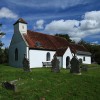
There is one road into Bincombe and from there the church does not look especially attractive. Pevsner refers to its “Blunt west tower”, which from a distance looks in need of a spire. The centre of the village is all farmyards, appropriate for this rural area, and you have to pass through one to reach the church.

We visited on the Saturday before the rogation service and we came round the side of the building and found people busily preparing the church, arranging flowers and tidying up the churchyard.

Consisting of a west tower, nave, chancel and south porch the church is mostly in the Early English style of the 13th and 14th centuries but there are traces of Norman work in the building. In 1862 the floor of the chancel was raised and other changes made and the church furniture was renewed. The organ came to Bincombe in 1901 from Broadwey Church, were it had been since 1873.

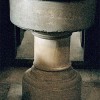
The church is entered through the south porch and beside the doorway (dated 1779) is a mediaeval Holy water stoop. The font is at the west end of the nave, beneath the tower. The round bowl with chamfered under edge dates from the 13th century and is of Purbeck marble. The stem is modern. In days past Fonts were kept filled and, in 1236, the Archbishop ordered that the covers should be secured to prevent the water being stolen for superstitious purposes; on the rim are traces of the old cover.

 The chancel east window is in memory of Elizabeth, the widow of John Howship, a surgeon of Saville Row, London. Elizabeth died on the 20th of November 1860 aged 73 years; she is buried in a single stone covered tomb with her father Robert Tillidge who died in 1806 aged 88 years. John and Elizabeth Howship had a son John who only lived for two months; he died on the 4th of March 1808 and is buried here. The windows on the south side are in the Perpendicular style of the mid 1400’s.

Holy Trinity has two bells: the larger dated 1658, is by Thomas Purdue and the smaller one, dated 1594, is by John Wills of Salisbury and is inscribed ‘Feare God.’

Recent changes include the installation of the clock in the tower as a thanksgiving for delivery and victory in WWII. At a cost of over £80,000 the roof was renewed and other repairs carried out in 1995. The modern sound and Loop system was installed in 2001.

When 2001 census statistics are compared with figures from the 1841 and subsequent censuses, we see an increased population something unusual in rural communities. On the gate of one of the farms on your right as you proceed into the village is the name Pashen – the family name appears in the 1841 census.

The name Bincombe probably means a place where beans were grown, a staple food in prehistoric and Saxon times.

We noticed these family names in the churchyard: Hawker, Fookes, Cooper, Christopher, Pashen. Grant, King, Loveless, Foot, Haines, Gollop, Cake, Hatton and Bayley.

John Hutchins

Visitors to Dorset’s History Centre in Dorchester, formerly the Record Office, can see and consult a history of Dorset in four massive volumes. The pages of these gargantuan tomes represent the life work of a remarkable clerical historian who died over 230 years ago, and a challenging project with a chequered history quite as intriguing as the life of its author: the Reverend John Hutchins. His four-volume work is the definitive archive for the county of his day, yet this clergyman’s monumental task suffered setbacks and came close to not reaching the presses at all.

On Sunday, July 25th 1762, 64-year-old John Hutchins, then rector of Holy Trinity Church in Wareham, was away conducting a service at Swyre Church near Bridport when fire broke out in one of Wareham’s many timber buildings. Fanned by wind, the fire rapidly engulfed a large area of the town including the rectory, where Mrs Hutchins was at home. At what must have been great personal risk the rector’s wife left and re-entered the blazing building more than once to salvage whatever she could of her husband’s transcripts and notes – including those for the developing history of Dorset – each time emerging with armfuls of the irreplaceable documents. Not all of the papers could be salvaged but enough were saved to enable Hutchins to continue his work on the project. But for this courageous act of a devoted wife, Hutchins history of Dorset may never have seen completion. Holy Trinity’s Rectory, insured for £300, was the fourth building to catch alight, but the fire left 132 other buildings either badly damaged or reduced to charred embers.

Hutchins attention and interest were first turned to studying the history of Dorset through the unusual channel of a request for a piece of genealogical research. In the mid 1730’s the then Lord of the Manor of Milton Abbas, Jacob Bancks, asked Hutchins if he would conduct enquiries into the history of the Tregonwells – the family of Banck’s mother – on his behalf. This soon led to Hutchins examining collections of earlier documentary material about Dorset. Bancks then encouraged the minister to start collating and writing a comprehensive historical treatise on the county.

In 1736 another noted antiquarian and historian of the day, Brown Willis of Blandford, returned to Dorset and further persuaded Hutchins to undertake the task of writing the county’s history. Three years later Willis devised a six-point questionnaire, together with an appeal for help, which he then distributed throughout the county. Thus John Hutchins came to begin his great undertaking. But what manner of man was this who’s unflagging motivation put his county down on paper for all to consult in the centuries to come?

John Hutchins was born in Bradford Peverill on the 21st of September 1698, the son of the Revd. Richard Hutchins, then rector of All Saints in Dorchester. Richard’s wife, John’s mother, died when John was only eight years old. When older, John was sent to be educated at Dorchester Grammar School, from where he went up to Oxford to study towards taking holy orders, graduating with a BA in 1722.

Hutchins first clerical position was as curate at Milton Abbas, and it was likely during this time that Jacob Bancks was responsible for his preferment to his next ministry as rector of Swyre by 1729. Again, through Banck’s influence, Hutchins secured the living at Melcombe Horsey, where by this time his writing of the history of Dorset was already underway, though the move to Melcombe proved to be a setback in his studies. He did however marry Anne Stephens, daughter of the rector of Pimperne, while at Melcombe. John and Anne had just one child, a daughter they baptised Anne Martha.

The Hutchins last and most enduring move was to Wareham, when John was appointed rector of Holy Trinity (with St. Martins and St Mary’s) in 1744. It was said of him that he was “a sound divine, rather than an eminent, preacher.” Little is known of his parochial activities before coming to Wareham but he seems to have been a conscientious parish priest. However, Hutchins was not without his difficulties during the Wareham years. The town was a stronghold of non-conformism, and furthermore one of Hutchins curates had to be committed to an asylum. Then with Hutchins in absentia came the day of the great fire and his wife’s Anne’s heroic act of salvage.

However in 1761, a year before the fire but when the History has been in writing for about 25 years, Hutchins received a generous subscription enabling him to research archives in London and Oxford. With occasional assistance from others, Hutchins would be pre-occupied with collating and writing his history for the rest of his days. Throughout these long years he would have little time from preaching, or energy for other writing.

By early 1773 Hutchins health had broken, being paralysed after suffering a stroke. Thereafter Anne Martha helped her father finish the work, writing his letters and other documents as he probably dictated them to her, but this naturally hampered and delayed the completion of the work. Just three weeks after he had written its dedication on 21st June, the author of The History & Antiquities of the County of Dorset died aged 75. He lies beneath an inscribed floor slab of King Edward’s Chapel in St. Mary’s. Wareham.

The first edition of the history of Dorset was published the following year under the supervision of Dr William Cuming of Dorchester and the antiquarian Richard Gough. Meanwhile, Martha had met (though it is not known how) and fallen in love with John Bellasis, a soldier in the East India Company. While Gough and Cuming were concerned for the welfare of widow and daughter, Bellasis was equally concerned to support his fiancée’s mother financially, as well as promoting his late father-in-law to be’s work and memory. Gough then arranged Martha’s passage to India in March 1775 where, re-united with Bellasis, they were married in Bombay Cathedral in June 1776.

Bellasis joined the EIC in 1769. By the time of his fiancée’s arrival in October 1775 he had been promoted from Ensign of Artillery to Lieutenant; he would ultimately become a Major General and Commander-in-Chief at Bombay.

While on an extended two-year leave in England with Martha from 1791 Bellasis arranged for Gough to supervise the publication of a new edition of the history of Dorset with William Morton Pitt MP and Thomas Bartlett Jr, Town Clerk of Wareham, acting as his chief Dorset representatives and helpers. In 1792 he arranged for a mural monument to his father-in-law’s memory to be set up in St. Mary’s.

Anne Hutchins died in 1793 and John and Martha returned to an India they would never leave again for the rest of their days. They had six children, all of whom survived infancy. Anne Martha Bellasis died on May 14th 1797, and in 1803 her widowed husband sent home a preface for the second edition of the History at his own expense; he died in 1808. After the first two volumes of this edition had come off the press a fire broke out at the print works, destroying Volume 3 and unsold copies of the previous two volumes. Fortuitously the printer held one copy of Volume 3 at his home, and this volume was re-printed. The fourth and final volume, The History & Antiquities of Sherborne in the County of Dorset, published by Nichols, Son & Bentley of London, came out in 1815, and the third edition of the set was issued between 1861 and 1873.

Before John Hutchins time the recorded history of Dorset was random and fragmentary. His legacy was to be the first person to marshal the hotch-potch of miscellaneous documents about the county then in existence into a single exhaustive reference. He was, for instance, the first to put forward a speculative account of the possible origin of the Cerne Giant, but also became involved journalistically in the tradition of the Chesil sea-monster called Veasta, and wrote about such historic features as Kingston Lacy and Badury Rings.

In this respect, perhaps, he was a man ahead of his time.

Dorchester – The Maumbury Rings

“The largest prehistoric monument of its kind in Britain” is how one early antiquarian observer described Maumbury Rings; just ten minutes walk from Dorchester town centre. It is said to have been able to accommodate ten thousand spectators and enclose an area equal to fifty football pitches, although these claims seem a little exaggerated. Certainly the class of monument to which the Rings belong is one found nowhere else in the world outside England, but many other examples of its kind have since been largely ploughed away, including others in Dorset.

Not so Maumbury Rings. This monument is the largest and most important structure of its kind in Britain and has survived intact simply because of its proximity to Durnovaria (Roman Dorchester) and because it has proved so useful for a range of different functions over the centuries. But Maumbury was originally constructed as a henge, one of those still somewhat enigmatic earthworks of England’s Neolithic people, and its origin can be traced back to about 2,500 BC.

It was Sir Christopher Wren who is said to have been responsible for first applying any archaeologically minded scrutiny to Maumbury Rings, though the great eighteenth century antiquarian William Stukeley also wrote about it at some length. Variously described as a “sun temple” or “a Neolithic dewpond,” others fancied the rays of the sun rising in the east passed through the north-east entrance to strike the rising ground at the opposite end, though this has since been shown to be a fallacy.

A large stone is said to have once stood near or across the south-west entrance, and which was long thought to have been the sighting-stone for solar and lunar observations. It is noted that in 1879 a minor excavation was made in the hope of locating this stone, but none was ever found.

Whatever Maumbury’s original purpose as a Neolithic enclosure was, it may well have suffered the same fate as other henges in the area had not the emperor Claudius resolved to bring Britain into the Roman Empire in 43 AD. When the town of Durovaria was founded it was soon appreciated by some engineers or planners that the Maumbury henge conveniently defined in its own outline an earthwork thought to be easily adaptable to serve as a small amphitheatre for gladiatorial or other entertainment without the extra labour and expense of having to start from scratch. Instead of what had probably been existing insubstantial embankments being levelled into oblivion by ploughing, they were re-inforced with rammed chalk and raised to their present day height.

It is believed that by the first millennium BC Maumbury Rings was in use as a Celtic earthwork, possibly some temple on the lines of Stonehenge. Following the departure of the Roman Legions in about 410 AD, the Rings probably continued in use as a meeting place, but no record exists from the Saxon period. During the Middle Ages the arena became the scene of jousts and other revels.

But it is not until the 17th century that we have a clear record of any major event connected with the monument. During the Civil War the Parliamentarians quickly saw the earthwork’s potential as a defensive site, and turned it into a gunnery emplacement to command the then exposed flank of the town from the direction of the Weymouth Road, up which the Roundheads expected the Royalists to advance. After the Civil War, the macabre rise in popularity of public executions by hanging led to the rings being used for this grizzly purpose. However executions at this locality ceased in 1705.

Rather through hearsay, a story has been handed down about the execution, probably in the late 17th century, notable for its particularly tragic circumstances. The details have apparently never been properly recorded, but a young unnamed woman was sentenced to death for some minor crime by hanging at Maumbury. However, at the time she was condemned she was expecting a child. Not wanting to condemn an unborn child to death as well, the magistrates deferred the mother’s execution until the child could be born in prison.

Following the birth the woman was duly hung, but has ever since left behind the unanswered question of who she was, who the child’s father was, and above all what became of the child. Was the child adopted? Did it die in infancy? Did it grow into adulthood and perhaps emigrate? The tragedy of this case is that it occurred a century too soon for the possible commutation of the sentence to transportation to be enacted. But clearly, this is a mystery, which can never be solved without intensive genealogical investigation.

In 1908 the archaeologist George Cary began the first systematic excavation of the earthwork to be conducted in modern times. Probably Cary hoped that the various romantic imaginings and speculations about the henge’s use in pre-Roman times could be laid to rest once the site’s history was set on a firm footing based upon the evidence of the stratigraphy and finds uncovered. Cary’s first excavation revealed that, as might be expected, sherds of recent pottery, ceramics, and other objects were abundant in the first foot or so of soil removed, and included a Victorian half-penny. But these and some older mediaeval pottery underlying them soon ceased.

By the end of the third season in 1910, two Romano-British graves had been discovered and opened, together with seven shafts approximately of the same age as the henge itself re-exposed in the arena floor. These shafts, which may have served a similar function to that of the comparable pits (Aubrey Holes) at Stonehenge, were found to contain a considerable number of tools made from deer antler, together with Neolithic pottery sherds and flint flakes. Interestingly, the existence of these shafts has led to the conclusion that the Romans experienced considerable difficulties in constructing parts of the arena floor and boundary walling of the amphitheatre.

During a much more recent excavation in the early 1970’s a deep cutting made into the chalk walling on the north east side showed that the Romans had to overlay the prehistoric shafts with rammed chalk in the arena’s western curve in order to stabilise the floor surface. It was therefore evident that the Legionary engineers found it harder than expected to adapt the earthwork to their requirements.

During this excavation another four shafts were exposed, bringing the total known to eleven. During an exploration of the outer part of the north entrance a third grave was discovered in the chalk, this time containing a skeleton of a well-built Romano-British man accompanied by a pottery vessel. But the work of this excavation was mainly concerned with determining the real purpose of the shafts. This was not proved, though it is thought likely that they were flint mines.

Today Maumbury is a tourist landmark and attraction, equally attractive to children and picnickers alike, with its own information board at the northern entrance.

Mary Channing – A Path to the Gallows

On January 15th 1705 an extraordinary marriage was solemnised in a Dorchester church. Extraordinary, because neither party to the union, especially the bride, was committed to the other out of mutual affection. Furthermore, the groom could scarcely have imagined that the ceremony would launch them both on a fateful journey that would end in capital crime and capital punishment. Neither could he have imagined that before spring turned to summer that year he would be dead.

The groom was Thomas Channing, a goodly tradesman of a Maiden Newton family, who had established his own successful grocery business in Dorchester; his bride was a reluctant, rebellious teenager called Mary Brooks. And they were wedded not out of love but purely out of convenience: in deference to the wish of the bride’s parents to see their daughter suitably placed with a respected, financially secure citizen.

The chain of events, which culminated in this peculiar tryst of fate, began some 18 years before with the birth of Mary Brooks in May 1687. Her father Richard and mother Elizabeth were keen to give their daughter the kind of education common to children of their social standing. Mary excelled in reading and writing, but her parents neglected to lend equal weight to the girl’s moral and religious instruction.

Whether or not this was a contributory factor, the girl manifested a latent sluttish disposition, which may have been aggravated by emotional depravation caused by her mother’s frequent absences. It was thought that the pastoral simplicity and rude country acumen of 18th century Dorset was no environment in which to equip a country girl for the niceties of high society, and so Mary was packed off to Exeter, London and elsewhere to gain experience of English higher society.

But this extraordinary degree of liberty was to exert further negative consequences on Mary Brook’s already weak character and tainted persona. Her sluttish manner gave way to vanity, promiscuity and riotous living. Every two weeks she would attend the local dance school, staying on for a night of frivolity and mirth with other young friends. She was ever at the homes of her neighbours, luring them into orgies of gluttony and intemperance while frittering the night away in gay abandon.

She was later to disown these “friends” when she began a loose affair with a local man. The pair would frequent public houses, where the wayward teenager would entertain her date with wine and shower him with gifts such as ruffles and cravats. Mary would willingly cover the expenses for these excesses, but her generosity cut deeply into her solvency. To financially support her highly social lifestyle Mary cajoled, or even conspired to rob, her parents of substantial sums, aided by some of her closest friends.

Naturally her cavorting and Jezebellian ways became the talk of Dorchester’s gossips, but Mary continued to drift from one extreme of pleasure-seeking to another. One citizen, who did not even know the Brooks family, even sent Mary’s parents a letter of complaint about their daughter’s wayward conduct. These correspondences would increase as Mary’s excesses increased. Clearly Dorchester’s busybodies had blown any hope the girl may have entertained of keeping her activities under wraps from her parents. Although Richard Brooks was shamed by his daughter’s behaviour and expressed his displeasure, Mary took scant notice.

Once the revelations of the extent of Mary’s conduct had come home to her parents they concluded that the best remedy lay in finding Mary an eligible husband – probably in the hope that she would knuckle down to the sober responsibilities of family life. To make the proposition more attractive they used the prospect of a considerable fortune as a carrot to dangle before several Dorchester bachelors. But of these only one would rise to the bait: Thomas Channing.

Although the grocer was an acceptable suitor in the eyes of the Brooks, their daughter’s affections lay elsewhere. Channing himself turned his attentions to another prospective bride for a time, but the iron will of Mrs Brooks proved to strong to countermand. As for Mary, her rejection of Thomas brought about confinement to her room for several days in punishment. Eventually, for the sake of her freedom, she grudgingly agreed to marry Channing.

After an initial postponement of 24 hours the unhappy union of Thomas Channing and Mary Brooks was consummated. Yet after a while Mary, who before and after was plotting how to rid herself of parental control, came to look on her marriage as the way to achieve this. Shortly before she had also been roused to anger when her current fancy had refused to marry her.

Amazingly the wedding party lasted for two days with the full knowledge of the Brooks, but apparently the total ignorance of the Channings. Only weeks earlier their son had told them he had relinquished all thought of marrying Mary, but after the wedding he changed his mind. By now though, a fateful dye had been cast. When the marriage was barely three months old Mary began an affair with yet another man, a visitor to Dorchester recorded only as Mr Naile, upon which she lavished her accustomed costly entertainment. She even persuaded Thomas to let Mr Naile take his place in their bed. That he did so most likely occasioned the illegitimate conception that added the drop of gall to Mary’s cup of tragedy.

By now, poor Thomas had become an inconvenient hindrance to his wife’s nuptial preferences. On April 17th she administered to her husband a dose of mercury purchased from the maid of the apothecary the previous day. After eating the dish of rice milk Thomas was violently ill and began vomiting. The following day, prompted possibly by the suspicion that he was being poisoned, he made out a last will and testament entirely disinheriting his wife. Following another three days of agony and unremitting pain the grocer died on April 21st. Following the post-mortem sixty to eighty people attended Channing’s funeral at St. Mary’s back in Maiden Newton.

Even before Channing died however, Mary had decamped. She went into hiding for 30 hours, first to a safe house in Dorchester, then into a wood four miles away. From there, with the aid of a friend’s employee, she made it to the home of a relation of her sister-in-law who lived in Charlton Worthorn in Somerset. Once he had learnt of Mary’s purchase of the mercury, Thomas’s father then organised a wide search. On Sunday Mary’s accomplice, following the offer of a reward and out of fear of being charged as an accessory, brought her back. That night Mary learnt of her husband’s death, but showed no emotion or concern.

In the morning she was brought before the justices at Dorchester for questioning. During the trial Mary had the opportunity to defend herself, but against the weight of two barristers and many prosecution witnesses the jury took only half-an-hour to find her guilty. On pronouncement of the death sentence Mary pleaded “her belly” (postponement on account of her pregnancy.) Until her baby had been born the sentence could not be carried out.

This pregnancy, of course, was a critical, if unintended artefact in the Channing case, providing an 8-month window of opportunity for appeals against the sentence to be lodged. Richard Brooks lost no time in petitioning Queen Anne and Mary’s eldest brother presented a petition signed by several Dorchester citizens to the judge at Wells. Mary’s mother sought the help of a lady, but all these efforts were to no avail. Multifarious deaf ears could not save a sinful teenager from the terror and humiliation of a public hanging.

While in prison much pressure was put on Mary to confess and repent, but she would maintain her innocence to the end. At first the Brooks were able to pay for respectable accommodation for their fecund daughter, but later seemed to lose concern for her welfare. Their support payments lapsed, so that Mary had to be relocated to a much more spartan cell with a bed made from only canvas tilting of an old wagon. It was in here on December 19th that Mary delivered a son that was immediately baptised at her request. The mother refused to have the baby withdrawn from her care.

But the opportunity for maternal care almost never arose. Soon after the birth Mary was smitten with fever and nursing the baby greatly weakened her. In these last tragic days Elizabeth Brooks was at Mary’s side constantly. On March 8th 1706 Mary was again summoned to the bar and asked if she could show just reason why the death sentence should not be passed. She could not, and so was told to prepare for death. Various clergy began a campaign to persuade Mary to repent of her sins, but without success. Yet Mary asked to be baptised (the Brooks were Baptists, who did not believe in infant baptism.) But how could the chaplain baptise one who wouldn’t repent? After a special dispensation from the Bishop of Bristol however, Mary was baptised on the 17th of March.

Only four days later on March 21st 1706 Mary Channing’s time had come. From the prison she was brought to her place of execution at Maumbury Rings on the outskirts of Dorchester, where a crowd of over three thousand had gathered for the macabre ordeal. Burning at the stake was the customary execution for women until the end of the 18th century. At 5 o’clock in the afternoon Mary was bound by the neck to a post while faggots piled up around her were lit. But the 19 year-old was already dead from strangulation by the noose. Then, with no sense of shock or revulsion, the multitude dispersed as Mary Channing’s mortal existence was consumed by fire.

As to the fate of her son, this seems to have been lost to history. Did he die in infancy? Was he perhaps brought up in a workhouse or even adopted by his grandparents or another family? Did he stay in Britain or emigrate to seek his fortune overseas? We may never know.