Dorset Ancestors Rotating Header Image

2010:

‘Buried in Woollen’

Introduced during the second half of the 17th century for “the encouragement of the woollen manufacturer” the ‘Act for Burying in Woollen’ was clearly designed to increase demand for home produced woollen cloth.

The 17th century was a time of crisis for the English woollen industry and particularly so in the West Country. Here many rural workers and their families supplemented their meagre income from the land by processing and weaving wool: they relied on a local market for their production, which was mainly low quality cloth produced in the home. In Dorset this cottage industry was controlled from Dorchester where many rich clothiers had their businesses: these people prospered from the woollen industry while the labouring classes supplying them scratched a living.

During the 14th and 15th and early 16th century woollen cloth produced in Dorset was exported to Northern Europe from Bridport, Wareham, and Poole. The 16th century saw a change in fashion as linen, satin, and silk became more readily available, while the demand for woollen cloth dropped away. The Dorchester merchants protected themselves by changing the way they dealt with their rural suppliers: the end result was a better finished woollen cloth but the new terms of business badly affected the producers who, in modern day parlance, became outworkers.

As a result of these changes there was distress in the hamlets and villages during the late 16th and 17th century. But this was a national problem, and measures were needed to increase demand, improve the quality of the woollen cloth and encourage the development and production of new textiles. To this latter end specialist workers were welcomed into the country for their expertise. The monarchy was restored in May 1660 and during the reign of King Charles II an Act was passed designed to increase the use of woollen cloth.

The ‘Act for Burying in Woollen’ was enacted by Parliament in 1666 for “the encouragement of the woollen manufacturer.” This Act required that no corpse “shall be buried in any shirt, shift, sheet or shroud or anything whatever made or mingled with flax, hemp, silk, hair, gold or silver or in any stuff other than what is made of sheep’s wool only.” The Act was amended in 1678 to make it easier to enforce and imposing a fine of £5 for non-compliance. It was a requirement of the Act that an affidavit be sworn before a Justice of the Peace or a priest of the church (but not the priest officiating at the burial) and delivered within 8 days to the priest who conducted the burial. The term ‘buried in woollen, affidavit brought’ is to be seen in the burial registers of the churches after 1666.

The affidavit frequently took the following form: “Mary White made oath this 15th day of January 1698 before …one of his majesties Justices of the Peace that Jane White of the parish of Morden lately deceased was buried in woollen only according to the terms of the Act of Parliament of burying the dead and not otherwise.”

Gradually the legislation came to be ignored and the Act was repealed in 1814 during the reign of King George III. The rich usually chose to pay the fine rather than be seen dead in wool.

The Death of Lawrence of Arabia

“Lawrence of Arabia fights for his life” ran the headline in the “Dorset County Chronicle” of May 16th, 1935. A charismatic figure who had played a key part in the events surrounding the First World War had come off his motorcycle on the way to his Dorset home from Bovington Camp. The headline was replaced the next week with: “Dorset village grave for Lawrence.” The saga was over. Countless books have been written about him, amid speculation that a mysterious car was involved.

According to the “Chronicle”, for a week the whole world had its eyes on the camp near Moreton, where Lawrence, a brilliant military strategist known more recently as Mr T.E. Shaw, lay at death’s door. Distinguished statesmen inquiring about him included Mr. (later Sir) Winston Churchill. Calls came in from all over the country and abroad.

The funeral was attended by peers, politicians, diplomats, distinguished soldiers, writers, artists and foreign emissaries, together with local villagers and private soldiers and gunners who had served with Lawrence in his famous campaigns in the Arabian desert. The Royal Air Force, in which he also served, was represented. The King and Queen were among hundreds who sent messages of sympathy.… A verdict of accidental death had been returned.

Lawrence loved motorcycling, travelled to and from London and explored parts of England on his machine. As King George V wrote: “His name will live in history. ”The King recognised in a telegram “his distinguished services to his country.”

Helen Taylor of Tyneham

She was not born there and she did not die there but she spent the happiest days of her life there and her ashes rest there. A simple genuinely heartfelt gesture during the dark days of World War II has made the name of Helen Taylor synonymous with the Dorset village of Tyneham.

The villagers, evacuated from Tyneham on the orders of the War Department have not been allowed to return to their homes. For the full story of the events that took place there in December 1943 see our feature “Tyneham – the Village that Peacetime Betrayed.” And there are photographs in the photo section.

Helen Beatrice Taylor was born at Tincleton on the 14th of September 1901 and her sister Harriet Elizabeth on the 16th of March 1892 to William and Emily Taylor. The sisters, known as Beattie and Bess, ran the laundry for Tyneham House, home to the Bond family. Helen always considered Tyneham her home but after the forced evacuation from the village she lived at Corfe Castle until 1994 when she went to live in a nursing home at Swanage.

Neither Helen nor her sister Harriet Elizabeth (Bessie) or their half brother Charlie ever married. Helen had suitors but it is thought she did not marry because she wished to look after her older sister and half brother. Charlie Meech is credited with saying one day on his return home after a hard days hedging “saw old Thomas Hardy sitting in his garden…wasting his time…writing.”

At Corfe Castle they lived a happy self-sufficient lifestyle – with large garden sheds immaculately kept including one that stored extensive well water worn wooden laundry equipment and others with garden produce.

The sisters had an elder brother, Arthur Henry Taylor, born on the 8th of March 1890. Arthur started his schooling at Tincleton, where he was one of twenty pupils. The Headmistress lived on the premises. Arthur showed early promise and was taken under the wing of a clergyman who furthered his education. Accepted by Cambridge University, from there he entered the army and rose to the rank of Captain, receiving the MC and MBE. His death in Jerusalem on the 30th of November 1929 was the result of a tragic accident. It seems he had worked with Lawrence of Arabia and introduced Helen to him at Tyneham.

The girls had already lost another brother Bertie and a half brother Bill Meech in the First World War. The CWGC Debt of Honour Register records that “Bertie Taylor, Private; Dorset Yeomanry (Queen’s Own) died on Saturday 21August 1915 Age 21. He was the son of William Taylor, of Tyneham, Corfe Castle, Dorset; Buried at Helles, Turkey. The Helles Memorial stands at the tip of the Gallipoli Peninsular. It takes the form of an oblelisk over 30 metres high that can be seen by ships passing through the Dardanelles.” William Meech was in the same regiment as Bertie and died on Saturday 26th February 1916 aged 28. He was buried at Alexandria, in Egypt.

Helen died at the age of 97 in May 1999 and was given a half page obituary in the Daily Telegraph of 13th of May 1999, with the headline “Village That Died for D-Day welcomes last exile” and “Woman returns to Tyneham after 56 years for burial in church she loved.”

Helen was the last person to leave the village in 1943 and she pinned a note to the door of St. Mary’s church that read: “Please treat the church and houses with care. We have given up our homes where many of us have lived for generations to help win the war to keep men free. We shall return one day and thank you for treating the village kindly.”

A Disastrous Fire at Shapwick – October 1881

On the 14th of October 1881 a fire broke out at Shapwick making nearly 80 homeless before it was brought under control. This small village is on the River Stour, overlooked by Badbury Rings. Just five miles south of Blandford Forum, itself no stranger to fires, it was virtually wiped out 150 years earlier and before that in 1564, 1677 and 1731 suffered the devastating consequences of fire. The residents of Shapwick didn’t have the Bastard brothers to rebuild their village.

The fire broke out between twelve and one o’clock and Mrs Andrews, who saw the thatched roof of a pigsty was on fire, raised the alarm. Her son immediately set off to get water to put out the fire. Reports say the wind was blowing a gale from the north-west at the time and the flames quickly spread to an adjacent barn and blazed on to the cowhouses and in an incredibly short time the whole area was burning out of control. A large rick of about 40 tons of meadow hay also caught fire.

Burning thatch was carried on the wind to buildings opposite which were quickly alight and from there jumped to a double cottage occupied by Mary Ann Hammett and her three children and Henry Kerley, his wife and two children. The wind continued to display its destructive power carrying the flames across the street and setting alight a cottage occupied by Mr. Cutler and Robert Cuff, his wife and five children. One pig was burnt alive and another was so badly burned it had to be killed, they were the property of Mr. Cutler and as far as is known were the only livestock lost to the fire. Other animals were let loose and escaped.

Even though the mostly semi-detached cottages were distanced from each other the menace of the gale negated any protection that might have afforded them and the fire travelled rapidly from home to home leaving little time for villagers to salvage their possessions.

A cottage occupied by Mr. Henry Masterman, foreman to Mr Martin Small, with two grandchildren and Charles Cuff and his wife were next in line to be attacked by the flames, which raced towards the home of Phares Kerley and his wife and child and then travelled on to set alight the homes of Henry Foster and Mary Oats.

The gale, still not satisfied with its destructive work, roared on carrying the flames to the homes of Peter Kerley and his mother. Then it was the turn of William Boyt and his wife and Robert Boyt and his sister.

James James had to get out quickly along with his two daughters, son and two grandchildren. The next house, occupied by Israel Andrews, his wife and four children adjoined the house of Mr. Feltham the shopkeeper and was partly used as a post-office: he lived there with his daughter. This property was of brick with a tiled roof and was better able to rebut the advancing flames. Most of the post office papers and stamps were saved and this building at least was left standing but it didn’t stop the fire, which continued its advance to the next cottage, the home of Martin Kerley, his wife and ten children. One of Mr Kerley’s daughters was recovering from rheumatic fever and was immediately carried to a place of safety. Thomas Kerley’s house, which he occupied with his wife and daughter and grand daughter, was the last house of the row to fall to the elements. Due to the heroic efforts of the villagers the fire stopped here and was prevented from advancing further up the street.

The elements persisted in attacking the next cottage but strenuous effort was made pouring water onto the roof and although the fire caught several times the cottage was saved. Not to be defeated the wind carried burning thatch over the garden to the smithy of Mr. W. Guy and his shop and house were soon consumed by the flames; the nearby home of Charles Weeks, his wife and six children was burnt out.

Soon after the alarm had been raised messengers were sent to Wimborne and Blandford and fire engines attended from both towns. It was mostly due to the efforts of the Wimborne fire brigade that the fire was stopped from spreading past Charles Week’s house. The Wimborne brigade saved Henry Frampton’s home, which was some comfort as he looked-on while a large barn he used to make hurdle, crib and spar in was set ablaze, the fire taking most of his materials and stock.

The Blandford engine and brigade arrived in the village shortly after and immediately set about putting out the hay rick at the other end of the village and saving the Anchor Inn and Mr Andrews house. The cottages being mainly built with mud walls and thatched roofs were easy prey for the fire and were quickly laid down.

Adding to the distress of the villagers was the loss of their winter stocks of potatoes and apples as well as their winter fuel, which most had stored in or nearby their cottages; very little was saved.

It was reported that with the exception of Mr Guy’s smithy and part of a property belonging to dairyman Mr Bartlett, the household effects of the tenants were uninsured. The cottages were owned by Lord of the Manor Mr Bankes of Kingston Lacey and were insured with the Atlas insurance office, of which Mr Bankes’ land steward, was the agent.

The Lord of the Manor with his daughter and land steward visited the village late on Friday and again on Saturday to see the extent of the damage. Mr Bankes sent £100 to the vicar the Hon. and Rev. A.G. Douglas to be distributed among the unfortunate cottagers to meet their immediate needs. Villagers whose cottages had escaped gave shelter to less fortunate neighbours and Mr Bartlett of New Barn, Mr Martin Small and other local farmers provided shelter for others. Mrs Douglas and her daughters looked after the younger children at the vicarage.

On Sunday special collections were made during church services at Blandford and Wimborne and collections were made at Sturminster, and Spetisbury and other towns and villages. The scene of the fire was visited by hundreds of people on Sunday when it was said the main street was almost impassable due to the throng of people.

The gale that propelled the fire caused widespread damage in the wider locality, bringing down trees and damaging farm buildings. On Lord Portman’s estate, shortly after six o’clock on Friday morning, an elm tree was brought crashing down through the roof of a hurdle-house.

The local newspapers described the fire as one of most terrible and disastrous fires that had ever occurred in the locality. 17 houses and cottages, three large barns, cowsheds and outhouses together with almost all their contents were lost. Someone visiting the area on the following Sunday said “ the village presented a sad, desolate appearance, only portions of walls and chimney stacks marking the spot where but a short time before many industrious labourers and their families resided.”

The Dorset Button Industry

If there is one industry that could be singled out as almost a Dorset speciality, it would be the manufacture of buttons for clothing. In the days before the industrial revolution buttony was a thriving means of earning a crust for many rural dwellers, but once there was machinery available for making buttons, the industry moved from a cottage to factory and from south to north. Yet at the peak of the industry in Dorset over 100 different types of buttons were being made, marketed and shipped abroad.

Buttons were not made in England before the 15th century; until then all clothing had been fastened using just a tie-string. It took a man who began his career as a soldier from the Cotswolds to make his adopted county a renowned centre for button-making, though he was not the first buttoner in Wessex. But it was more than knowledge of continental culture that Abraham Case picked up during his years in the Army when stationed in France and Belgium. Case was deeply impressed by the skill and high standard of the buttoner’s art in those countries and after leaving the army he settled in Shaftesbury in 1622 where he soon went about setting up his own buttony business.

From this small beginning buttony had virtually become the foremost Dorset industry by the beginning of the 18th century. It came to employ thousands of women and children and was worth £12,000 a year. Buttons were exported from Liverpool to Europe and America, where they were in great demand.

But Case lived in the days before corporate automation. Within and from Shaftesbury the industry was devolved to many outworkers, mainly women but also some men and children living in cottages. Some villages as well as larger towns became centres with depots provided for the buttoner’s finished goods. Following Shaftesbury’s lead, Blandford, Bere Regis, Lytchett Minster, Iwerne Minster, Langton Matravers and Poole all became significant centres for the industry in its initial phase.

The earliest buttons produced by Case at Shaftesbury were mainly of two types called “High Tops” and “Knobs” made from the horn of Dorset rams. A disc of horn was covered with a piece of linen then worked all over with fine linen thread, creating a conical knob shape depending on the button style required. High tops were used as the buttons for gent’s waistcoats. It is appropriate to indicate at this point that that icon of Dorset, the sheep, not only provided the wool for woollen garments but also the backing material for the “roundels” invented to fasten them with!

A broad variety of button styles, including high tops and knobs were made in east Dorset, as well as those produced in a sire-ring: Blandford Cartwheels, Ten-Spoke Yarrels; Basket Weave; Honeycomb; Cross Wheel of Spiders Web; Jaml or Gem; Spangles; Birds Eye and Mites. Mites and Spangles were very small and bore some beadwork. The Singleton was a black button made from the fine linen-covered padded ring produced exclusively by Case’s widow only between 1658 and 1682.

The finished buttons were then mounted onto cards for sale. “A-1” quality buttons were mounted onto pink cards and reserved exclusively for export. “Seconds” were put onto dark blue cards while those of the poorest quality of all were fastened to yellow cards. All buttons other than those of the finest quality were reserved for the domestic market. Any dirty buttons were boiled in a linen bag before mounting.

Outworkers would take finished buttons to be exported to their local depot on designated “button days” where they could sometimes be paid by barter rather than in cash. It was said that skilled master buttoners could make up to 144 buttons in a batch for which they could be paid 3s 9d (it was 3s 6d for poorer quality buttons.)

When Abraham Cash died the business was taken over by his sons Abraham Jr and Elias. The younger son Elias relocated to Bere Regis where he established the branch industry there and in 1731 engaged john Clayton to re-organise the production. On Clayton’s recommendation an office was established in London in 1743 to manage sales and marketing. The following year the depot at Lytchett Minster was opened. Third generation Peter Case set up depots at Milbourne Stines, Sixpenny Handley, Piddletrenthide, Langton and Wool. By the beginning of the 19th century there were depots for the cottage outworkers in all centres of the industry. Children were employed in the main depots at Shaftesbury and Bere Regis to prepare material for the outworkers.

During the reign of George II, Case’s grandson took the process a stage further with the development of the wire-ring button. The wire was brought in one-and-a-half ton bales by horse-drawn wagon from a factory in Birmingham. This wire would then be made into button rings by being twisted in a spindle before dipping the cut ends in solder. Children were employed to thread the rings onto gross bundles or to polish the finished buttons. The latter procedure had to be stopped when it was realised that the polishing was damaging the thread. At Blandford linen shirt buttons were made as well as the native style called the Blandford Cartwheel. The town’s earlier Huguenot lace industry was by then in decline, but the button makers soon found a new use for the fine lace thread.

In 1851 Prince Albert’s Great Exhibition of art & industry was held at the purpose built Crystal Palace. Among the exhibits was the Ashton Button Machine a contraption that within years would virtually wipe out the Dorset button industry, bringing unemployment and starvation to Case’s cottage outworkers and their families. Naturally, escape in the form of emigration was a much sought after alternative. Indeed, it was said that the government paid for the expatriation of some 350 families from Shaftesbury alone, to begin a new life in Australia and Canada. For those who remained Ashton’s invention became responsible for the appearance of the button factory proper at Birmingham and elsewhere.

For about the next fifty years buttony was off the commercial radar in Dorset until early in the 20th century, when Dowager Florence (Lady) Lees of the Lytchett Mission, and a beneficiary of the Case family estate, sought to revive the industry at Lytchett Minster after the death of Henry Case in 1904. Lady Lees set up a small business specialising in the production of “Parliamentary” buttons for Dorset MP’s in their respective constituency colours: pale blue for South Dorset Conservatives; purple for East Dorset Conservatives. In 1908 these buttons were in full production, but Lady Florence’s brief revival of the industry was brought to an untimely end by the outbreak of the First World War. More recently the clearance of an old cottage on the Lees estate turned up several boxes full of buttons that were then sold to Americans to raise funds for religious film productions. Lady Lees died a few months before the last of these films was completed.

It should be noted here that members of the Women’s Institute at Verwood have been working at a second revival of the industry for some time, through the method behind making high tops and knobs appears to have been mainly lost. The revival is based on the wire-ring button types, where a ring is held in the left hand and “casting” done by button-holing closely all around the ring, then sewing over the loose end at the beginning. The button-holed ridge is then turned inside by pushing with the thumb using a bored “slicker” – though it has been found that this weakens the threads. When laying the spokes of a wheel the thread must be kept taut to hold the spokes in place. These are then secured by a cross-stitch at the hub centre. The button can then be rounded off in many designs.

Specimens of Dorset-made buttons can be seen in the County Museum, Dorchester and the museums at Shaftesbury, Poole and Christchurch. Some are also displayed in the Victoria & Albert Museum, London.

Thomas Masterman Hardy

“I have done my duty, thank God, Kiss me Hardy.” The last words have resonated across two centuries, and were there ever any, spoken by an Englishman, more famous than these? Then Admiral Nelson expired, mortally wounded by a musket shot fired from the French warship ‘Redoubtable.’ Thomas Masterman Hardy, his first officer, had the honourable distinction of having Britain’s greatest naval hero dying in his presence, if not his very arms. The place was the surgeon’s quarters of the flagship HMS Victory; the occasion, the last phase of the most famous sea battle in British history.

But the Battle of Trafalgar, fought over two hundred years ago, probably owes its triumphant outcome as much to Hardy as to the admiral under whom he so lovingly served. Writing after the event, Hardy noted “it has cost the country a life no money can replace, and whose death I shall forever mourn.” Hardy was a witness to Nelson’s last will and testament, and bore the colours at his funeral. He was made a baronet in recognition of his gallant service at Trafalgar, receiving also the gratitude of parliament, a gold medal, and swords of honour from the City of London and the Patriotic Fund.

Such accolades would likely not have surprised Nelson had he lived to see them bestowed. There had been a long tradition in his family that young Tom told his parents as soon as he could talk that he was determined to be a mariner. He grew into a well-built man with the potential to be a fine sailor of officer material and of good character. He was also courageous and daring, at least once setting off in rough seas in a lifeboat in an attempt to rescue a man overboard. Hardy had an instinct for doing the right thing at the right time, and took great pains to master every technical detail of proficient seamanship.

Hardy’s paternal ancestors were minor squires of the Melcombe area, descendants of the le Hardi’s, Norman French immigrants from the Channel Islands who spread into south Wessex in the 16th century. We find a Joseph Hardy in possession of the principal house in Portesham in the mid 18th century; it was his son Joseph Jr. who married Nanny. They were Thomas Masterman Hardy’s parents.

On his mother’s side Thomas was descended from the Masterman family, then tenanting Kingston Russell House near Long Bredy. Indeed, Joseph and his wife occupied this home for some years and it is generally believed it was here, on April 5th 1769, that Thomas was born, though obituary information credited to his elder brother states that he was born at his maternal grandfather’s home in Martinstown, near Maiden Castle. Thomas was the sixth of his parent’s nine children and their second son. The children’s grandfather, the elder Joseph, died in 1778, the family then leaving Kingston House to take his place in residence at Portesham.

Few details of Thomas’s childhood survive, though it was noted that he would often climb the hills above Portesham to gaze across the Channel that some twenty years later he would be helping to defend. With the Portesham house now crowded out with many children the Hardy boys were packed off to Crewkerne Grammar School over the border in Somerset. Here, under the headmasterships of Dr Patch and Dr Aske, Thomas received his spartanly disciplinarian, though not inefficient education.

When he had been at Crewkerne for three years a wish of Thomas’s – that he should be able to go to sea at the first opportunity – was fulfilled. Captain Francis Roberts of Burton Bradstock, long an acquaintance of the family, agreed to take Thomas on as an apprentice aboard his brig, HMB Helena on November 30th 1781. From then on Hardy’s general education took second place to his naval apprenticeship, though protracted periods of shore leave did enable him to return to school, as Roberts intended, “to learn navigation and all that is proper to a sailor.” Later, Roberts and Hardy transferred to the Seaford until April 1783 when Thomas returned to shore, first to attend Milton Abbas Grammar School and then to undertake a short period of training in the Merchant Service.

Hardy’s induction into seamanship in the Merchant Service continued until 1790 when he re-entered the Navy as a midshipman under Sir Alexander (Lord) Hood on the Hebe. That year he was promoted to Master’s Mate and went on to serve on the sloop Tisiphone with Captain Anthony Hunt. In 1793, still a midshipman, Hardy transferred to the Amphitrite, a ship of Lord Hood’s fleet, for operations against the Spanish in the Mediterranean.

By mid-November 1793 Hardy was a Lieutenant serving on the Meleager frigate, a vessel of Nelson’s squadron then under Captain Tyler, but replaced in June 1794 by Captain Cockburn. It was therefore about this time that Hardy was introduced to Nelson. By then he had matured into a slow, cautious and tranquil naval officer of genial humour, both fearless and tenacious.

Hardy’s next significant posting came in August 1796 with Cockburn on the Minerve. This year there was an engagement with two Spanish frigates during which Hardy courageously raised his colours to draw the Spaniard’s fire upon himself, thus enabling Nelson to withdraw to safety. However, Lieutenants Culverhouse and Hardy, with 40 other crewmen, were taken captive aboard the Santa Sabina. The next morning the Spanish fleet was reinforced, compelling the admiral to make his escape. The prisoners were later transferred to the Terrible, from where they disembarked at Gibraltar on 29th of January 1797. Here, Hardy and the crewmen were able to re-join Nelson on Minerve, which sailed from Gibraltar on February 11th, pursued by Spanish ships.

Nelson was taking the Minerve to rendezvous with Admiral John Jervis when a crewman fell overboard. Hardy immediately had himself lowered in the jollyboat to attempt a rescue, but the current took the boat astern towards a Spanish ship. Nelson averted Hardy’s capture by ordering the mizzen topsail to be backed. This bold action caused the Spaniard to shorten sail, enabling Hardy to be picked up, though the crewman could not be saved.

The Minerve reached Jervis in time for the Battle of Cape St. Vincent on the morning of February 14th. Nelson and Hardy’s conduct in the battle earned high praise. On June 16th Hardy, now a Flag-Captain, captured and was appointed to command the Mutine at Santa Cruz, then sailed for Aboukir Bay, Egypt, where Nelson drew up his plan to impound the French fleet for the Battle of the Nile in 1798. Here 13 of the 17 French ships were destroyed or captured.

That August Hardy was promoted to Captain of the Vanguard, in which he served before transfer to the Foudroyant under Nelson in Naples and Sicily in 1799. Two years later Nelson gave the French another mauling at Copenhagen, forcing the French commander Villeneuve to flee with the Vanguard in pursuit.

The 1802 Treaty of Amiens wrought a brief and fragile truce between the three powers, but Napoleon had styled himself Emperor and had trampled the whole continent underfoot. Only the British navy stood between him and the imperial domination of all Europe. He conceived a plan to cajole Spain into an alliance, and then build up a coalition armada in the West Indies, which would then re-cross the Atlantic and deliver a decisive blow against an outnumbered British fleet.

In May 1803 Hardy in the Victory attempted to blockade Villeneuve in Toulon harbour, but a strategy of keeping his distance enabled the French to break the blockade in April 1805 and leave the Mediterranean to head for the West Indies. Nelson gave chase, but contrary winds slowed the admiral’s progress. By June the French were nowhere to be found in the Caribbean, having re-crossed the Atlantic to put in at El Ferrol in Spain.

Nelson learnt that on September 2nd the French and Spanish fleets had assembled at Cadiz. Two weeks later Nelson and Hardy joined the rest of their fleet off Cadiz. The Napoleonic armada put to sea on October 18th in an attempt to head into the Mediterranean. Off Cape Trafalgar, on Nelson’s orders, the British fleet split into two columns, one led by Admiral Collingwood on the Royal Sovereign, the other by Nelson with Hardy on the Victory.

Engaging the Redoubtable, the Victory’s yardarm entangled in the enemy’s rigging. Sharpshooters on the Redoubtable took aim at figures on the deck. What happened next could so easily have turned out differently, since the French were firing semi-blind through a smokescreen; if Hardy had been hit instead of Nelson, his story would have ended here. After Nelson fell, Hardy took command of the Victory until Collingwood could relieve him. Amazingly no British ship was lost at Trafalgar – the French lost 18 destroyed or captured. There were 1,700 British casualties; 6,000 of the enemy were killed or wounded.

Clearly Trafalgar was a resounding British victory, but for Hardy it came at the expense of a great personal loss. Nelson, a Norfolk rector’s son, and the Wessex countryman would seem unlikely duo for a binding friendship. They had in common a ‘lust for brine’ from an early age but were in most other respects opposites. Hardy was tall, broad, robust in health and came through 58 years of naval service unscathed; Nelson was physically unimposing, prey to several minor ailments (including sea-sickness!) and had lost an eye, an arm and most of his teeth. Hardy was of strong character, humorous, and had many sterling qualities; Nelson could be morose, sexually over-passionate, despondent and suicidal.

For the rest of his life Hardy remained active in the service, though he would raise his colours at sea for the last time in 1827. He went on to captain the Triumph in the North American Station in 1806 and on November 17th the following year married Anne Louisa Emily Berkeley. From 1809-12 he was Commander-in-Chief at Lisbon, with the rank of Commodore of the Barfleur of the Portuguese service. From 1812-13, when Britain and the USA fought a naval war, Hardy commandeered a squadron from the Ramillies on the North American Station.

For three years from 1815 Hardy captained the Royal Yacht Augusta, and that year was awarded the KCB. In 1816 he fought a duel with the first Duke of Buckingham. From 1819-24 he was Commander-in-Chief of the South American Station, during which time (1821) he served as a Colonel of the Royal Marines. He was Rear Admiral of the Blue in 1825. In 1826 he escorted an expeditionary force to Lisbon and commanded an experimental squadron in 1827.

1830 saw Hardy as Rear Admiral of the White and then First Sea Lord. In September 1831 he was awarded the GCB. In April 1834 he was appointed Governor of Greenwich Hospital and on 10th January 1837 was made Vice-Admiral of the Blue.

Sir Thomas Masterman Hardy died on September 20th 1839, and was buried at Greenwich Hospital. There is a memorial at St. Paul’s, but his native county did not forget him. In 1844 an octagonal tower 70 feet high was raised upon Blackdown Hill near his beloved Portesham, 770 feet above the level of the English Channel he had so often gazed across with eager eyes when just a boy.

Footnote:

On a day in August 1805, 2 months before Trafalgar, a crowd has gathered by Gloucester Lodge in Weymouth. A man wearing a blue uniform of a naval officer, gilt epaulettes, cocked hat and sword, acknowledges the cheers of those who have come to see this local hero. He is Captain Thomas Masterman Hardy, the Captain of Nelson’s ship Victory and he is in Weymouth at the King’s command to tell his Majesty of Nelson’s latest voyage. A few days later Capt. Hardy boards a coach at Dorchester for Portsmouth where he joins Nelson on board the Victory.

The 1846 Dorset Summer Assize

The 1846 Summer Assize started with all of the usual pomp and ceremony. The Judges, Mr Justice Erle and Mr Baron Platt, arrived in Dorchester at seven o’clock on the Friday evening and were met just outside of the town on the London Road by The High Sheriff, Charles Porcher Esq., accompanied by his Under Sheriff, Thomas Coombs, Jnr., Esq., and other officials.

The Judges were then escorted in a procession led by a corps of Javelin Men in fine liveries, under the command of Mr. Mark Baker. The Sheriff and Under Sheriff followed in their official carriage drawn by four horses and the cavalcade made its way to the Shire Hall.

On Saturday morning the Judges accompanied by the High Sheriff attended a service at St. Peter’s Church where the Rector, the Rev. J.M. Colson, welcomed them. The mayor of Dorchester, George Curme Esq., was present, accompanied by the borough magistrates and members of the council. The Rev. Charles Baring Coney of Kimmeridge preached the Assize Sermon.

In an address before the commencement of the hearings Mr. Baron Platt commented “there have been great efforts made in this country of late years, by the nobility, by the gentry, by the influential traders of this land, and particularly by the ladies, which I am happy to say have had a beneficial effect.” He went on to say that there had been a real diminution of crime throughout the country but that this improvement had not extended too the southern counties, including Dorset.

The Judge said, “It happens too often that the child of crime, after conviction and suffering punishment, is cast out of prison friendless, characterless, cheerless.” He continued: “surely, gentlemen, it is useful if something can be done for the purpose of giving a reasonable means of bringing back, if possible, this individual to the station he once held in society.” We hear echoes of this today.

It is worthwhile looking at some of the cases heard and the punishments handed down.

William Rideout, aged 56, was before the court accused of stealing six bushels of potatoes, the property of Richard Paviour, at Sturminster Newton Castle. The prosecutor had put the potatoes in a box in his stable from where they were taken. The local newspaper report says “suspicion was excited, and at the bottom of the prisoner’s garden a heap of potatoes was found covered over with grass, just the quantity that was lost, and the same, a mixture of white and purple.” The jury found the prisoner guilty but recommended he be dealt with leniently on account of a long prison sentence he had already served. Mr Rideout was sentenced to be imprisoned for two months, with hard labour.

Charles Barnes, aged 16, was charged with stealing a silver spoon from his master, Mark Andrews, at East Burton. The prisoner left Mr Andrew’s employment without giving any notice; the spoon when missed was traced to a silversmith’s at Wareham. Charles Barnes had sold it for 9s 6d and told the court he had picked it up in the road but the jury did not believe him and found him guilty. He was imprisoned for 6 months, with hard labour.

On a charge of murder was James French, aged 35, found to be suffering from insanity but nevertheless guilty and sent to prison. The following extract from the evidence given by Thomas Jackson to the court provides an insight into life and the sleeping arrangements in a lodging house of that time.

“I keep a lodging-house at Lyme Regis; I knew the prisoner, who was lodging in my house on the night of the 8th instant. At half-past ten at night I saw him in the bedroom, and carried him a cup of coffee; three of my children and John Steers, the deceased, were in two other beds; I saw Steers in bed, and he was asleep at the time I was in the room; I remained about five minutes, and went down to supper, and then retired to bed about eleven o’clock; I saw that French was awake when I was going to bed, and I desired him not to disturb me again, and wished him good night.”

Perhaps the most interesting case to be heard was that of George Boyt, charged with killing and slaying Isaac Gerrard at Corfe Mullen by shooting him. He pleaded guilty and the jury returned a verdict of guilty but without malicious intent. Mr Baron Platt sentenced him to one month in prison without hard labour. Boyt was no doubt relieved at the sentence and probably a little apprehensive when a little while later the Judge called him back before him. The Judge told him he had reconsidered his sentence and because he was convinced there was no malicious intention he reduced the sentence to one week in prison without hard labour. George Boyt was released two days later on the 23rd July 1846.

The First Churchills of Round Chimneys

Whenever the name Churchill is mentioned people naturally think of Sir Winston of the Second World War, twice Prime Minister, and associate his family with Blenheim Palace in Oxfordshire. After all, this was the seat of the Churchills as the Dukes of Marlborough in the 18th century. And, true enough, it was here in 1874 that the soldier statesman Sir Winston of the 20th century was born.

Less well known (if at all) is the perhaps not-so-surprising fact that the great man’s earliest documented ancestor was another Sir Winston, though one who never lived outside of the 17th century.

But this earlier Winston Churchill was no Oxfordian; nor was he a Londoner or a native of the home counties. In fact he was of true Dorset origin, first seeing the light of day in a remote farmhouse situated in the mid north-west parish of Glanvilles Wootton, called Round Chimneys. The three evenly spaced small chimneys which give the farm its name appear in an relatively early photograph, along the apex of a roof sloping much further down at the rear than at the front, but the house also has an economy of windows and smooth-rendered walls giving it the appearance of an American-style farmhouse that would not look out of place in the Allegheny foothills of Pennsylvania.

In 1620 however, when the earlier Winston Churchill was born here, the farmhouse would likely have looked quite different. Although there appear to be no records of who his parents were, they evidently brought young Winston up in the Royalist tradition of a Cavalier. He became a Member of Parliament as well as holding a position in the Royal household known as the Board of Green Cloth. As a Royalist he fought on the side of Charles 1 in the Civil War, but following the defeat of Charles he had to forfeit his estates. As a member of the Board of Green Cloth Churchill may have had a hand in formulating resolutions such as the one passed in June 1681 that cherry tarts should be issued to the Maids of Honour instead of gooseberry tarts, as cherries were cheaper. Later he also joined the only recently formed Royal Society.

It was noted that Winston was a surprisingly superstitious man. Harking on the fact that he happened to be born and baptised on a Friday, he went through life believing it to be his lucky day. So much so evidently, that he saw to it that he married and was even knighted on Friday too, though it is not recorded whether, as he believed he would, he died on that day.

As a loyal and respected member of the Royal household Churchill received a knighthood at some time, either from Charles 1 or 11. In 1648 his daughter Arabella was born, followed in 1650 by the arrival of a son, John, then another son, Charles, after John. It was John Churchill who grew up to be the first Duke of Marlborough and who somewhat eclipsed the obscure and lesser-known standing of his father. But like Winston, John Churchill (or “Corporal John” as he came
to be known) became a Royalist soldier whose advancement was spurred on by his sister Arabella when she became mistress to the Duke of York, later James 11.

When the first Winston did die in 1688 at the age of 68, it was not before he had left a written legacy in the form of a history of the English kings titled Divi Britannici.

John Churchill, who as we have seen was also born at Round Chimneys, was brought up as an Anglican and educated at St Paul’s School in London, where the masters failed to inspire him with any tastes in literature, though he was handsome, with attractive manners. In 1678 he married Sarah Jennings, a lady-in-waiting to Princess Anne, and was raised to the peerage in 1682. He once saved the life of the Duke of Monmouth at Maastricht, though this would later prove to have been a futile and undeserved intervention. For by 1685 Churchill was second in commandof the King’s troops dispatched to suppress Monmouth’s western rebellion, and so was largely responsible for the Duke’s capture and execution. It was as if Churchill had saved a life only to take it later.

Before becoming the founder of the Marlboroughs John Churchill became 1st Baron of Sandridge. Under this title and at the head of 5000 men he defected to William, Prince of Orange in 1688, once James 11’s Catholicism had become notorious and at odds with Churchill’s Anglicanism. After campaigning in the Netherlands and Ireland, in 1701 Churchill was made 1st Duke of Marlborough by Queen Anne and sent by her as Commander-in-Chief of the Anglo-Dutch alliance to fight in the War of Spanish Succession, which brought Gibraltar under British colonial dependency.

Between 1702 and 1711 Churchill was primarily engaged in fighting the French, where his fame reached a climax in the campaign of Ramillies. He drove the French from occupation of Spanish Gelderland, but Churchill’s crowning glory came when he fought and won the Battle of Blenheim in 1704.

The outcome of these campaigns made this Dorset soldier-farmer’s son largely responsible for altering the course of European history by thwarting France’s attempts to join forces with the Bavarians. For these actions a grateful King and country rewarded John Churchill with the gift of the estate of Woodstock Manor in Oxfordshire. Here Churchill built the great palace that upon its consecration has honoured and perpetuated the place name of his crowning military triumph in its own.

Of the Duke, it was said that he never lost a battle or failed a siege. His domestic life however, somewhat tainted the success of his military career. He had to suffer intrigues perpetrated by his wealthy wife who was keeper of the Privy Purse for Queen Anne, as well as becoming her confidant. In 1711 his standing with the Whigs, upon whom he depended, was fatally undermined when, making an ill-judged demand that he should hold a Captain-Generalship for life, he gave his enemies a chance to topple him. Churchill was recalled and politically savaged in Parliament.

Rather than have to face the hostility of his compatriots, the Duke made a quiet retirement abroad. He was made Captain-General by George 1, though he was never considered trustworthy again, and after some years in declining health he died from a stroke in 1722.

Churchill’s eldest daughter was Lady Anne, who married Charles Spencer, 3rd Earl of Sunderland in 1700. Their son, also called Charles, became the 3rd Duke of Marlborough and 5th Earl of Sunderland upon the death of Lady Anne’s sister, who was Duchess of Marlborough in her own right after Anne and Charles had pre-deceased her.

So Round Chimneys Farm played a direct role as the setting for the roots of two of the country’s leading aristocratic families. However, the farm is not the only Dorset connection with the Churchill’s. Canford House, for instance, was once the home of Lady Wimborne, wife of Ivor Guest but formerly Cornelia Spencer Churchill, sister of the high Tory statesman Lord Randolph Churchill. By his American wife Jennie Jerome, Randolph was the father of the latter Sir Winston, who was therefore Cornelia Wimborne’s nephew. Furthermore, Sir Winston’s own son Randolph married Pamela Digby, heiress of the Digby’s of Minterne House.

The wheel comes full circle when we learn that after the Reformation Winchester College granted Minterne House, originally the Manor of Cerne Abbey, to none other than the first Sir Winston Churchill. He in turn left it to his younger son, General Charles Churchill, who also owned a town house in Dorchester which later burnt down in a fire in which his widow perished.

Note: We have received an email from a descendant of the Winston family informing us that the parents of The First Winston Churchill (1620-88) were John Churchill and Sarah Winston, daughter of Sir Henry Winston of Standish in Gloucestershire. Sir Winston received the ‘Winston’ from his mother’s maiden name to keep it in the family. Sir Henry Winston’s line goes back to the Winstons of Tre- Wyn, Pandy, Monmouthshire, Wales who were knights and later gentry.

Cerne Abbas – St. Mary’s Church

The worn down curved stone steps at the entrance to St. Mary’s church are testimony to the numbers who have come here to worship over the centuries since this church was built by Benedictine monks around 1300. The first vicar was inducted in 1317. There had been a Benedictine Abbey here since 987 AD – dissolved in 1539.

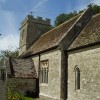
The difference between the outside and inside of this church is breath taking. Viewed from the outside, as parish churches go, it is ordinary, except perhaps for its tall west tower that has a statue of the Virgin Mary above a large four light west window: it is one of the few not to have been destroyed in Cromwell’s days.

St. Mary’s comprises a tower, nave, chancel, north and south aisles, with a porch off the south aisle. The roof area over the nave is higher than over the two aisles and it is the windows in this heightened area that flood the inside of the church with light emphasising the feeling of being in a large airy and uplifting space. These upper windows, or clerestory, were installed in 1530 by Thomas Corton, the last abbot of Cerne Abbey.

Entering the church you step into the tower area, to each side of you the north and south arches of the first stage of this three stage early 16th century tower: ahead of you the larger east arch and the screen, erected in 1749, leading into the nave. Before you go any further, look upwards at the interior of the first stage of the tower beautifully lit by the large west window – high above you hang six bells.

Proceeding down the nave’s central aisle, over three large slab memorials, to the stone screen with its six lights either side of a central entrance into the chancel. On each side of the nave are four arches and above these are painted shields with biblical texts. The records show that in 1679 Robert Ford was paid twelve guineas for painting three of them. Hanging over the nave a large chandelier probably 18th century, the modern seating replaced the pews during major restoration works in 1960/61. The carved pulpit is dated 1640. The north and south aisles have modern electric light fittings that seem out-of-place.

The chancel’s large east window bathes the area with light and here you can see parts of the original 14th century church. The window includes illustrations of numerous late 14th century shields-of-arms. The lancet windows on each side of the altar are the original early English windows. Recent restoration work revealed the windows and a blocked doorway on the south chancel wall. There is a 14th century piscina in the wall to the right of the altar and what is thought to be a consecration cross can be seen on the north wall of the chancel.

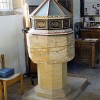
The font located in the south aisle near to the south porch is probably mediaeval, its octagonal bowl mounted on a modern base and plinth. The cover was added in 1963.

About the church are many memorials to many families including Dr. William Cockeram 1679, Thomas Cockeram 1862 and his wife Anne 1847; Robert Farr 1720; Elizabeth Foord 1766 and Robert Foord Snr 1768; George and Susanna Turner 1750; Samuel Randall 1785 and his wife Elizabeth 1769; Thomas Boys 1774, and others.
 The Notley family is referred to in two of the floor tablets in the nave. The family, we are told, were early settlers in America and owned Cerne Abbey Manor in Washington, the site on which Capitol Hill stands today.

We have placed several photographs of St. Mary’s Church in the gallery.

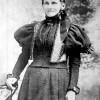
Alice Maud Trent (1887 – 1937)

Keeping Her Memory Alive

The village of Winfrith, with its thatched cottages, shop and old church, lies equidistant from Dorchester and Wareham in the farming county of Dorset. It hasn’t changed much since 1887 when Alice Maud Trent was born there, daughter of an agricultural labourer.

She must often have walked the four miles over the hills to Lulworth Cove, the beautiful circular inlet where the tides come in from the English Channel, and perhaps she dreamed of other lands, for she was to sail the world’s oceans.

Her father was William Trent, one of 14 children born to his father John Trent. The Trent family was a large group established primarily in the parish of Winfrith Newburgh, and especially in the Blacknoll area. William was baptised in 1852 at St. Christopher’s, Winfrith. He married Arabella Baker in 1874. She was also born in 1852 in the same place and baptised at Winfrith, and both were 22 years old when they married.

The couple had 11 children. William and Arabella both died in 1901 within a few weeks of each other from unrelated illnesses, having been born in the same year 48 years before.

Alice Maud was only 14, and had left home and the village. The most probable explanation for her whereabouts being that she was a ‘living in’ servant. The next sighting we have of her is in London where we know that during WWI she was a member of the Women’s Police Volunteers and was seconded to work with the wartime Ministry of Munitions.

She was, according to Steven Trent Galbraith, her grandson, “a very worldly woman” in the sense that at 36 she decided to go to the other side of the globe. During 1923 she worked as an asylum nurse in Australia, while visiting her sister Emma there.

She decided to return to England via the United States so as to call on her other sister, Sarah Kate now married to Henry Burden, in Brigham City in the far west state of Utah. And here a rather astonishing thing now takes place: she meets somehow or other, at the age of 37, with George Galbraith, 73 – and in May of 1924 they are married. George, who was Steven Galbraith’s grandfather, had an exciting life.

The first son born in the United States of Scottish immigrants, at 19 he was working on cattle drives from Texas to Wyoming. But when she said goodbye to Alice Maud in Australia, Emma could have had no idea that her sister would meet up with a former cowboy.

Robert Galbraith and his wife Helen had come across the Atlantic from Loch Lomond and the Trossachs, via Liverpool with four children. They settled in Illinois.

George was a perfect candidate for the Wild West. He was to have eight children by his wife Grace, and became foreman of a huge cattle ranch on the Utah-Wyoming border. He lost his wife in 1918 when he was 67, and later took his family to Utah where he made a good living from a fruit farm.

When Alice Maud married George in 1924, one of her children by law was older than she. They had a son, William Trent Galbraith, in 1925: he only lived for two days. Three years later Ernest, Steven’s father, was born when Alice Maud was 40.

The Great Depression now descended on the country. And in 1937, Alice Maud passed away: leaving a twice-married widower aged 86, and Ernest, aged 10. Two years later in 1939, George died leaving Ernest an orphan and the remaining half-brothers and sisters ranging in age from 47 to 61. One of the sisters raised Ernest to adulthood, and from the age of 16 he was going to sea, visiting ports all over the world – perhaps taking his cue from his adventurous mother and aunt.

Steven was given the middle name of Trent to keep alive the memory of the girl from Dorset. And he says today, after considerably digging into his family’s history: “The night before I married Lori, my wife, my Dad pulled me aside and gave me the ring that his father married Alice Trent with. Then, when my son Joshua was born, I named him Joshua Trent Galbraith….”  Steven hopes and expects Joshua will similarly name his first son.

It was back in 1985 that Steven started on his genealogical journey, with very little to go on, one of the family having destroyed all the documents and photographs of Alice Maud that she could find. A few have survived.

We have only the briefest information about the youngest sister Alice Emma Trent, baptised March 10, 1895. She was only six years old when her parents died and it is likely she lived with the eldest child in the family, Rhoda Trent. She had married and was still living in Winfrith. All we know about Alice Emma is that she travelled to Australia where it is believed she married a man named Ernest Cummings and lived in New South Wales.

It is worth saying something about Alice Maud’s sister Sarah Kate. We know she was at home in 1901 when she would have been 16 years old. The next we know of her is that she is in the United States working as a maid in the household of Lord Bryce, the British Ambassador.

She decided to stay in the United States and travelled to Brigham City, on the shores of the Great Salt Lake and surrounded for hundreds of miles by mountains up to 10,000 feet – a vast contrast to the rolling wolds of native Dorset. Here she married Henry Burden. We think there is little doubt she knew him before travelling because he, like her, was from Winfrith.

In June 2002 Steven and Ernest came to Dorset: they met Trent family descendants still living in the area and others travelled to meet them.

Steve related how when a 12 year old boy his Mother had told him how difficult it had been for his father as a youngster and how other family members had “tried so hard to destroy the memory of Alice Maud Trent.”  Steve says “ She and my Dad in a way to keep her memory alive, gave me Trent as a middle name and they asked me if I would like, it would be a nice thing if I did the same if I ever had a son.”

Those few days in Dorset the culmination of years of searching mean Steven has fulfilled a promise he made 36 years ago, when as a 12 year old boy he pledged he would find her and keep her memory alive.

More photographs of Alice Maud Trent and a photograph of Steven Trent Galbraith with his father Ernest taken during their 2002 visit to Dorset, can be found in the gallery section.

Ernest Galbraith passed away on the 28th June 2003.

Photos in the gallery